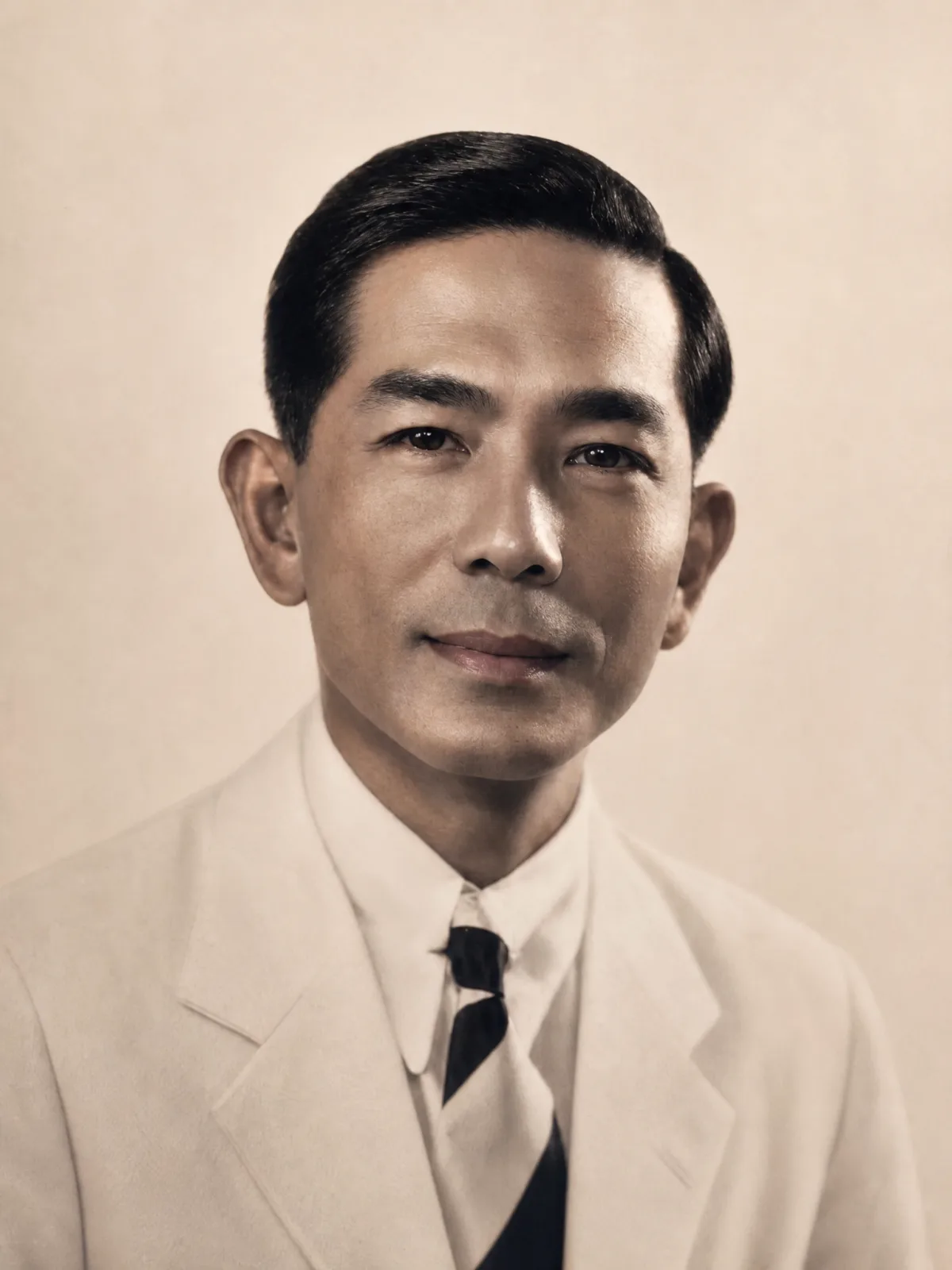

Bago before the boy
In November 1944, in the third year of the Japanese occupation of the Philippines, the Kempeitai arrested Ramon Sitchon Araneta in Manila.1 He was a sugar planter from Negros and a lawyer, a director of the company that published the Philippines Herald, and a familiar figure in elite Manila.2 They took him to Fort Santiago, the old Spanish fortress in Intramuros that the Japanese army’s military police had turned into an interrogation prison.
Days later, his wife received a telephone call at the family’s house in Manila. It carried the news that families with a man held inside Fort Santiago had learned to dread. The later chapters of this story tell how Ramon came to that fort, and what that call meant. His story begins much earlier, and a long way to the south. It begins on the island of Negros, three generations before he was born, in the years when sugar was remaking the island and his family was rising with it.
Negros had not always been sugar country. For most of its history it was one of the quieter islands of the central Philippines, a long volcanic spine with a thin scatter of people, mostly fishers and small farmers, along its two coasts of no great interest to the colonial government in faraway Manila. The Negros that Ramon’s grandparents knew as children was still mostly that older island. The one he would inherit was something else entirely, and the change came within a single lifetime.
From the middle of the nineteenth century, as the nearby port of Iloilo opened to foreign commerce and planters and credit crossed the narrow strait into Negros, the western plain of the island was remade. The lowland forests were cut down and in their place, cane went up, field after field of it, until the flat country of Negros Occidental was very nearly one unbroken sea of sugar cane, cut by roads and rivers and the mills that pressed the crop each harvest. A new group of people rose with the cane. They were the hacienderos, the planter households who had taken early hold of the land: a small class, intensely local, and growing rich. The Aranetas were one of those families, and the town of Bago was theirs.
Bago lay in the flat coastal south of Negros Occidental, on the river that gave the town its name, where the cane plain ran down to the sea. It was a working sugar town, close enough to the great central mills to send them its crop and close enough to the water to ship out the sugar. To grow up in Bago, as Ramon would, was to grow up inside the sugar economy with no other world on offer. The fields, the cutting season, the mills, the price of sugar, the loans taken against next year’s crop: in Bago, this was simply what life was made of.
The Aranetas were old in the town, and so were the families they had married. When the Spanish administration drew up Bago’s padrón general, the colonial register of households and tribute-paying families, in 1817, the Sitchon name had already been written on its pages for a few generations.3 They stood in the rolls among families like the Suansings, another of the established names of Bago’s governing class, the principalía: the small body of Filipino townsmen who collected the colonial taxes, kept the local books, and held what authority a town possessed. Ramon’s mother, Natividad Sitchon, came from that line.
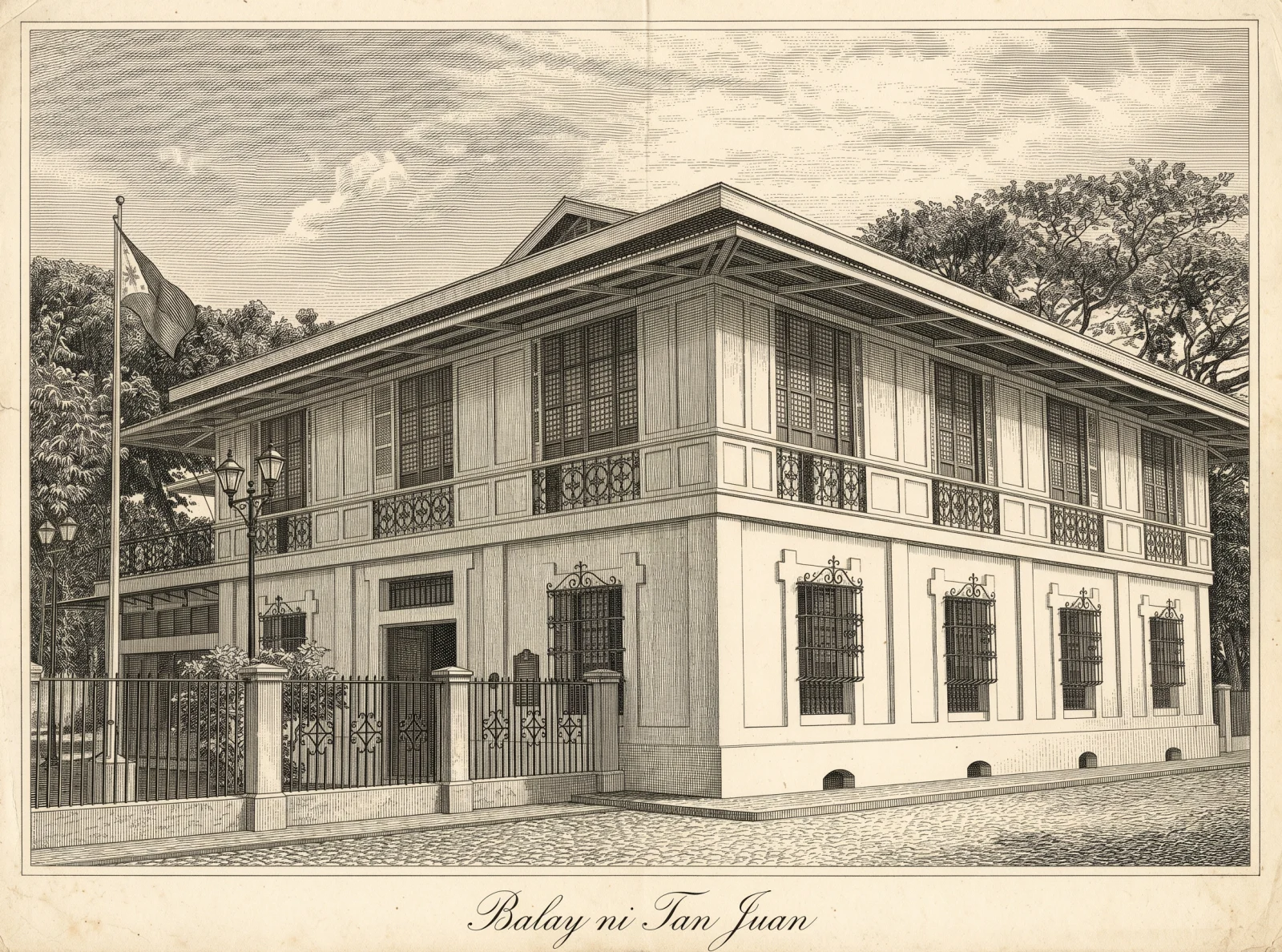
His father’s family had set in and spread its roots even more thickly into the place. Across the nineteenth century the Aranetas branched and rebranched through the Bago district until they were less a single household than a web of cousins, each with his own canefields and his own affairs to put before the notary. This is easiest to realize from one small fact seen a decade later: a single Bago notarial deed signed in the 1920s would carry eight separate Araneta signatures, eight grown men of one surname formalizing one another’s business on a single page.4 Ramon’s father, Marciano Araneta, born in Molo, Iloilo in April 1871, was one planter among that crowd of cousins, and a substantial man within it, who would farm well over a thousand hectares of Bago land in the course of his life.5
Marciano married into Bago through his wife Natividad Sitchon, a native born and bred there. The match joined two of the oldest names in the town, and like many such matches it was made within the family, arranged between parents and grandparents. Marciano and Natividad were third cousins, their grandparents, sisters. Natividad was past the customary marriage age by the time the wedding was held. Her youngest daughter Eva would later tell her relatives that her mother had been an old maid by the time she was betrothed to her cousin.6 The family called her Edad through the whole of her life. She defended the cousin-marriage convention in a line the grandchildren remembered. Ano mo na ang Principe de Gales si no se conosen? What use is the Prince of Wales to you if you don’t know him? She kept her house and her person with a fastidiousness that the children remembered as legendary. She had no germs in her at all, her daughters would later say, half in jest and half in love; she brought her own bedsheet when she stayed in another woman’s house, but would die of tuberculosis all the same.6
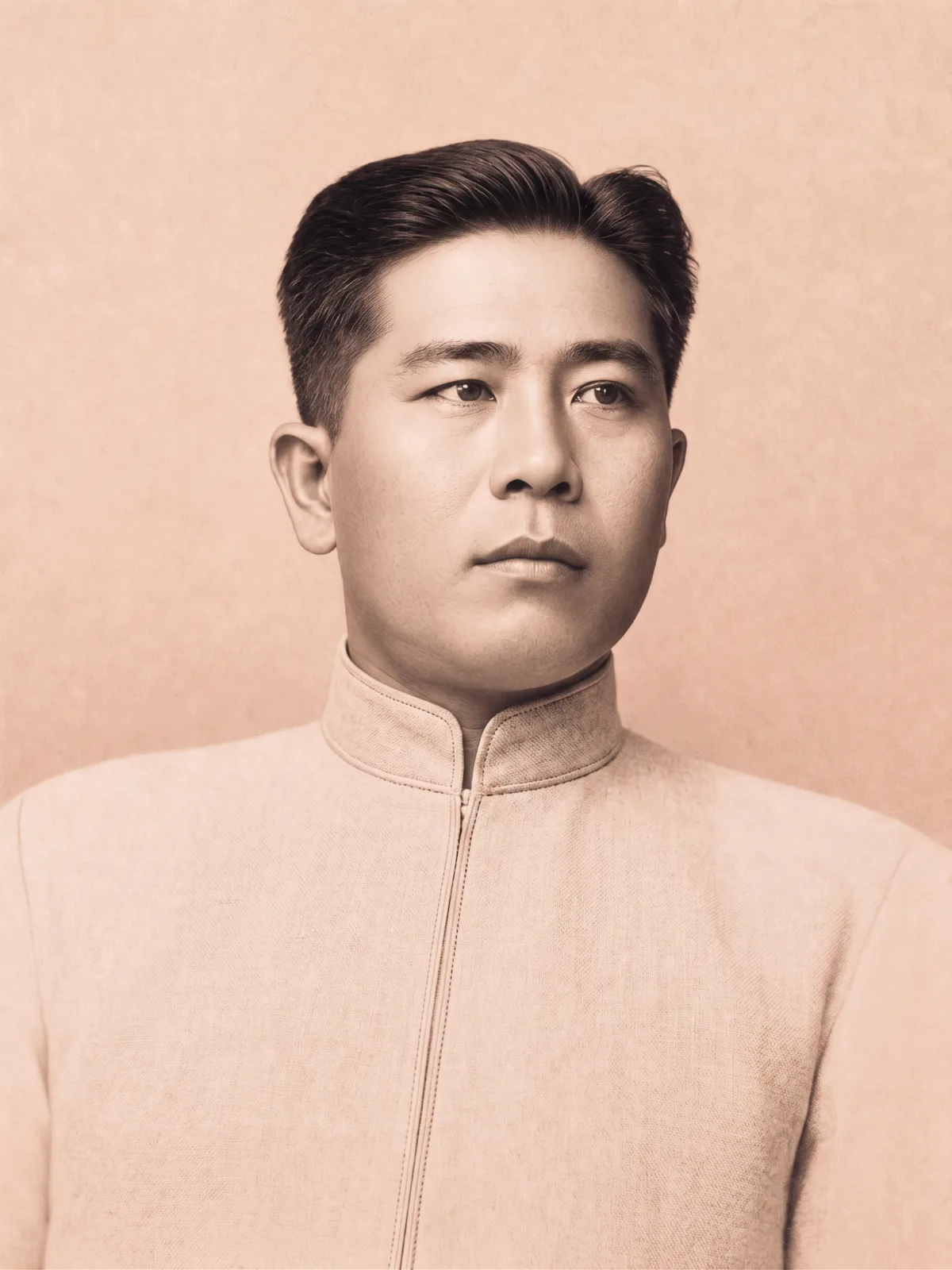
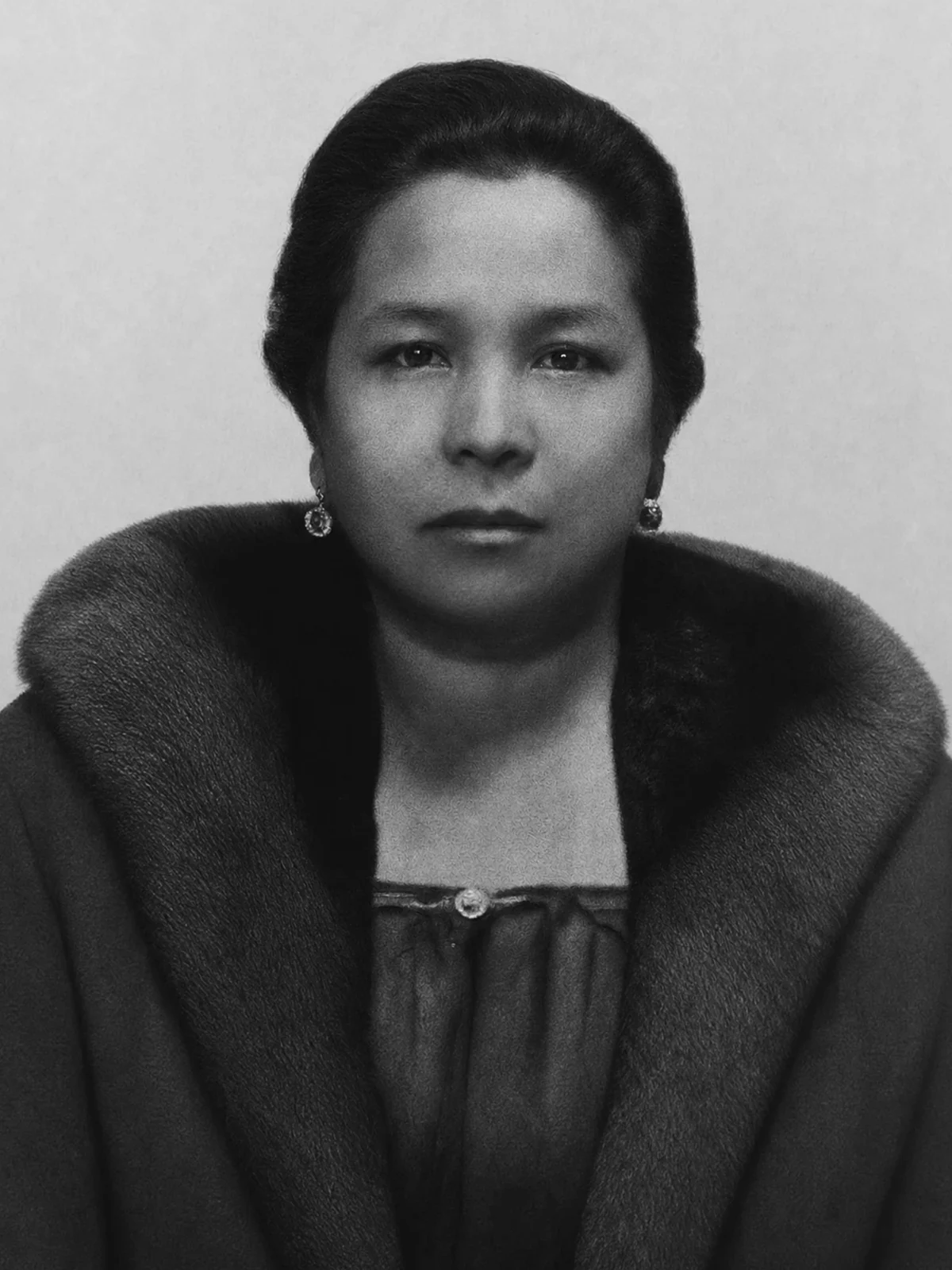
The marriage included a third name, albeit quietly. Marciano’s own mother had been a Yulo, and the Yulos were among the most powerful of all the Bago families.7 They gave the town more than one of its headmen across the generations, and in the next century they would give the country a speaker of its National Assembly. Through his mother Marciano was as much a Yulo as an Araneta. The tie ran on the bride’s side too: Natividad Sitchon was a cousin of Doña Segunda Sitchon, the mother of that future speaker, Jose Yulo of Bago.8 The Yulo connection would run on through Ramon’s life, from baptism onward.
This was how the planter families of Negros were held together: by marriage, repeated down the generations, until the map of who owned the cane and the map of who was related to whom were very nearly the same map. The Aranetas, the Sitchons, the Yulos, and around them the Lopezes, the Alunans, the Ledesmas and the Locsíns, married among themselves in every generation, and every marriage bound land to land and name to name. The world that was about to produce Ramon Sitchon Araneta was a small one. It was landed, it was close-knit, it was intricately related to itself, and at the very end of the Spanish century, it was waiting for him.
First legitimate son
Ramon Sitchon Araneta was born in Bago on the morning of 16 December 1893, at about six o’clock, in the house of Marciano Araneta and Natividad Sitchon. He was their first child. The two old families of the town, the Aranetas grown thick across the canefields and the Sitchons long settled in the colonial records, had been joined in the marriage of his parents, and now there was a child to carry both names forward.
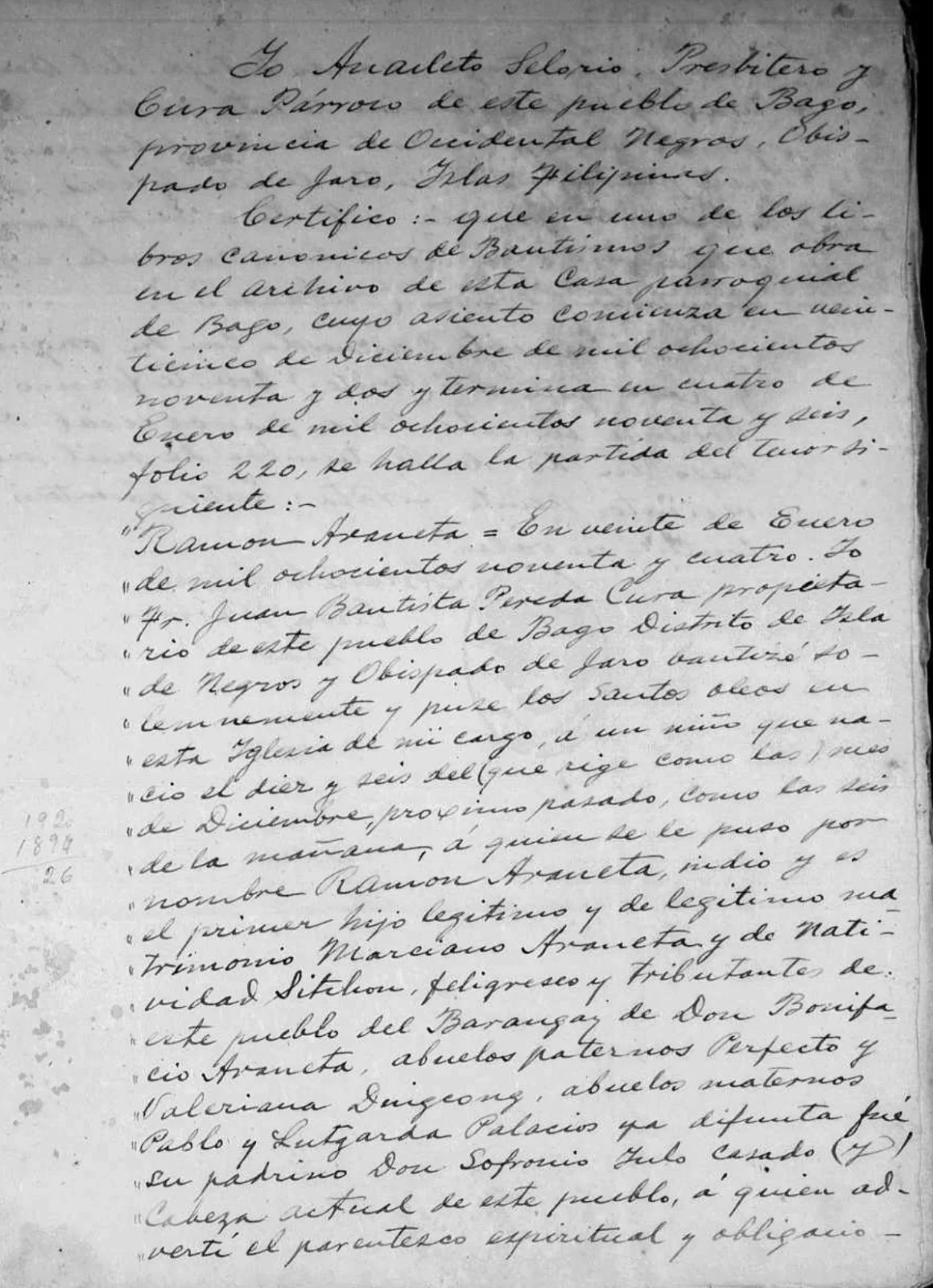
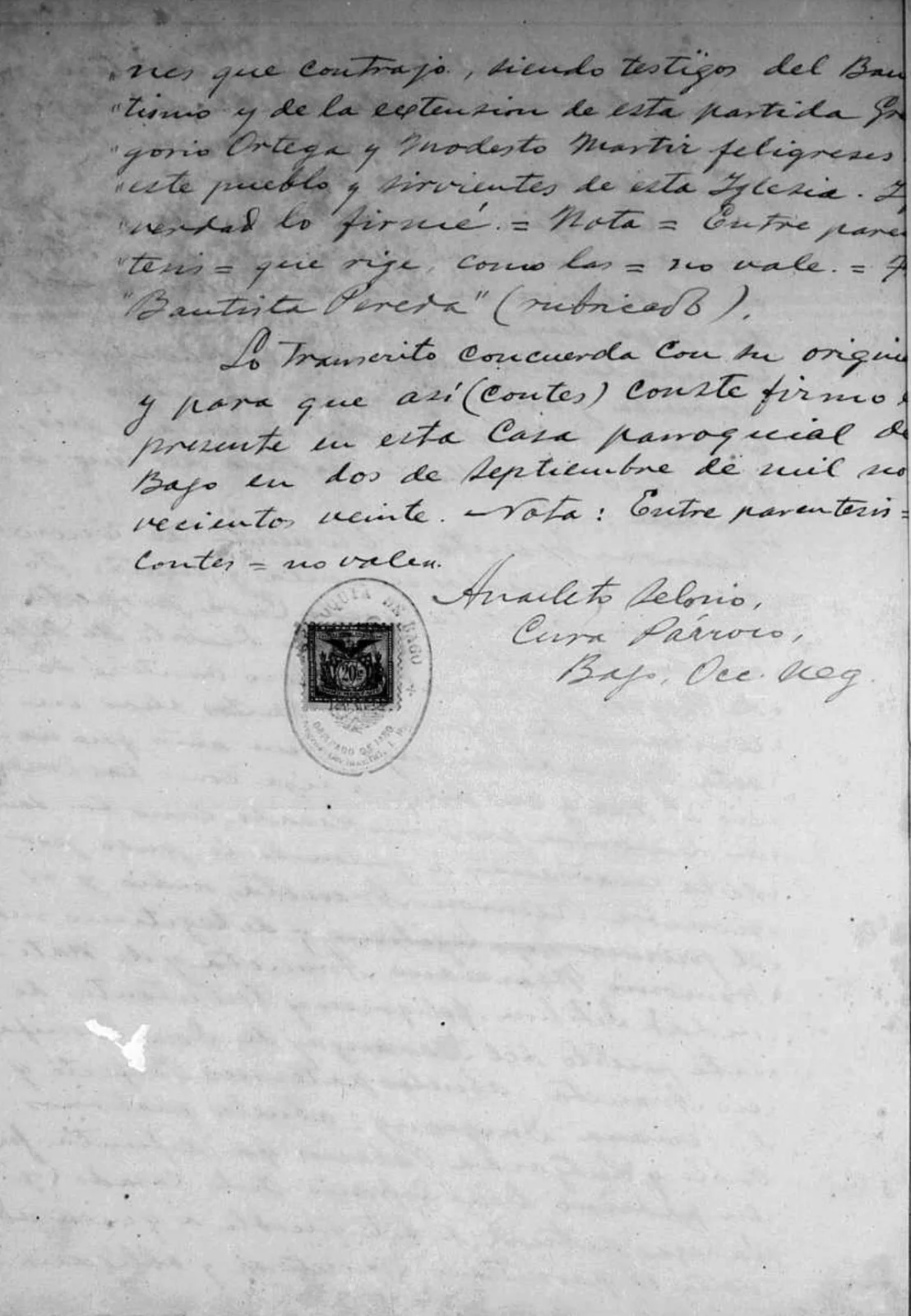
The Church did not record him at once. Five weeks passed before he was carried to the font, and it was 20 January 1894 before Fr. Juan Bautista Pereda, the parish priest of Bago, baptized him and entered him in the parish books.9 A delay of that length was unremarkable in a rural Negros parish at the close of the Spanish century, when a baptism waited on the priest’s own calendar and on the family bringing the child in to the town church. Pereda wrote the entry into the libro that ran from December 1892 to January 1896, on folio 220. That page is the earliest record of Ramon’s life this account draws on. Direct documents of his childhood and youth are few, and a good deal of what can be said about those years has to be read out of this one and out of the records of the family around him.
Pereda set the child down as the primer hijo legítimo y de legítimo matrimonio of Marciano and Natividad: the first legitimate child of their marriage. The noun took its masculine form, hijo, by the plain grammar of the parish books, not because the tally was a tally of sons. It was a tally of children, and Ramon was the first of them. The next of them, a daughter, arrived the following November.
The same page recorded what the colonial state made of him. In the place reserved for it, the entry set down a single word, indio.9 It was not a remark about anything a five-week-old child was or had done. That a family as settled as the Aranetas, with land and a name old in Bago, still had its first son written into the books that way is a fair measure of how completely that order reached. Those caste words stayed in the parish books of the Philippines until Spanish rule itself was gone.
The child was given a godfather, and the choice carried meaning on more than one level. He was Don Sofronio Yulo, one of the cabezas of Bago. The cabeza de barangay stood at the final rung of Spanish local government: he was the head of a barangay, the cluster of households that formed the smallest administrative unit of the colony. and he answered to those above him. It was the cabeza who kept the list of his families, gathered their tribute for the Crown, and held them to order. The office passed, generation upon generation, through the principalía, the propertied townsmen. To be a cabeza was to be a man of weight in the town. But Sofronio Yulo was no stranger to the Aranetas; the godfather was already family. Marciano’s mother had herself been a Yulo. Sofronio was an uncle of Marciano’s, which made him a great-uncle of the infant at the font.7 The baptism did not begin the bond between the Aranetas and the Yulos. It set a seal on one that was generations deep.
One more office was named on the page. The household of Marciano Araneta was entered as belonging to the barangay of Don Bonifacio Araneta, another man of the surname, a kinsman or an elder standing at the head of the very unit within which the family lived. Two parishioners of Bago, Gregorio Ortega and Modesto Martir, both servants of the church, witnessed the rite.9 With that, the record was closed. In the compass of a single page, a child five weeks old had been fixed into the whole of the colonial world: named to his parents and to their joined families, ranked by caste, attached to a barangay, and bound by godparentage to a cabeza who was also his great-uncle. It was a thorough piece of bookkeeping. It was also very nearly the last service the Spanish century would do for him. Ramon was not yet three when revolution broke out against Spain in 1896, and not yet five when the Americans came to take the islands. The careful colonial order that folio 220 set down around him was already ending. The world he would actually grow up in was a rather different one.
The American century
The Spanish century ended a month before Ramon turned five. In November 1898 the revolutionary forces of the Negros planters, under Aniceto Lacson and Juan Araneta, one of the elders of the wider Bago family, took the Spanish garrison at Bacolod, and the island declared itself an independent cantonal republic for the few weeks that intervened between the end of Spanish rule and the consolidation of the American. By the spring of 1899, Negros had come under the United States military government under the Treaty of Paris. The boy in Bago had become, without leaving his father’s house, a subject of a different power. None of this is likely to have meant anything to him at the time. What it would mean to the world he was growing up in took a generation to make itself plain.
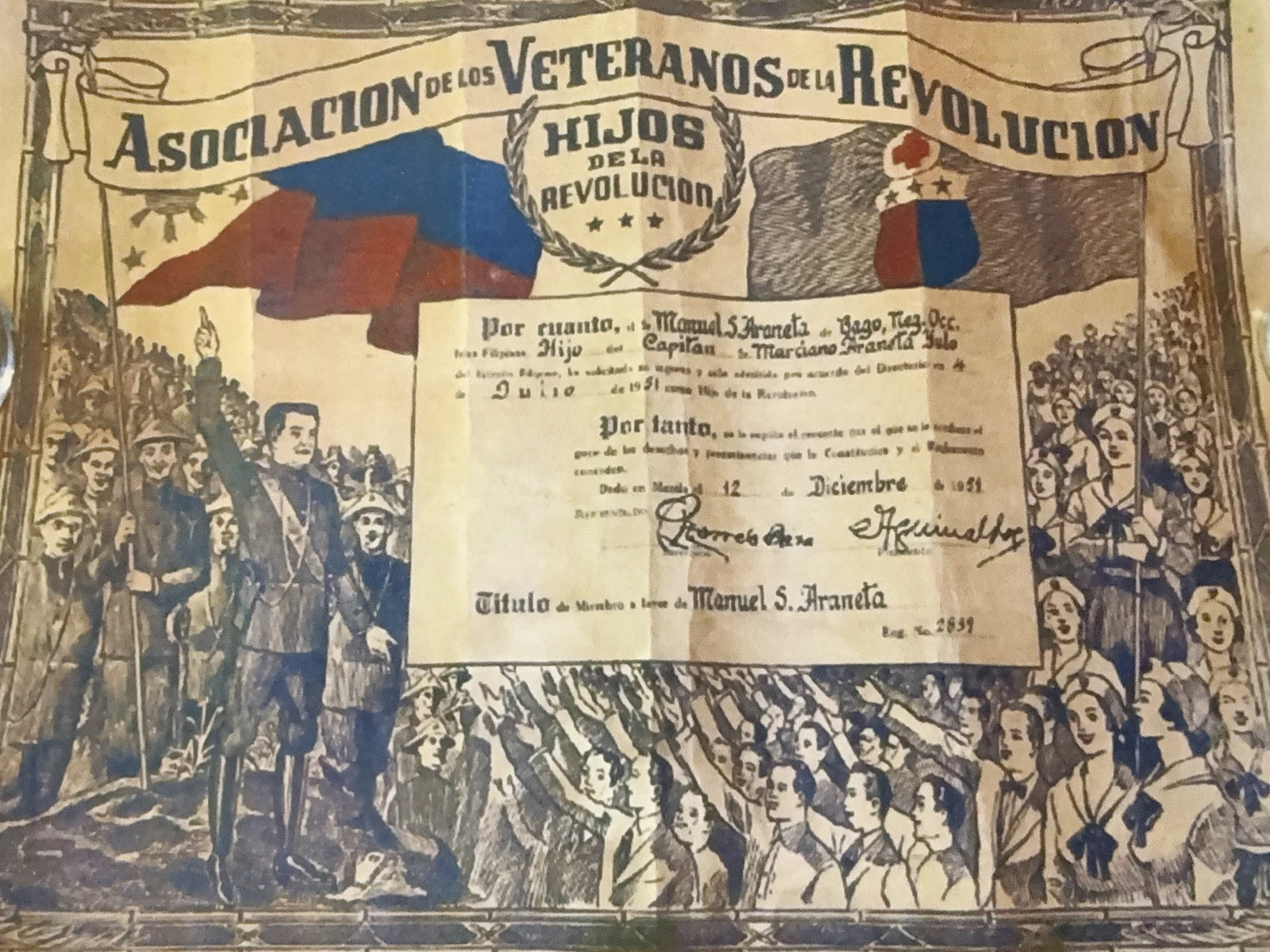
The grandparents on his father’s side were both still living when he was born, and one of them would live through his early boyhood. The parents of Marciano, his grandfather, Vicente Araneta y Suansing, and the grandmother, Cleofe Yulo, are named in two of the family’s surviving parish records, the 1894 entry for Ramon’s younger sister and the 1897 entry for his younger brother. Vicente’s line is traced back to the same stock from which the Manila Aranetas also sprang. The family reckoned the two houses cousins, though the surviving trees differ on exactly where the branches part. The bond between the two branches was kept warm in Marciano’s own generation: he was especially close to his uncle Felix Araneta of the Manila branch. and visited him in town frequently. Felix in turn, named two of his own sons Vicente and Luis after Marciano’s father and grandfather. Don Salvador Araneta, an eldest son of Felix who would write a memoir of the family decades later, remembered Marciano as a man with a bass voice and a jovial nature.10 The mother’s family, the Sitchons, were more entrenched in Bago; one family account holds that Marciano’s brother Bonifacio had married a sister of Natividad’s, so that two Araneta brothers had taken two Sitchon sisters in the same generation. Like many other planter households of Bago, a marriage was very often a doubled bond.
A sister joined the household eleven months after Ramon. She was baptized María at the same parish church where he had been baptized, and the family came to call her Cecilia; she would be the second of the nine children Marciano and Natividad would have together.11 A brother followed in April 1897, Juan Jorge.12 After the turn of the century the children came more steadily, and by the time American flags were flying over the town hall Ramon had at least two siblings around him and a baby on the way.
The new order reached Bago through its schools and offices. The Americans built the first public schools the island had seen and taught in English rather than Spanish. The children of the planter families were among the first to be put through them. The town itself was reorganized under American municipal codes, the old Spanish offices renamed or refitted, and the appointments made under a new colonial seal. On 30 January 1906, the Philippine Commission named Marciano Araneta auxiliary justice of the peace of the municipality of Bago.13 The boy was twelve and his father now held the lowest rung of the new colonial civil order. The household had kept its civic standing across the change of empires. That same year, on the evidence of a later sworn statement, Ramon already knew Rafael Alunan, the son of one of the great Negros sugar families, his own age and almost certainly a Manila schoolmate. A boy in Bago at the start of the American century, the son of a planter and the grandson of a cabeza, was now being shaped on lines that ran north from the canefields to the new capital.
The law beckons
What we know of Ramon’s schooling comes from a handful of institutional documents and one family memory, which all place him on the standard path of a Bago planter’s son of his generation; he would move on to Manila for further schooling. Eva, his youngest sister, who at the age of eighty-six in 2005, spoke of him in a mix of Hiligaynon, Spanish, and English, remembered her eldest brother as the one who had been “valedictorian en Ateneo desde que empezo”—valedictorian from the day he began.6 The detail belongs to family memory rather than to any record yet found in Ateneo’s own archives, and it should be taken as such. What the documents show in fact, is that he completed a Bachelor of Arts at the Ateneo de Manila by the early 1910s. The Ateneo de Manila was the Jesuit school in Intramuros at which many of the ilustrado generation had been formed. His father Marciano had gone up to Manila a generation earlier and taken the older route: a commercial segunda enseñanza at the University of Santo Tomás, where in 1891–92 he had won the Dominican university’s prizes in Correspondence and Mercantile Operations and in Political Economy.14 The training that had enabled the father to run the sugar central was not the training his son was now being given. Rizal had been an Ateneo man. The children of the major Manila families and of the planter aristocracy of the provinces went there as a matter of course, and the school’s catechetical Latin and severe disciplinary code had shaped the men of the Propaganda Movement, the reformists who in the 1880s and 1890s carried the Filipino case to Spain. In the newspapers of Barcelona and Madrid and in the lobbies of the Cortes they pressed for their country to be represented in the Spanish parliament, for Filipinos to stand equal before the law, and for the friars’ hold on the islands to be broken. They won almost none of these demands. By the middle of the 1890s the campaign for reform from within the empire had failed, and its failure paved the way to the revolution of 1896. Ramon was on the receiving end of that tradition just as the American century was rewriting what was yet to come.
From the Ateneo, he would go on to the University of the Philippines. The University had been chartered by the Philippine Commission in 1908, and its first colleges opened in 1910 and 1911. The College of Law was among the youngest of them, founded in 1911, hardly more than a department in its early years. Classes were taught in a series of small rooms at Padre Faura. The 1913–14 Bulletin of the University lists Ramon in the First Year Class of the College of Law.15 He sits on the roll alongside two brothers from Pagsanjan, Laguna, Conrado and Francisco Benitez. Conrado would become an economist and historian, founder of the UP College of Business Administration and a delegate to the 1934 Constitutional Convention that drafted the Philippine Commonwealth’s constitution. Francisco would be the longtime dean of the UP College of Education, a central figure in Filipino public education in the first half of the twentieth century.
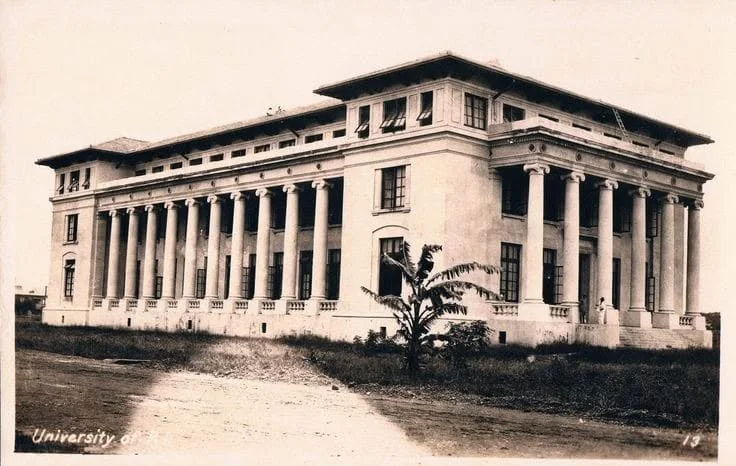
Two years later, the 1915–16 Bulletin lists him again, this time in the Third Year Class.16 The catalogue makes clear that the bachelor of laws (LL.B.), for which Ramon was enrolled, is a four-year course: four standing classes followed by a graduate review. The year in which he would have completed the degree was in 1917, a fact the catalogues would have confirmed had they recorded completion as well as enrollment. By 1920 he had taken his place at the colonial bar and sworn it in his own hand. In the expediente matrimonial drawn up for his marriage that September, the word he gave for his profession was abogado.17 He was twenty-six. Two men would stand for him at that marriage, Rafael Alunan and Baldomero Roxas, both of whom he had known since his early school years. He had known Alunan, likewise a scion of a Negros sugar family, since about 1906, when the two were twelve years old. He met Roxas in 1913, the year Ramon began at the Ateneo in Padre Faura. His immediate circle, it is evident, was drawn from among the children of the provincial elite in Manila’s schools.
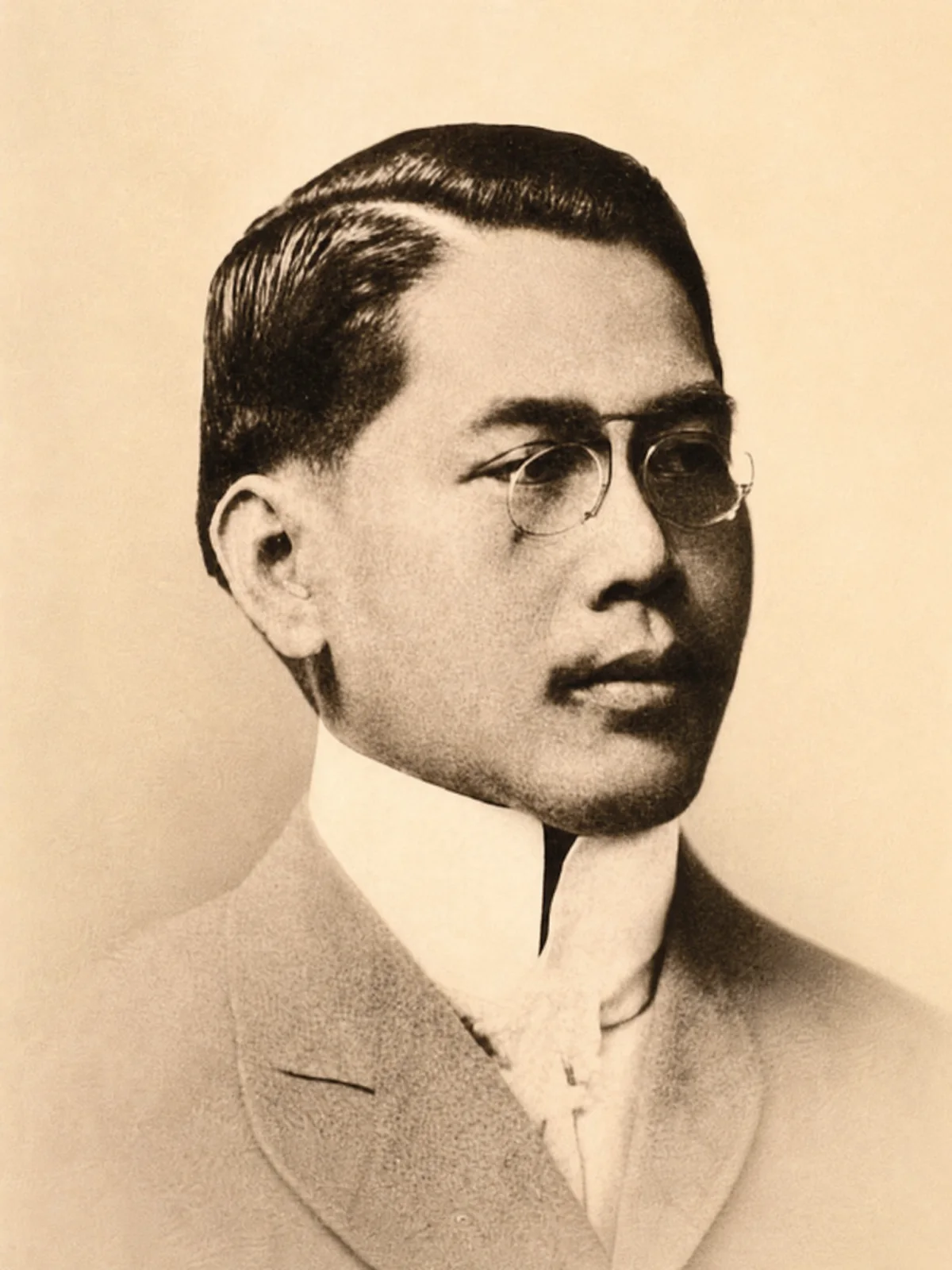
One small, oblique trace from those years tells how fully he had become integrated in Manila by the time he completed his law degree. A cousin from the Manila Aranetas, Don Salvador, would write decades later that “up to the first world war the only Araneta family in Manila was my father’s.”10 Letters addressed to “Ramon Araneta,” Salvador said, sometimes arrived at Felix’s Manila house in those years and were mistaken for his young brother of the same name. They were not for Salvador’s brother, but for our Ramon, Marciano’s eldest son. By about 1918, he was already operating as a Manila correspondent in his own right. The waylaid letters would place him exactly where the catalogues had: in the city, four or five years deep into his legal studies, on the cusp of the bar admission and the marriage that would establish him in adult life.
A Friday in Malate
Maria Socorro Chuidian—Coring, as the family would always call her—had her own story before she became his bride. The Chuidians were Manila Chinese mestizos, merchants of the city, settled in its community for generations and tied by marriage to the Urbano family of the same milieu. Coring’s father, José Chuidian, was of that line. Her mother, Alejandra Urbano, passed away at a young age. After her passing, an aunt of Coring’s, Juana Urbano, would sign a document dated February 1907 before a Manila notary for the jewels Alejandra had left and accepted their trust on behalf of her young niece.18 Coring was about thirteen at that time. The document, common in its day, survives as a guardian’s accounting drawn up under the Spanish civil-law conventions that had held over into the American era. It is the earliest documentary trace of the girl who would marry Ramon thirteen years later.
A later family account places her, in the years after her mother’s death, at schools in Hong Kong and in England. The Chuidians had the means and the trading connections to send their daughter abroad to be educated. The account, however, is drawn from family memory rather than in record, and the schools are not named. But it suits all that can be said of Coring in the years to come, one with the bearing of a woman who had been taught early that her own world would be a wide one.
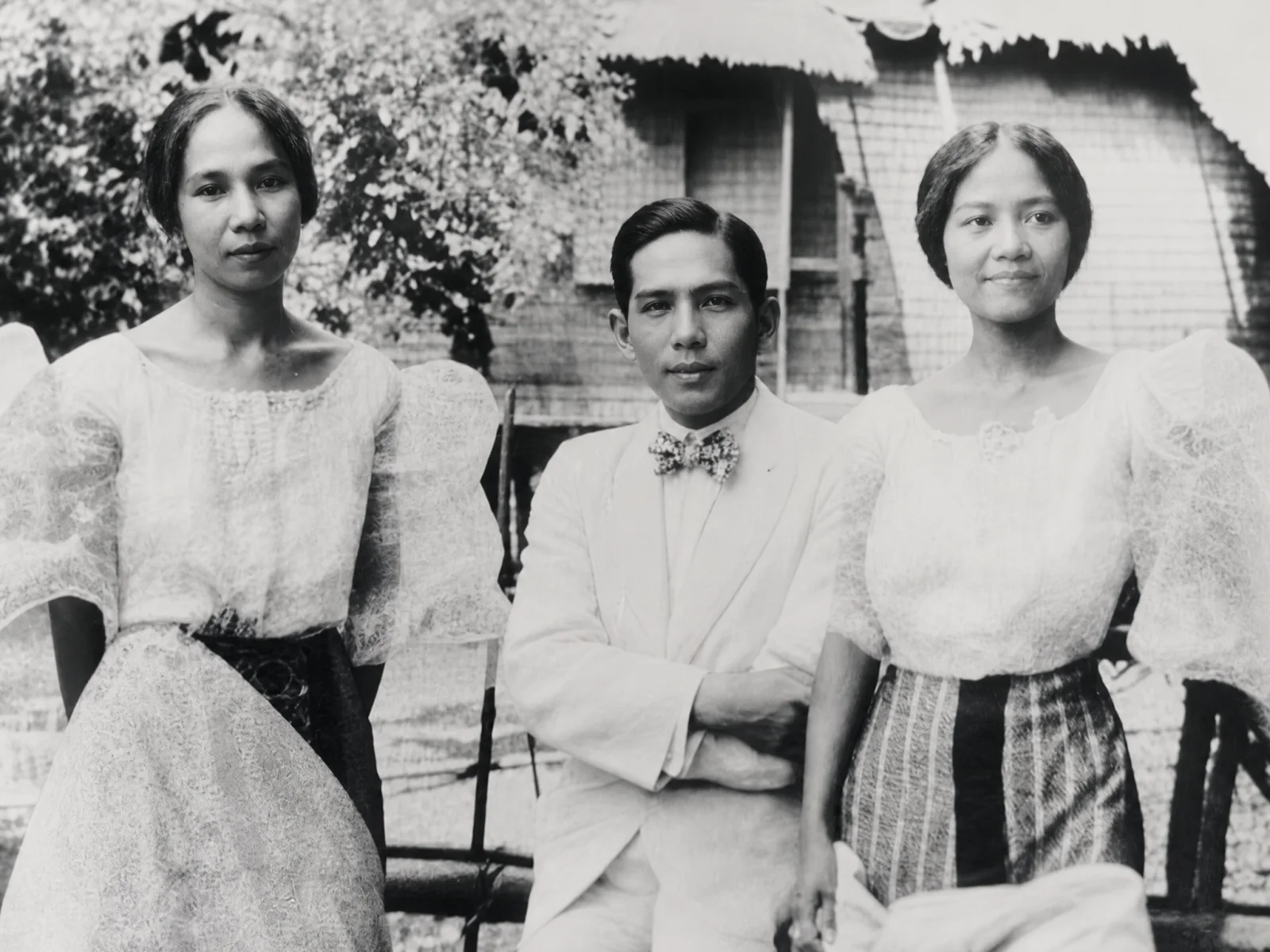
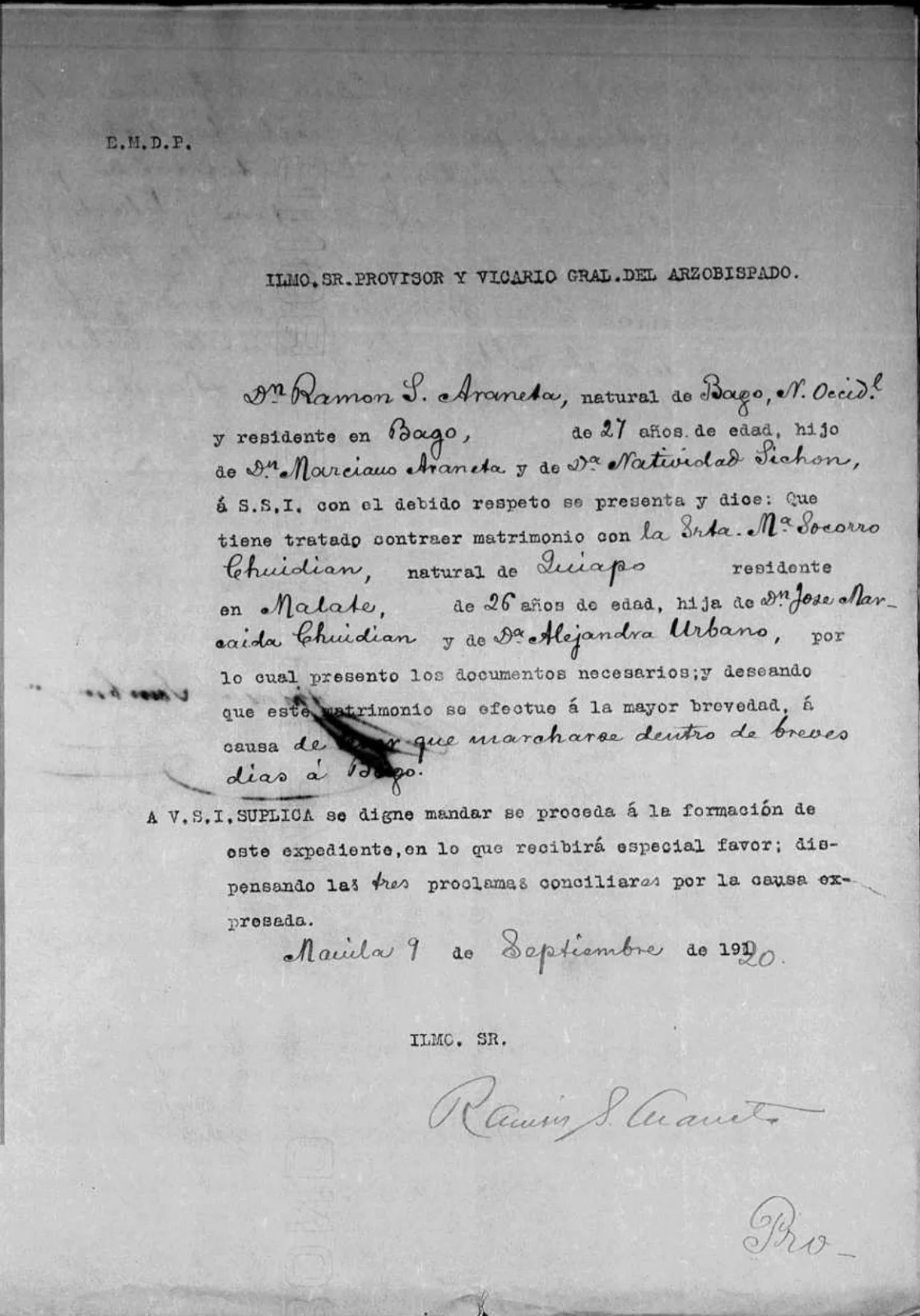
The wedding took place on Friday 10 September 1920, at the Parroquia de Nuestra Señora de los Remedios, the parish church of Malate, by the Manila bay. The officiant was a Redemptorist, Father P. M. Lynch, C.Ss.R. The banns had been dispensed that same day by the decree of the Ecclesiastical Governor of the archdiocese, José Bustamante: the dispensation was granted on the practical ground that the groom needed to return to Bago, and the Church was in the habit of accommodating such requests for the planter aristocracy. The bride as well as the groom was twenty-six. Two witnesses stood with them. The first was Don Baldomero Roxas, a Batangueño doctor of Lipa, by 1920 a resident of Santa Cruz, Manila, the same Roxas Ramon had known since his year at Padre Faura. The second was Don Rafael R. Alunan, an abogado of Talisay, Negros Occidental, by 1920 a resident of Malate, the friend of fourteen years’ standing.17
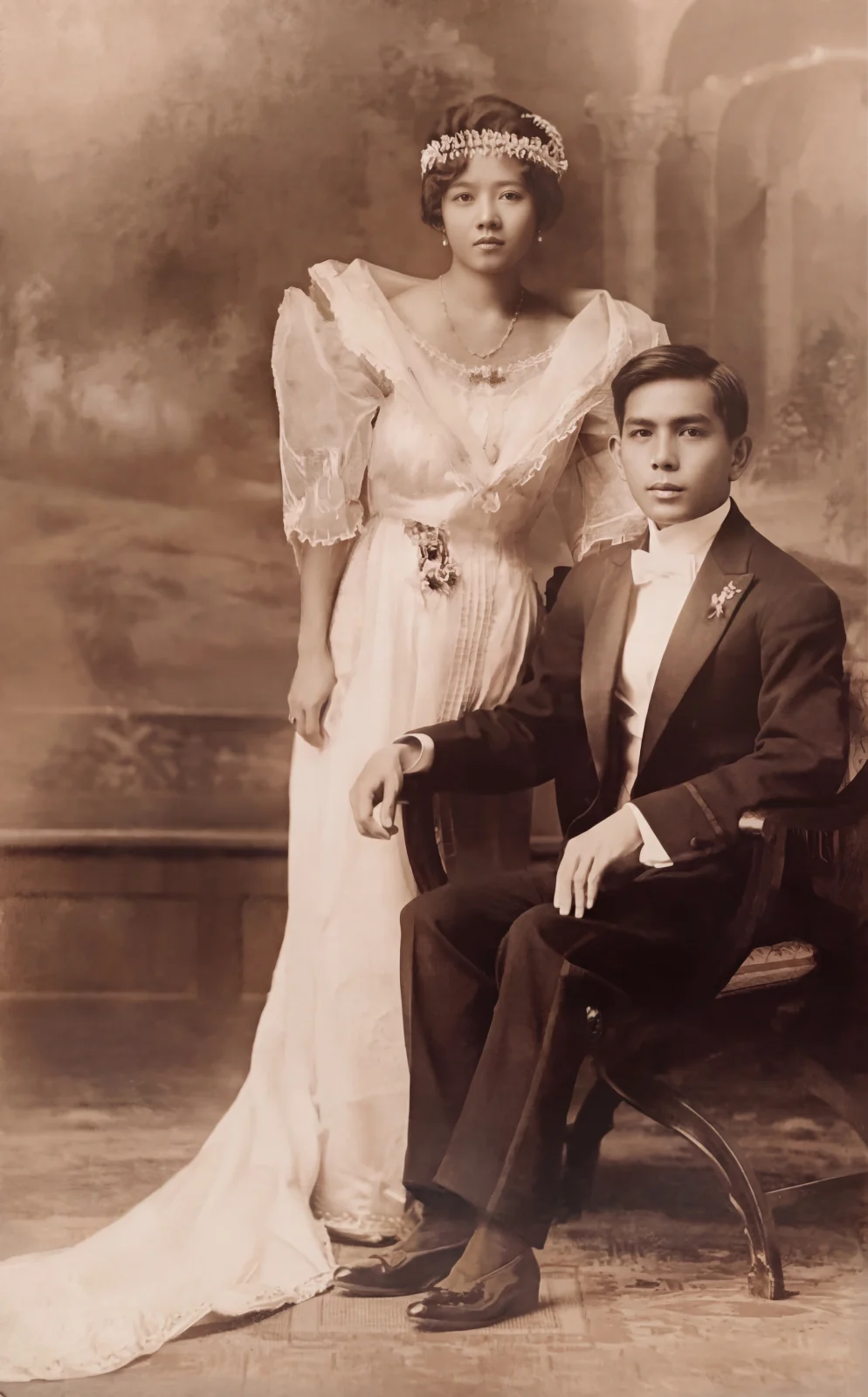
The documentary record of the marriage is a folder of papers called the expediente matrimonial, the file the Spanish Church compiled before solemnising any marriage in the Philippines. It collected the bride’s and groom’s baptismal extracts, their affidavits of intention, the formal interrogations of two witnesses for each party attesting that the bride and groom were of good Christian standing and free of impediment, and, when needed, the dispensation of banns. It was a thick document carefully designed, intended to leave no aperture through which a void or invalid marriage could later be undone. The expediente for Ramon and Coring survives in full. It is from this file that we know, in his own sworn hand, that his profession in 1920 was abogado.17 He was, by his own oath, a sworn lawyer of the colonial bar, a sugar planter’s son turning a corner into his adult working life. He signed for the priest, and signed for the witnesses, and left for Bago.
Two of Ramon’s siblings would marry within the same timeframe. His brother Manuel married Rosario Ledesma in 1923. His sister Cecilia married Jose Yulo in 1922.19 This match too had been made within the cousinage, in what her younger sister Eva would remember decades later as a small domestic crisis. Cecilia had nearly eloped with a Spanish consul named Fernando Reguera when Natividad cut in. Cecilia ngaa kay ara si José nga primo mo, she said, dejate de consules y de historia: Cecilia, your cousin José is right here, leave the consuls and stories behind.6 The cousin José was Jose Yulo, then a young Manila lawyer, the son of Marciano’s maternal uncle Sofronio Yulo and thus Cecilia’s own first cousin once removed. She married him in 1922. He would be Speaker of the National Assembly by the end of the decade.
The years at Fermina
He left Malate on the afternoon of his wedding day. The dispensation of banns had been granted on the practical ground that he was needed in Bago. A working sugar town did not pause for a city wedding. The 1920–21 milling season was due to start within weeks, the cane standing high in the fields, and the family operation was a working enterprise that ran on a calendar of its own.
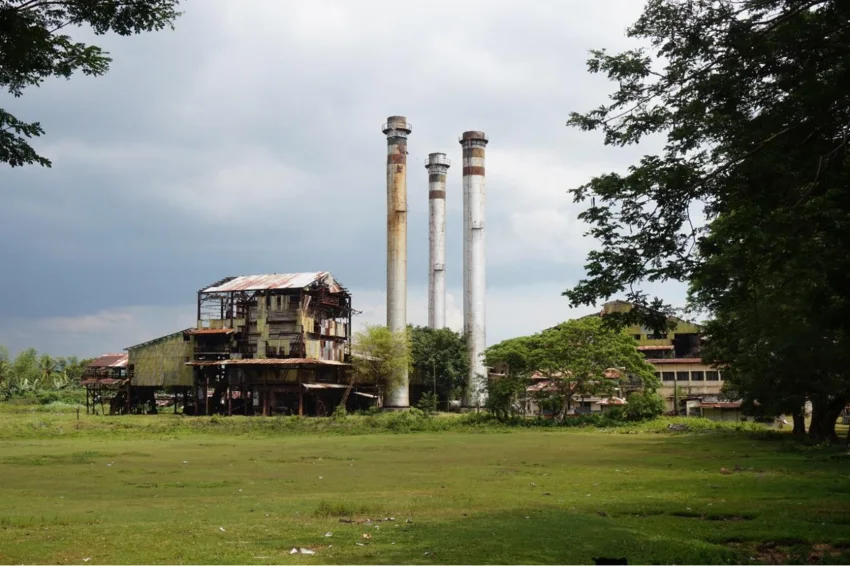
The land was Marciano’s. The principal hacienda was called Fermina, in Bago, and the family had been working it since at least 1914, when Marciano had mortgaged its 1914–15 crop to the Bank of the Philippine Islands.20 By the early 1920s, the operation had grown to three haciendas: apart from Fermina, it would come to include Bantolinao and a third, indicated in the parish ledgers as “Elisa” in one document and “Eloisa” in another. The cane from all three was milled at the Central Ma-ao, the centralized sugar mill that took the district’s cane and pressed it into the sugar of commerce. The Central, too, was a family enterprise. The first trial run of its mill, on 15 September 1920, was presided over by Marciano as the Central’s president and reported on by the trade press.21 Sometime in those early years, the operation passed from Marciano to Ramon. By October 1923, it was Ramon who signed the Philippine National Bank crop mortgage for the next year’s harvest for all three haciendas: ₱61,200 against the 1923–24 cane, at eight per cent.22 The cane went behind bank credit before it was cut. This was how the Negros sugar economy ran.
A planter of Ramon’s class did not cut his own cane. The cutting was done by the sacadas, the migrant cane workers who came down from the poorer Visayan islands of Antique, Iloilo, and Cebu each milling season to do the work that the local Negros population could not or would not supply. A contractor in one of the cane-supplying provinces recruited gangs of men, brought them across to Negros for the season, housed them in barracks on the haciendas, paid them at the per-day or per-ton rate agreed upon with the planter, and returned them after the harvest. In June 1925, Ramon signed with the Antique contractor Isidro Manzanilla to bring 150 sacadas down for the 1925–26 season at Fermina.23 The terms in the contract are the period’s standard: 94 centavos a day for the cutters, ₱1.40 for the cabos who supervised them, a 10-hour working day, rice supplied at 45 centavos the ganta, the dry measure of about 2.5 kilos of rice that Filipino households used. By the next harvest, the wage structure had shifted; the 1928 contract with the Negros contractors Ga, Pilasol, and Villegas moved the cutters’ pay to a per-ton basis.24 The sacadas built the Negros sugar economy. Their wages were what made the planter’s profits possible, and what kept the moral economy of the canefields a thing to be argued over by writers and reformers for the rest of the century.
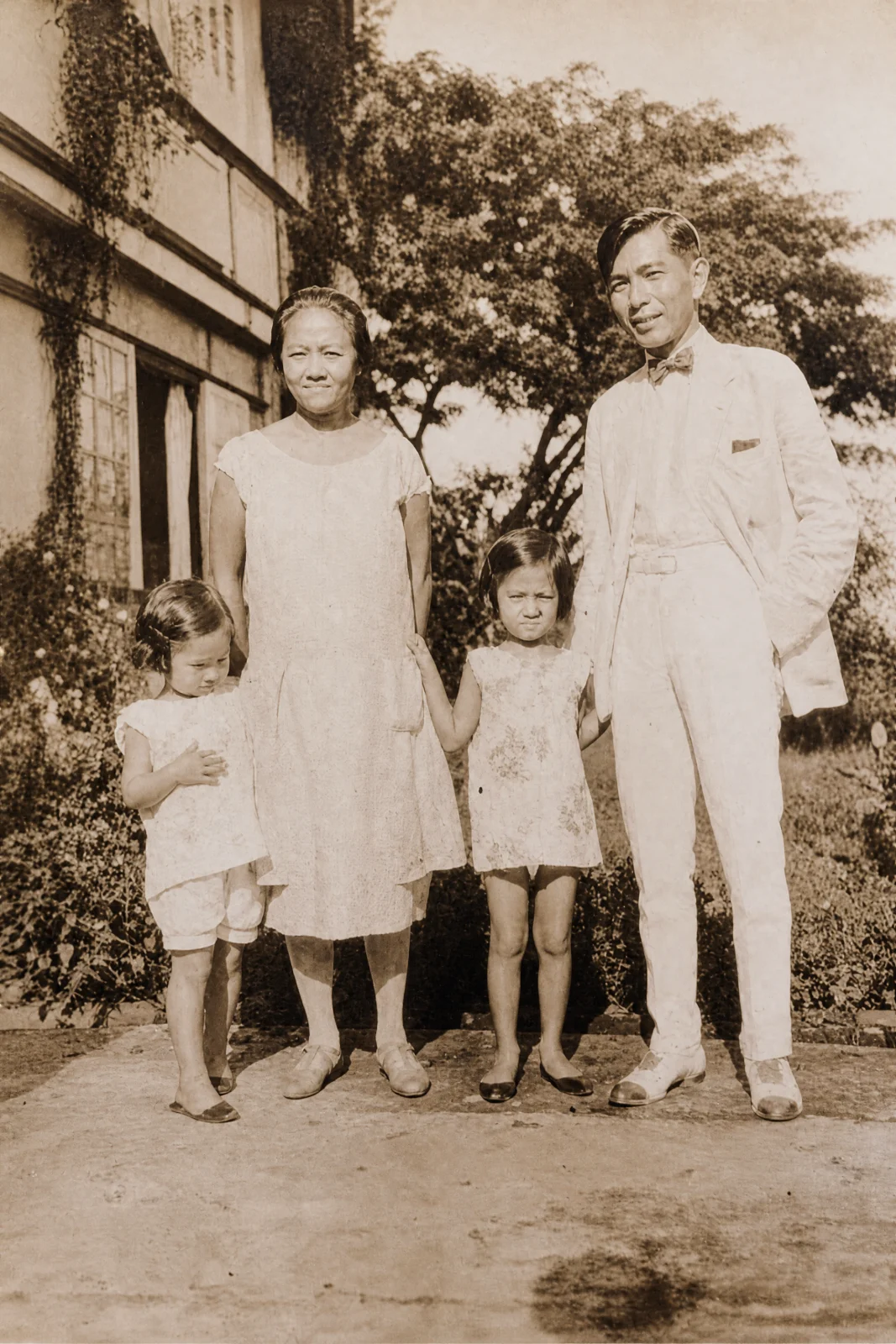
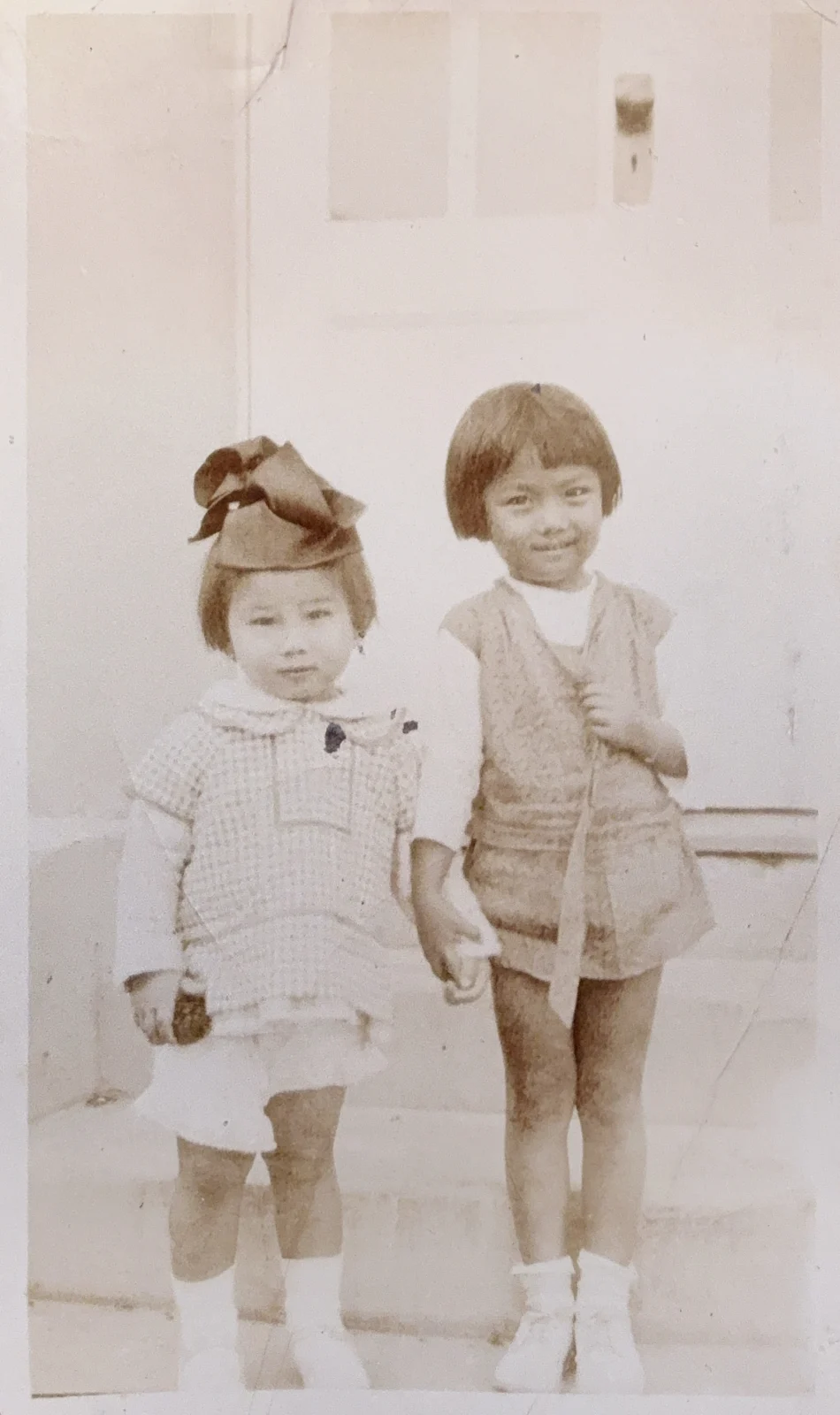
The family grew up around the work. The eldest daughter, Maria Teresa Juana, called Jenny, was born about 1921, within a year of the marriage. A second daughter came on 29 March 1925; they named her Socorro, after her mother, and called her Corito. By late 1925, Jenny had come into property of her own. The document does not say how, only that an estate had to be administered for her, and Ramon was named her tutor, the court-appointed guardian under the Spanish-civil-law system the colonial state had carried over into the American era. The Court of First Instance of Negros Occidental, 22nd Judicial District, made the appointment.25 In order to complete it, Ramon had to post a guardian’s bond of ₱2,000, with two sureties. They were Carlos Dreyfus, a Bago neighbor, and Jorge Leon Sarmiento Araneta, an older Araneta cousin then resident in Bago who would, a decade later, sit beside Ramon and his brother on the board of the company that published the Philippines Herald.
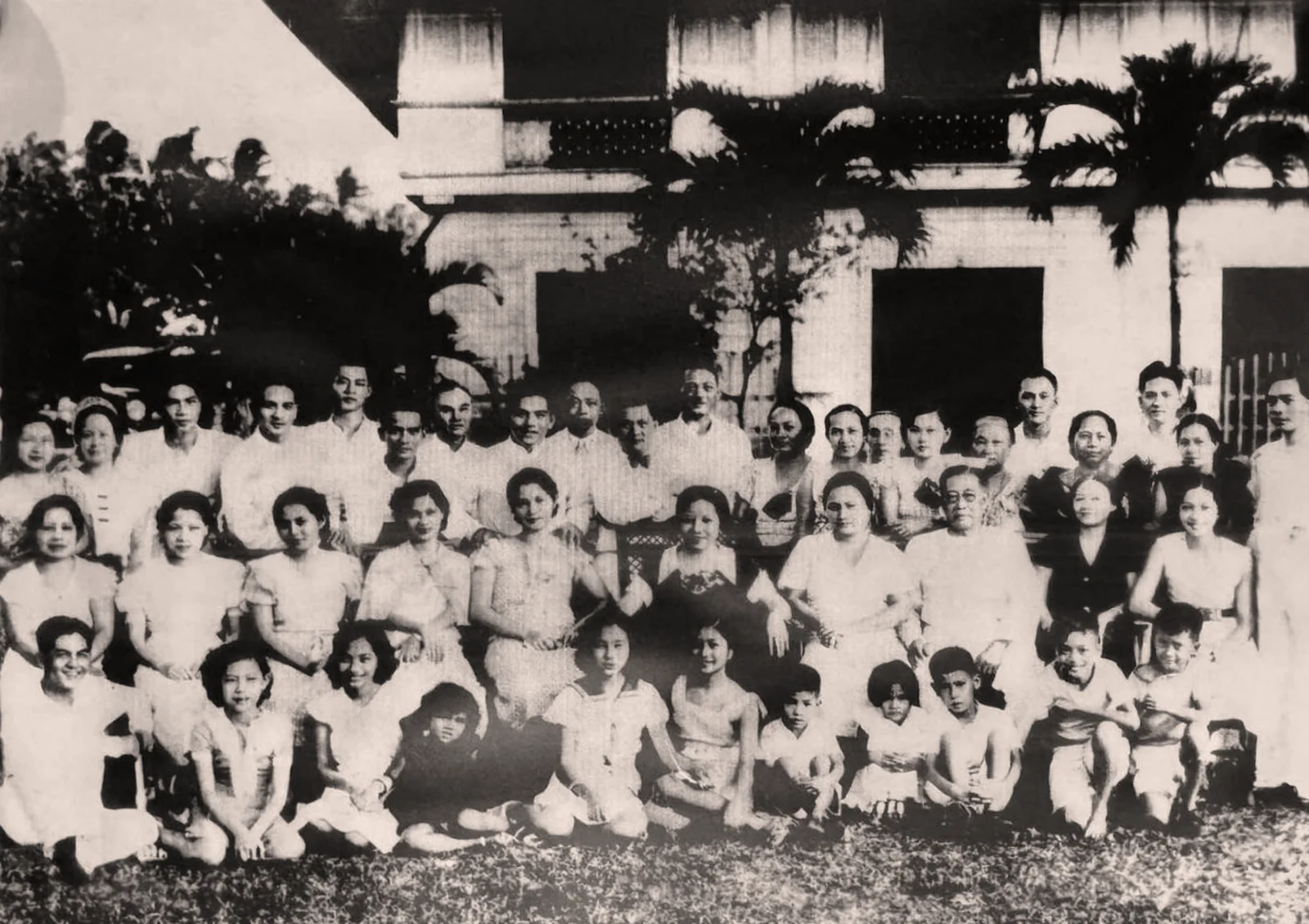
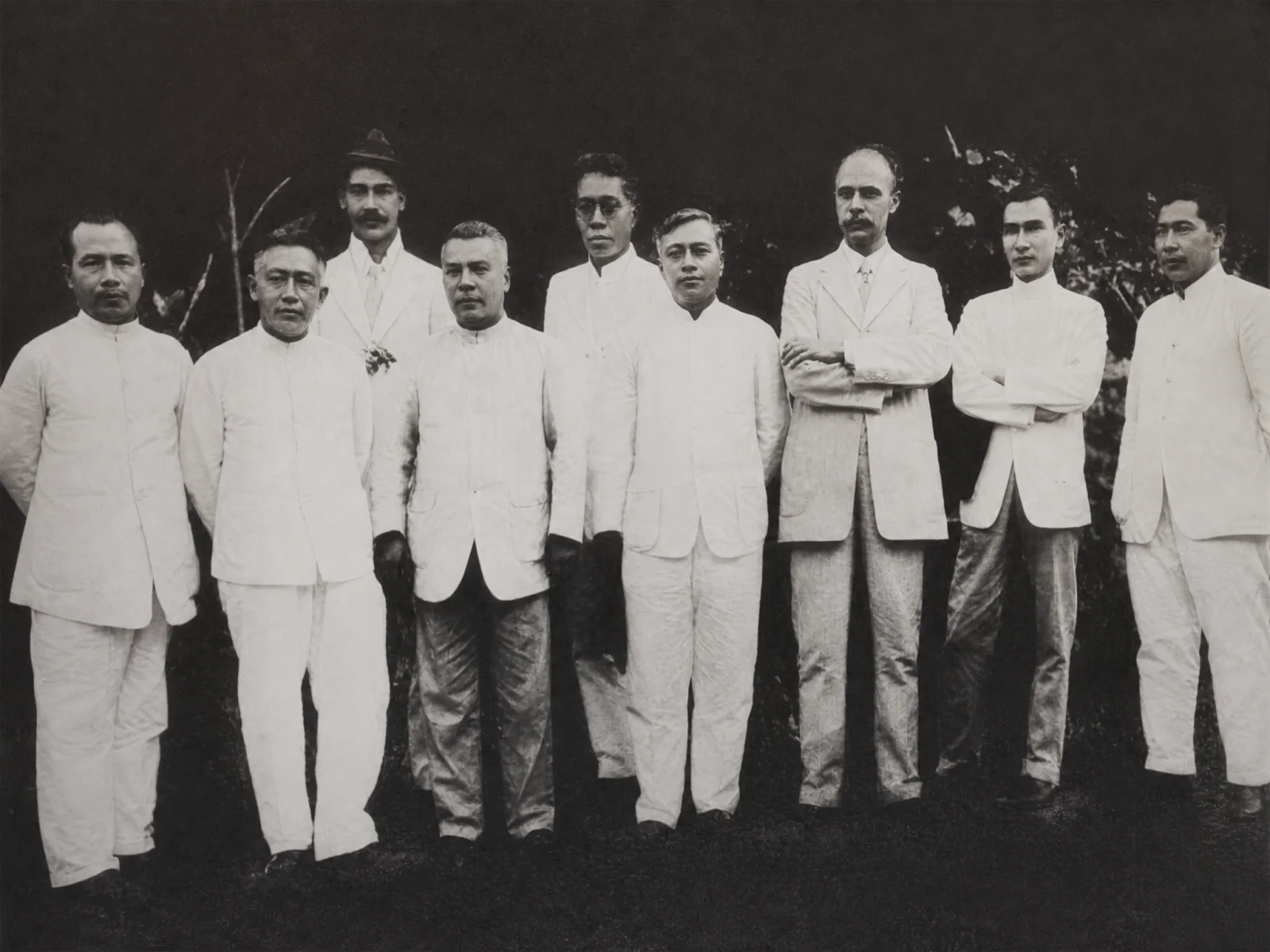
Second row (L–R): Caná (ampon of Marciano), Chitang del Rosario-Araneta, Ester Araneta-Araneta, Esperanza Araneta, Rosa Aldeguer-Araneta, Cecilia Araneta-Yulo, Maring Locsin-Araneta, Marciano, Coring Chuidian-Araneta, Eva Araneta-Serra.
Third row (L–R): Conching Baylon, Rosario Ledesma-Araneta, Pablo Araneta, J. Amado Araneta, Eduardo del Castillo, Job Araneta (husband of Caná), Juan Araneta, Aguedo Gonzaga (Governor of Negros Occidental), José Yulo, Jorge Araneta, Agueda Gonzaga, Elsie Gonzaga, Sayong Catajay, Evelyn Torres, Julia Torres, Raul Torres, Luisa del Castillo, Manoling Araneta, Ising Yulo-Araneta, Ramón Araneta.
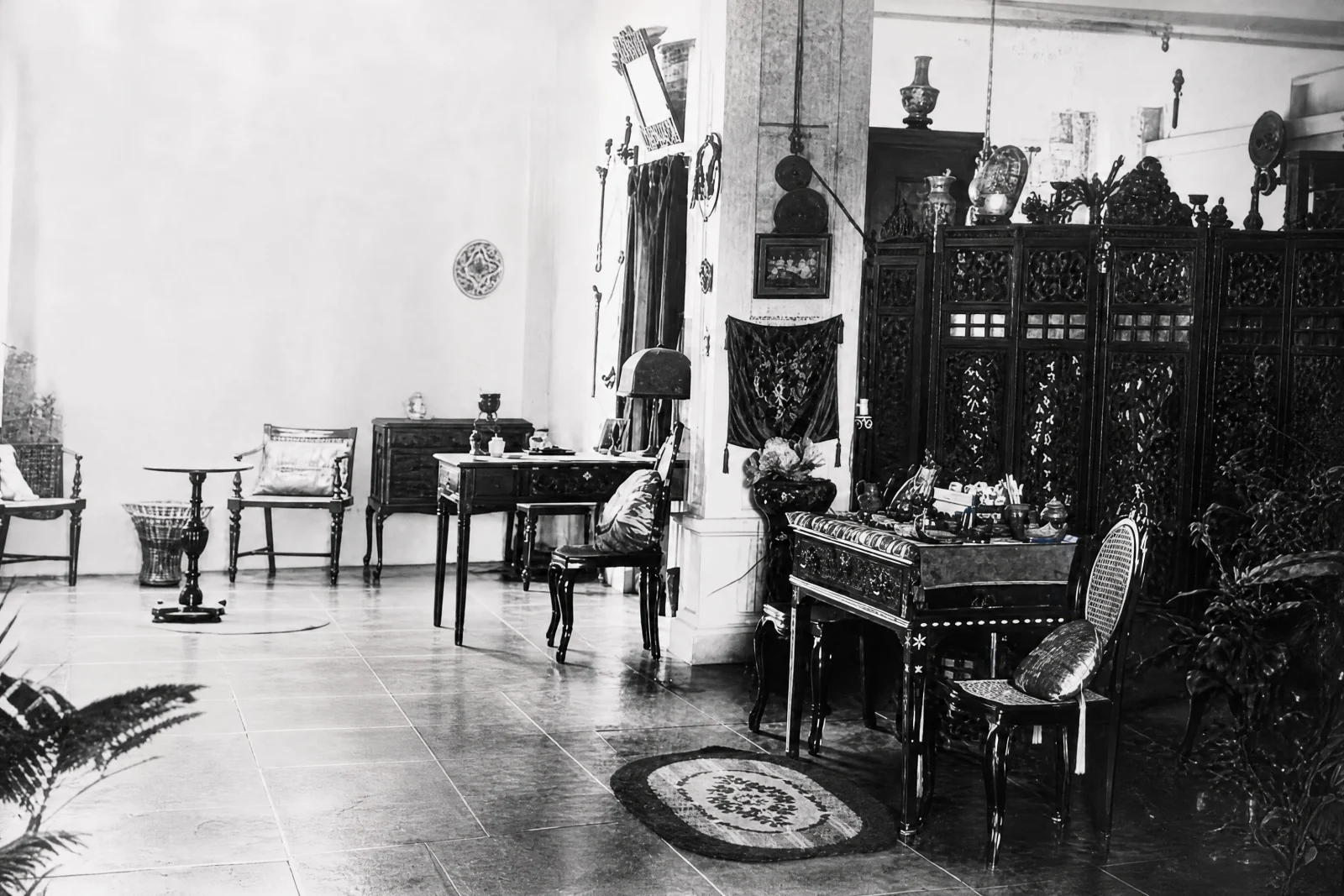
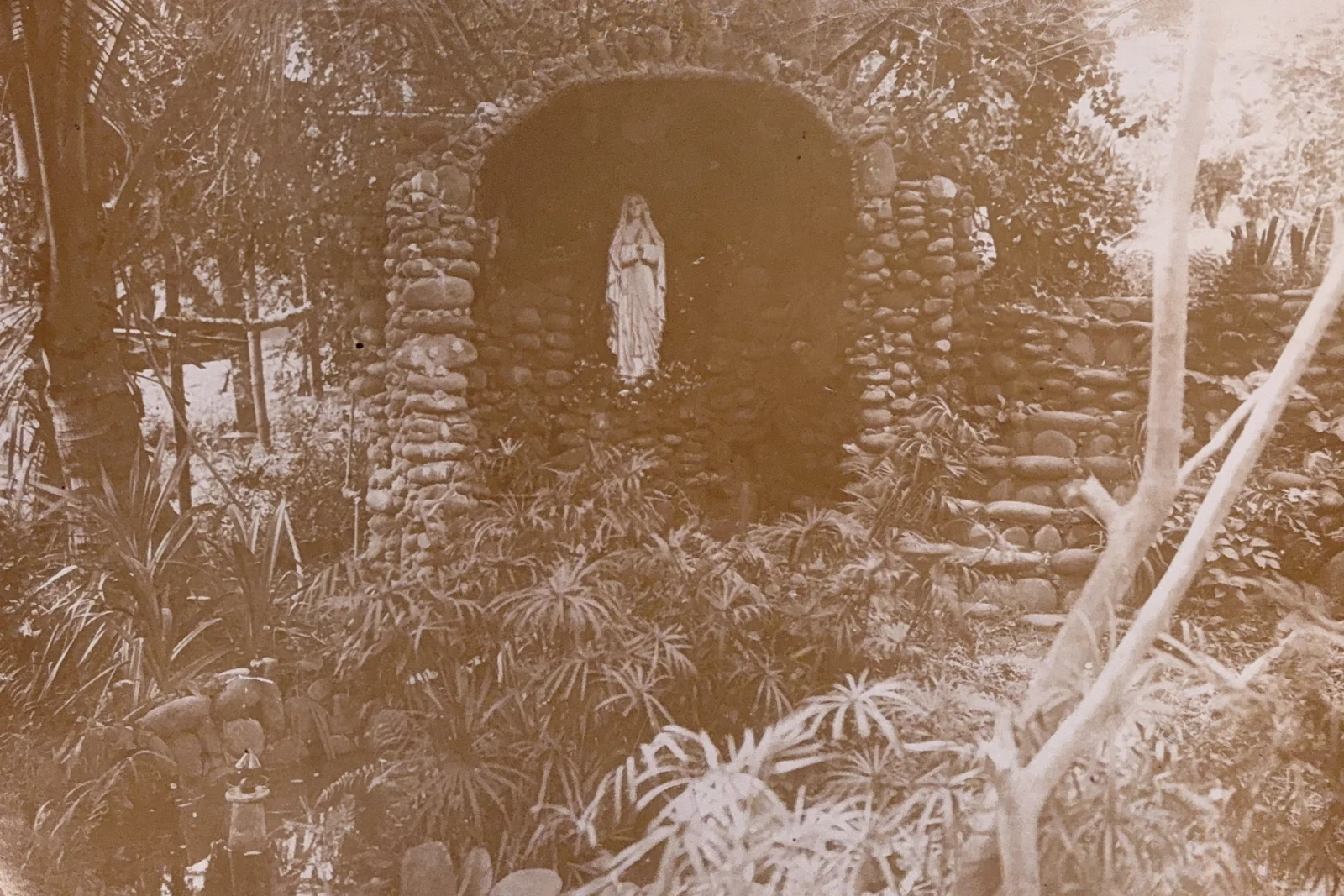
The household lived at Fermina through these years. By the time Ramon’s nephew Manolet visited it in the next decade, he would describe the farmhouse as an architectural study of Spanish mansions in California: lush gardens, neat patios and walkways full of exotic plants, an ornamental water feature flowing from miniature mounds of stones to the front of the house, and inside, mostly Chinese vases and other antiques. The child visitor was kept on the covered porch by the valet Umbing, who answered the door in a white barong, dark trousers, slippers, and white gloves. The house was already a social one when Ramon and Coring took up residence in it. Marciano had been running it that way for years. A 1981 biography of Speaker Jose Yulo, written by Baldomero T. Olivera, would describe the rhythm of the place: every March, when the Manila colleges let the Negrense students home for the long vacation, Don Marciano kept a months-long open house at Fermina for the children of the planter families. Selected students of both sexes, friends of his own children and of his nephews and nieces in town, were week-long house guests; on weekends and birthdays an orchestra was brought down from Silay, the best in West Visayas, hired everywhere else only for the largest occasions, and a dancing party was held on the lawns.8 This was the world Ramon and his siblings had grown up in, and it was the world the next generation, including the youngest sister Eva and the youngest brother Pabling, came back to from school. Natividad ran the house with the formality her family was known for. The same Olivera book places her as the lifetime sponsor of the San Juan Bautista fiesta in Bago each 24 June, the town’s largest annual celebration, and notes the position as a recognition of her place at the top of Bago society. The Negrense planter families were great party-givers in this period, and the Aranetas of Fermina were one of the houses where the tradition was kept up. Ramon, Coring, and the children lived inside that working hospitality. Ramon was still resident in Bago, in the barrio of Ma-ao, as late as 14 June 1928. The cedula he posted that day was issued there, on a sacada contract signed at the hacienda. He was a Bago planter and the son of a Bago planter, and the eight years between his marriage and the move to Manila were the time when that was the whole of what he was.
Borrowed against the cane
By the end of 1936, the borrowing had come to an end. A single, notarized deed signed in Manila that November, consolidated seven years of overlapping debts, and settled what was owed to the Philippine National Bank at ₱25,000 to be paid down across five years. It moreover required, as the recurring condition of the settlement, the delivery of 800 piculs of sugar a year, about 50 metric tons, out of the next five crops. The Aranetas were among the many Negros families pressed to that kind of agreement by the downward slide of the world sugar price through the early thirties. They were also among the handful of the families that survived.
The borrowing had been accepted as the standard for many years. Marciano had been a client of the PNB since at least July 1916, when he had taken a ₱17,000 mortgage on Natividad’s Ma-ao parcels, her own land, pledged to the bank to secure her husband’s loan.26 Through the 1920s, the family had run season-by-season crop mortgages with the bank as the standard finance of their sugar enterprise, of the kind Ramon signed in October 1923 for the Fermina, Bantolinao, and Elisa harvests. The summer of 1925 had seen Marciano post a ₱80,000 PNB surety on Ramon’s behalf. By the spring of 1926, the crop financing was running at ₱80,000 a year against a single harvest. None of this was, by the standards of the period, irregular. The PNB was the planters’ bank, and the planters borrowed.
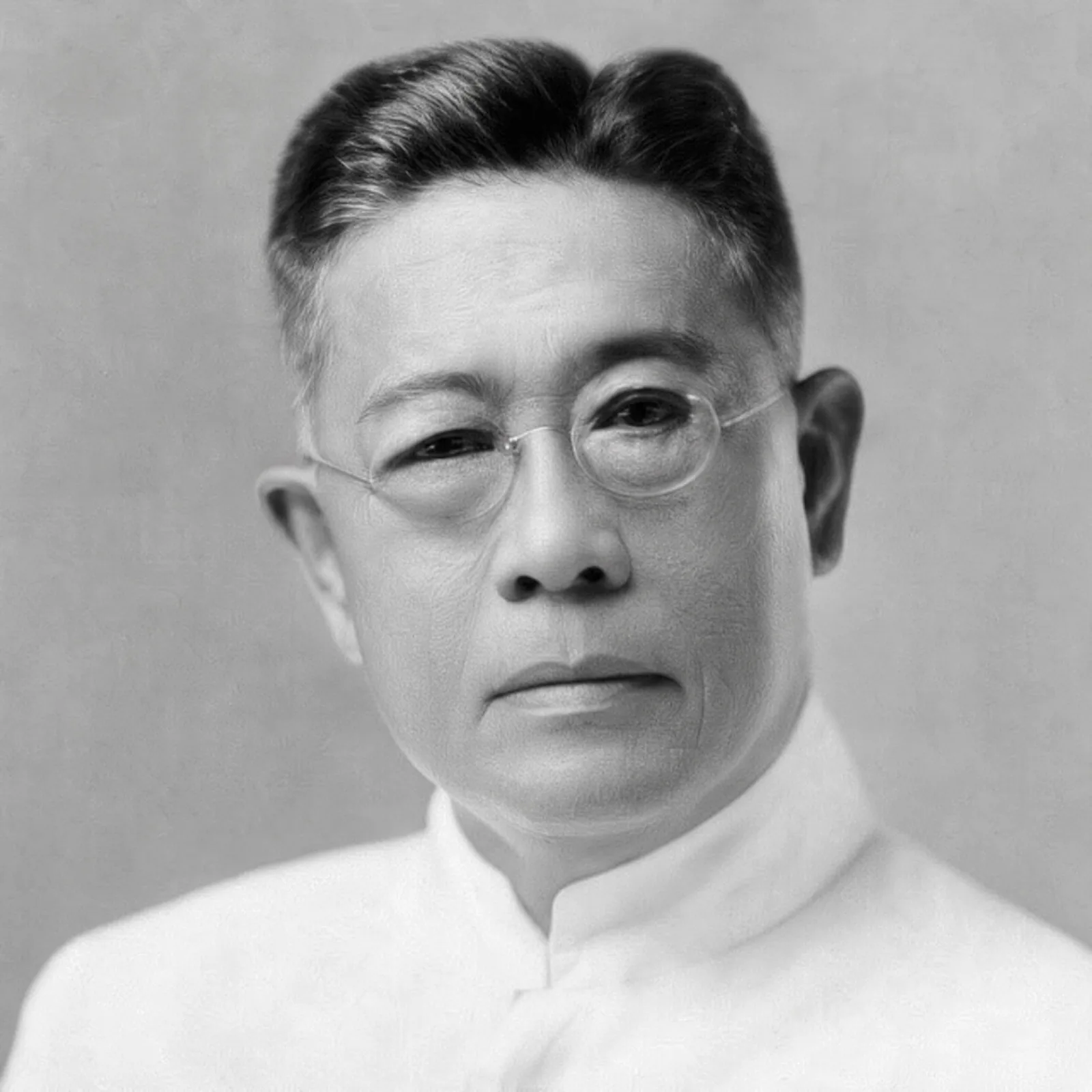
The escalation came in 1929. On 28 June that year, Ramon mortgaged the family’s 18,715-square-meter San Juan del Monte property in Rizal, the family’s Manila house, for a ₱7,000 PNB loan. On 20 August, he took out a further ₱15,000 agricultural loan at nine per cent, with Marciano stepping in as guarantor and pledging roughly 1,437 hectares of his Bago land as collateral, the funds restricted by the deed to work animals, tractors, and worker housing. On 5 December, a third loan followed, of ₱84,000, against the 1930–31 cane harvest at Fermina and Bantolinao.27 The following May, Socorro added her own 83 San Miguel Brewery shares as further collateral on a ₱8,000 loan. The family had extended itself across every available form of security in eleven months. They had no way of knowing that the world price of sugar was about to fall and continue to drop thereafter.
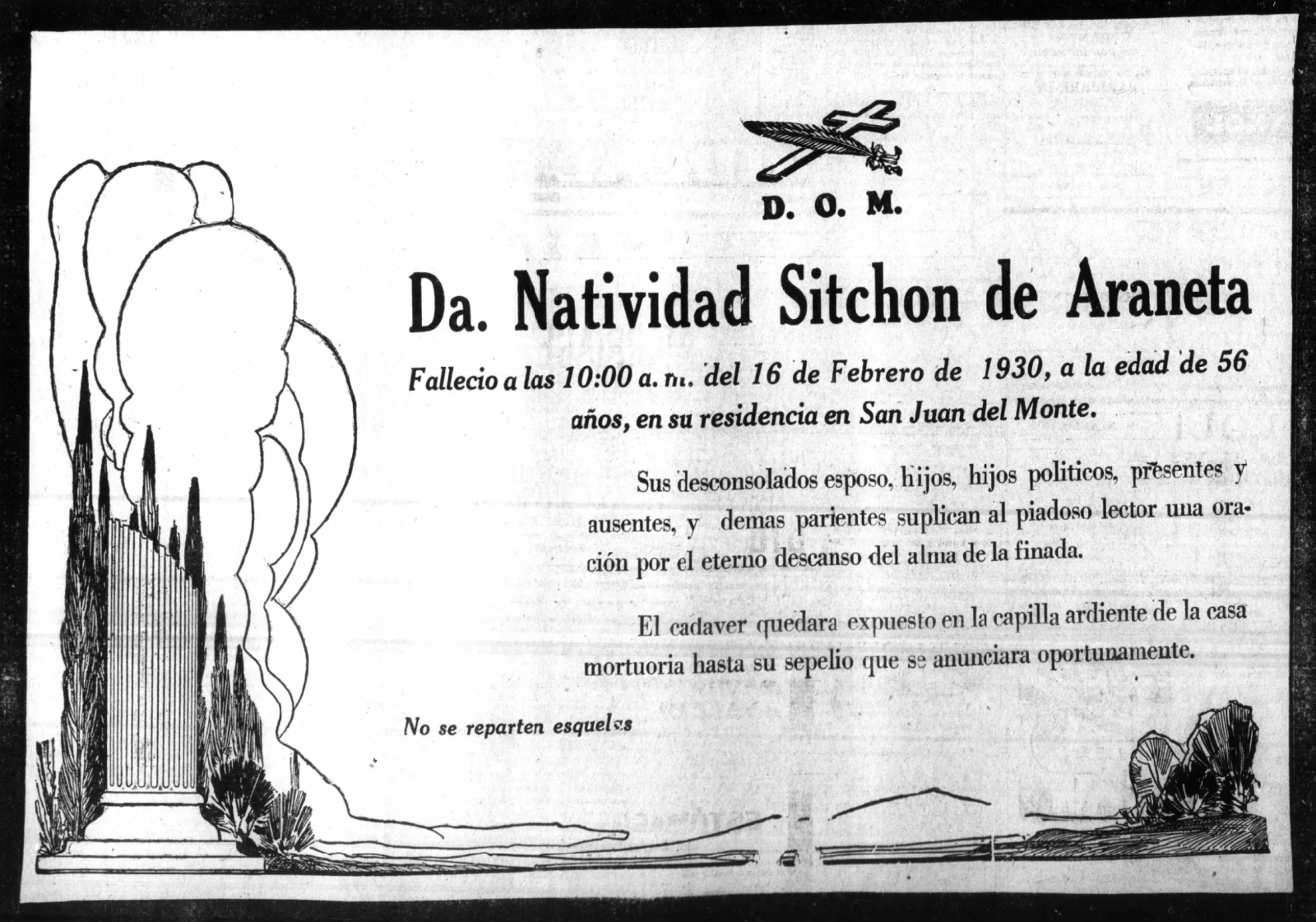
The Depression reached the Negros canefields in 1930 and 1931. The world market for raw sugar shrank; the Cuban harvest competed with the Filipino; and the United States, the principal export market, was about to impose by act of Congress the sugar quotas through the Jones-Costigan legislation of 1934. The Aranetas had also been bereaved. On 16 February 1930, Natividad Sitchon, Marciano’s wife and Ramon’s mother, died at the San Juan del Monte property the family had mortgaged eight months earlier.28 She was about fifty-six. Marciano would later remarry, taking the much younger María Locsín as his second wife, with whom he would have a daughter, Ramon’s half-sister Lucy.
On 15 June 1930, four months after Natividad’s funeral, Marciano and his son-in-law Jose Yulo signed before a Manila notary and effectively formalized their partnership contract for a Pampanga sugar operation they had been jointly running since August 1927.29 Marciano Araneta y Compañia held the lease on two haciendas, Carmencita and Pabanlag, in Floridablanca, Pampanga, financed by the Pampanga Sugar Mills, and in the enterprise father- and son-in-law held equal shares. The Bago operation, on the other hand, was now solely held by Ramon.

By the end of 1932, the position was no longer tenable. On 31 December, the PNB consolidated the Araneta family’s debts to ₱25,000, payable across five years. When the family fell behind on that, the bank brought suit. On 30 May 1934, the PNB filed Civil Case No. 6470 in the Court of First Instance of Negros Occidental, the 22nd Judicial District, against Ramon for ₱27,716.39 plus interest.30 Two years of negotiation followed. On 7 August 1936, the bank’s board, by Resolution No. 72, agreed to a final settlement: the principal back at ₱25,000 over five years, with the 800 piculs of sugar to be delivered annually out of the next five harvests.31 The deed of settlement was ratified in Manila in November. The Aranetas had not lost the land, they had not lost the haciendas, and Ramon, by his early forties, had passed through the largest financial crisis of his life with the family’s working enterprise intact. The cost was seven seasons’ margin to the bank, and a commitment of the family’s next five harvests to its first claim.
The Manila years
By 1930, the center of the family’s life had moved north to Manila, though the Bago years were not over and the haciendas would keep running. The youngest of the three daughters, Natividad Ludovina, called Vida, was born there on 14 April 1930, her birth registered in the City of Manila’s civil books.32 The first Manila house was the property at the Magdalena Estate in San Juan del Monte, a Rizal suburb above the city, the same one Ramon had mortgaged to the Philippine National Bank and at which his mother Natividad died, eight months before her granddaughter was born.
By the spring of 1935, the family had moved into central Manila proper, taking a house at 904 Calle Wright in the Ermita-Malate quarter near the bay. From there, on 2 October 1935, Ramon and Coring sailed for California on the S.S. President Coolidge, an American liner of the Dollar Steamship Line. The young Conchita Sunico, Coring’s niece, sailed with them. She had been crowned Manila Carnival Queen earlier that same year, with President Quezon personally backing her candidacy. The Pacific crossing took 25 days; the Coolidge reached San Pedro, California, on 27 October.33 The party was admitted under U.S. immigration regulations as temporary visitors for two months, but the visit ran longer. By Christmas 1935, the three were stopping at the Shoreham Hotel in Washington, D.C., as the Evening Star’s society column noted.34 The trip overlapped the Manila inauguration on 15 November of the Philippine Commonwealth, the transitional self-government Manuel Quezon now led as first Commonwealth President. Whether the Aranetas’ Washington stay was incidental to the Commonwealth’s beginning or part of the wider movement of Filipino political and business figures into and out of the American capital that month, the documentary record does not say. Ramon was not yet a figure of national politics, but the trip placed him in Washington at the moment the Philippines’ new constitutional life began.
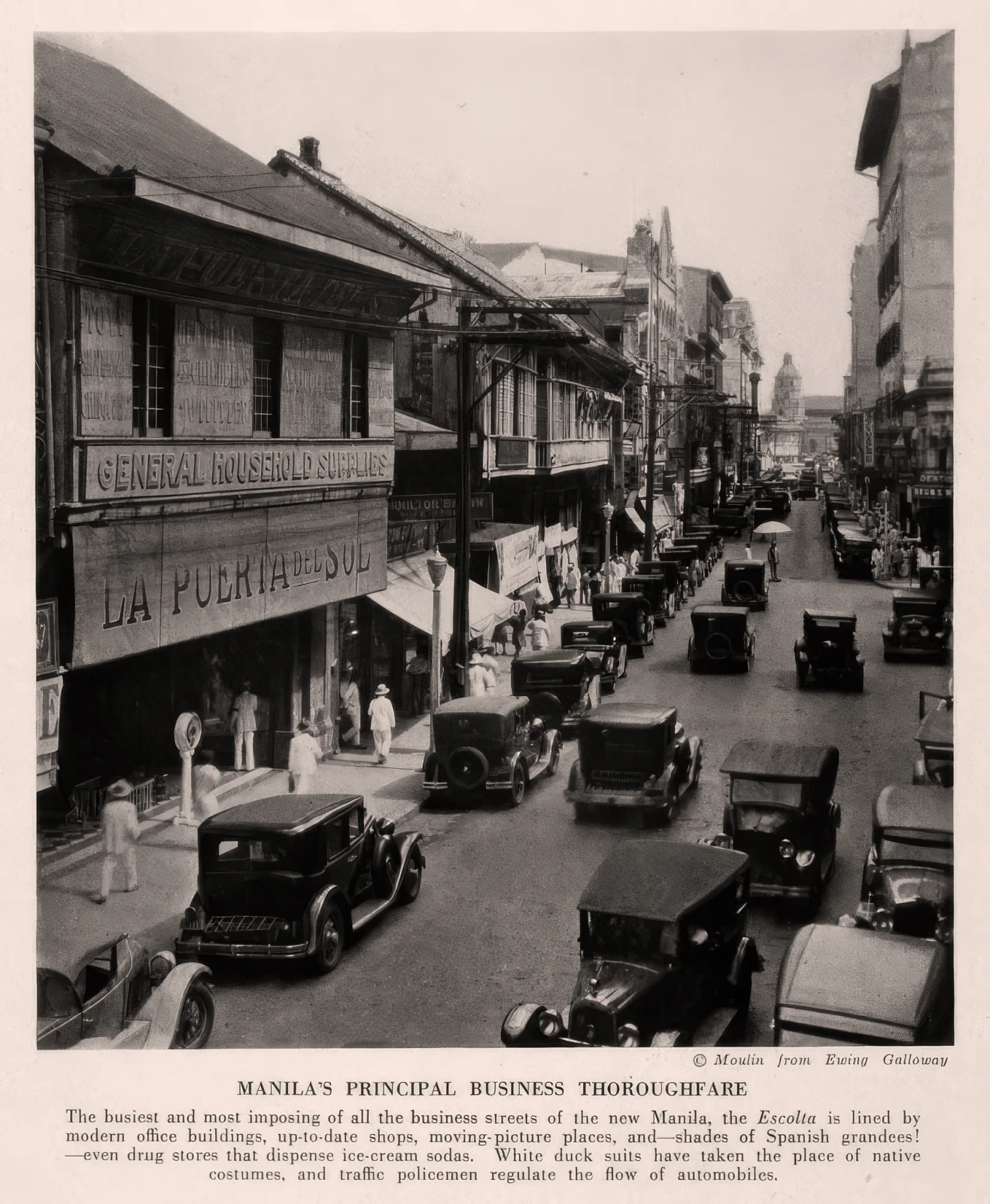
Back then, Manila’s working life revolved around Escolta, the principal commercial street of Binondo, the old Chinese-mestizo quarter on the north bank of the Pasig. Ramon kept two addresses there. The first was a suite in the Samanillo Building, a substantial Spanish-era commercial block on Escolta, which served as the family’s sugar business and corporate affairs office and, increasingly, as the Manila waypoint for the wider clan. In February 1937, when his sisters Cecilia and Eva sailed for Washington on the S.S. Empress of Japan to join Speaker Jose Yulo, taking Cecilia’s six minor children with them, the Samanillo Building was the address Ramon gave the U.S. consular officer as the Manila relative-of-record for all eight of them.35 The second office was on the ground floor of the Crystal Arcade, the Art Deco commercial pavilion built four years earlier, three blocks east on the same street. The Crystal Arcade was the showpiece of prewar Manila commercial architecture, a long, arcaded gallery of brass and tiled marble running from Escolta Street through to Calle Pinpin, and its ground floor had been remodelled in 1936 to house the trading floor of the newly organized International Stock Exchange of Manila.
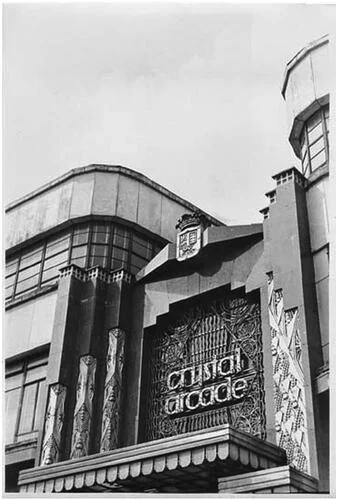
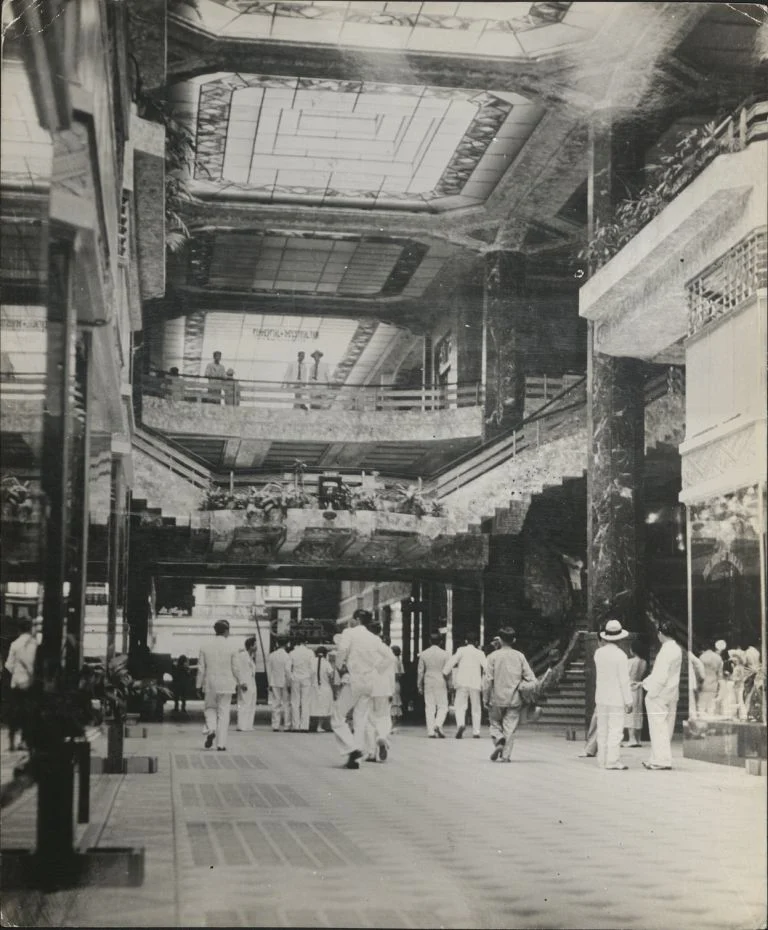
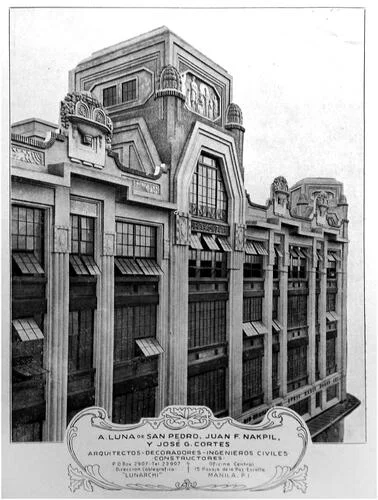
Ramon was one of the dozen founding incorporator-directors of that exchange when it opened in October 1936, and chairman of its Clearing House Committee, the financial-settlement engine that reconciled and netted out each day’s trades.36 Two of those directors would later become major figures in Philippine financial history. Miguel Cuaderno, who sat alongside Ramon and B. H. Berkenkotter on the Clearing House Committee, would in 1949 take office as the first Governor of the Central Bank of the Philippines, the institution that would shape postwar Philippine monetary policy for a generation. Arsenio N. Luz, the founding chairman of the Building and Quarters Committee, who had taken responsibility for remodelling the Crystal Arcade to house the exchange, would, eight years later, on a Saturday night in November 1944, be one of the five men sent from the city to retrieve Ramon’s body from Fort Santiago. Their work in 1936 was the unhurried civic business of building a new institution. None of them could know how short the stretch of time lay before them.
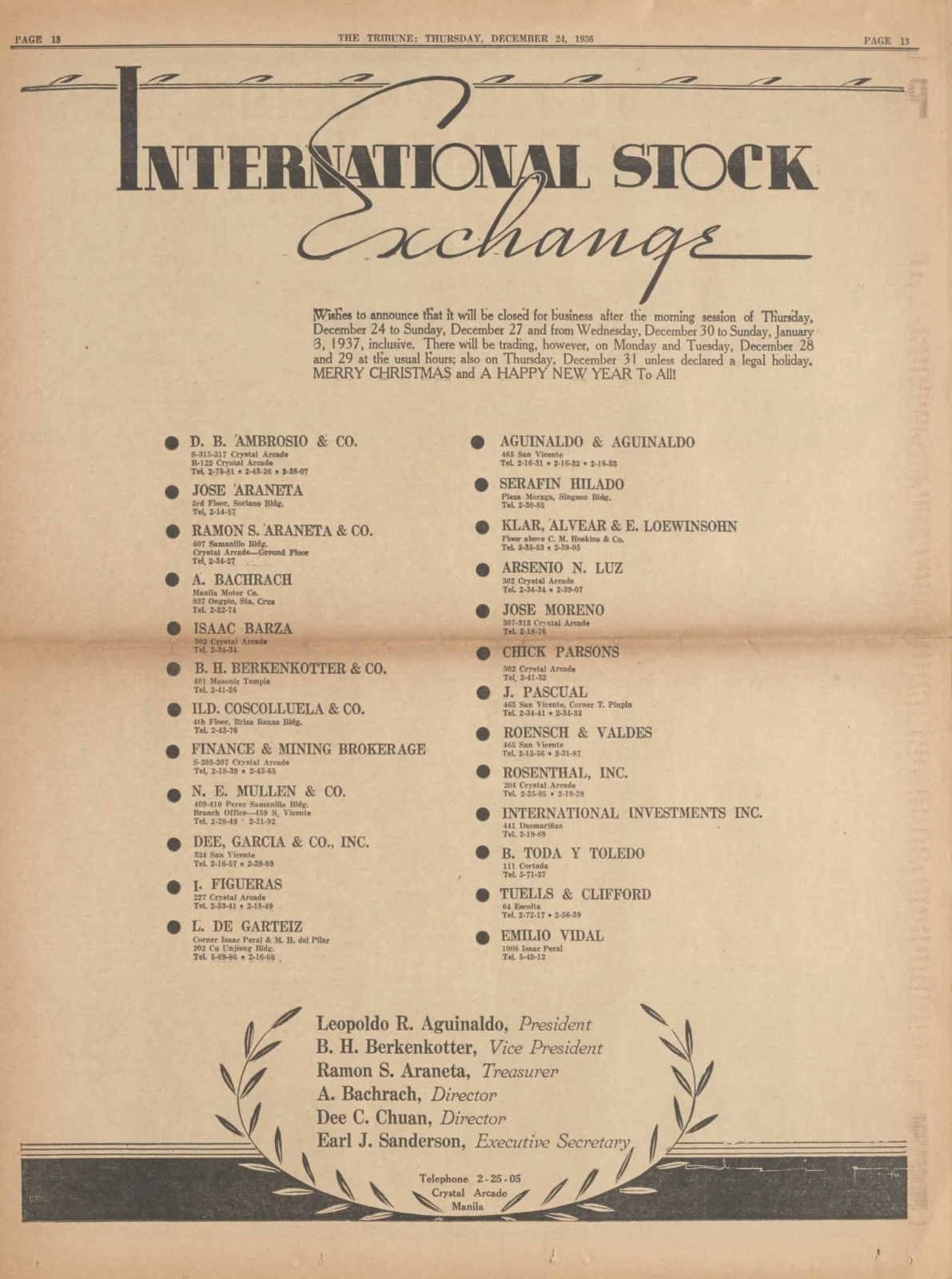
The brokerage, Ramon S. Araneta & Co., kept its trading desk on the ground floor of the Crystal Arcade, a few paces from the exchange floor. By late 1936, it had acquired a partner. The Tribune business page announced on 30 October that the Pampanga banker Norberto Quisumbing had resigned the managership of the Peoples Bank and Trust Company’s San Fernando branch to associate with Ramon, “another well known broker,” in brokerage and in mining investments.37 Across the trading floor were the desks of fellow brokers Ramon would see daily. Among them was Charles “Chick” Parsons, the American businessman with offices at 302 Crystal Arcade. Parsons, whose American naval-reserve commission would, in a different life seven years later, make him the central submarine-running liaison between General MacArthur in Australia and the Philippine resistance. Ildefonso Coscolluela, who would in April 1938 be elected president of Amalgamated Minerals, Inc. with Ramon joining his board, was another. So was Jose Araneta of the Manila branch of the wider Araneta clan, working out of the Soriano Building. The Manila financial-services world in the late thirties was a small one, and Ramon was at its center.
The house that the family eventually came to call home was the one at 3060 Taft Avenue Extension, Pasay, in the southern stretch of the boulevard near Vito Cruz. The family called it Kamalig, a Tagalog word for a granary or storehouse. By late 1937, it had been “recently re-modelled,” the Tribune society column noted on 23 November of that year, when Ramon and Coring and the J. Amado Aranetas threw a party of about a hundred guests there for Cecilia, their sister and Speaker Jose Yulo’s wife.38 The Yulo house was on Peñafrancia, in Paco, a short drive north across the city. The Taft Avenue house had, the Tribune said, a wide lawn, a terrace, and trees all around it. A long porch ran across its front. The grounds opened onto Taft Avenue Extension on one side and onto a garden that ran toward the Hernaez residence next door on the other.
His youngest sister Eva, who half a century later would remember it in mixed Hiligaynon and Spanish and English, described his life inside that house in the words of someone who had taken in a younger sister’s view of an older brother’s establishment. Como vivía. Como un rey. “How he lived. Like a king.” The household was, by her account, run on a scale unusual even for the elite Manila of the late thirties. An American nanny named Mary looked after the daughters. Five Japanese gardeners kept the grounds. The night guard, a Bombay-born man in a turban, stood watch beside a second guard from Thailand. Tunding, a Filipino butler in a white barong and white gloves, ran the indoor staff. His friends, in Eva’s phrase, were the five Elizalde brothers, the three Zobel de Ayala brothers, and Andres Soriano—the heads, between them, of three of the major Manila business houses of the prewar decade. Don Salvador Araneta, the eldest son of Felix Araneta of the Manila branch, who would see Ramon at parties and on the streets of Ermita and Malate, would remember him in a memoir written decades later as a man whose manners were those of a perfect gentleman, who was always well dressed and very neat.10 By the end of 1937, Ramon had been seven years in the city where he lived.
If the household ran like a court, its mistress cared little for the display. Coring had the manner of quiet, old money and no taste for showing it off; she did not like to dress up. One family story illustrated this perfectly. On a visit to New York, she walked into Tiffany’s on Fifth Avenue in a plain duster—the loose housecoat you throw on when you do not expect to be seen—and the saleswoman, taking her for no one, explained in a careful voice that the sterling place settings she had pointed to were a special item. Coring looked at her. “I know what they are,” she said. “Give me fifty.”
The house comes down to us also through the eyes of a child who visited it. Menchu Eleizegui, the daughter of Quirino Eleizegui, a colleague from Ramon’s office, was taken there on Sunday calls as a girl. Her family, close to Coring’s through the Chuidian side, came often, and she remembered Ramon’s house long afterward as an international house and the visits as a thrill. The driveway ran long from the gate, and by the time a car reached the door the household’s turbaned guard had come out to open it. Inside the door was the bar, open every day, where a bartender the children knew as Umbing presided, and a small lion skin lay on the floor, head and all, which the visiting child found friendly rather than fearsome. In the kitchen, Mary sat the children down for something to eat, and over the daughters was a French-Swiss companion the family called Madame Guy.71 In the garden, there was a fallen mango tree with a low main branch the children loved to climb.72 It is the kind of thing the documents of a planter’s business never preserve, and it survives only because the people who had been children in that house set it down for one another long afterward.
Pallbearer for Mr. Anderson
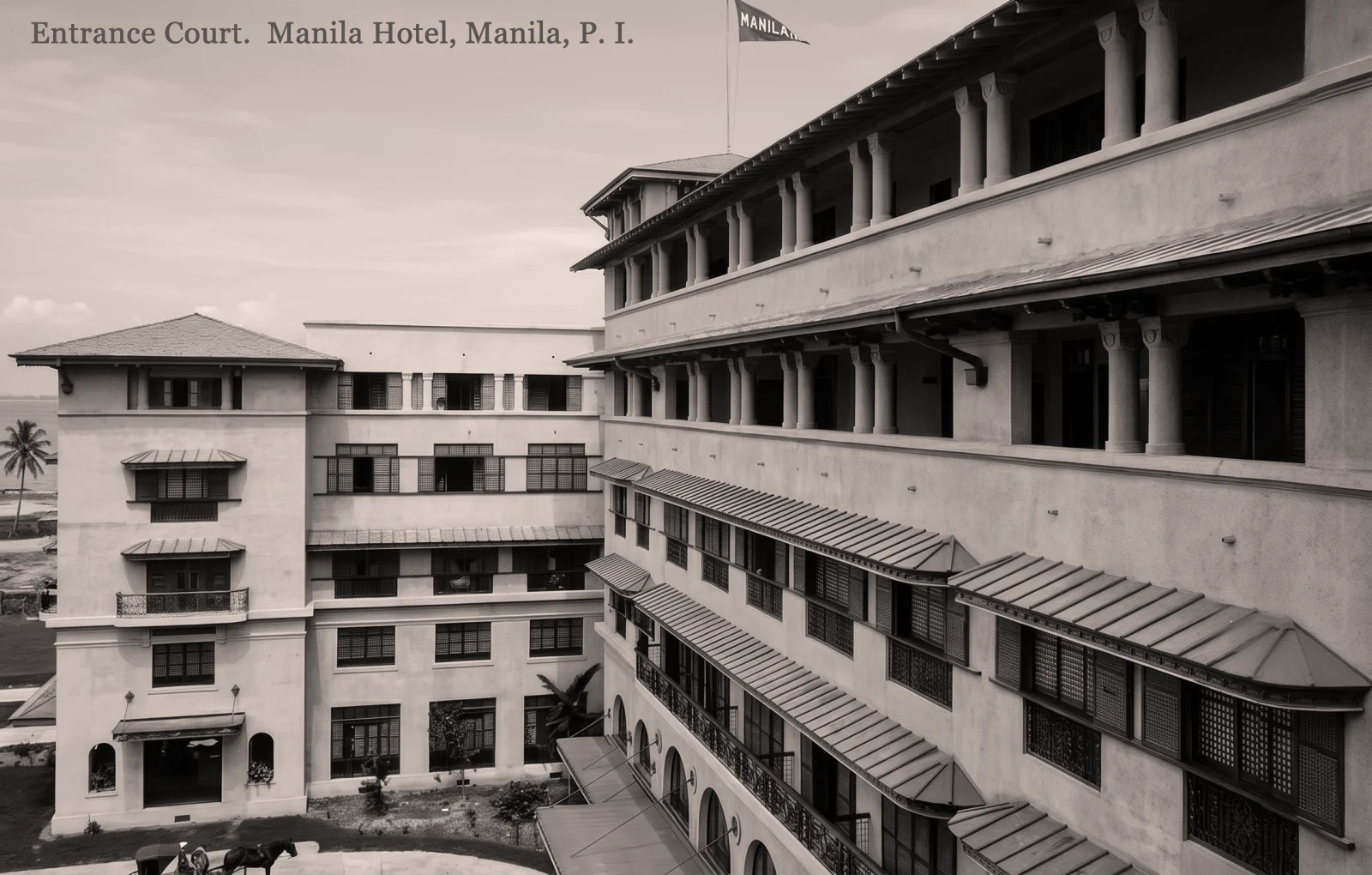
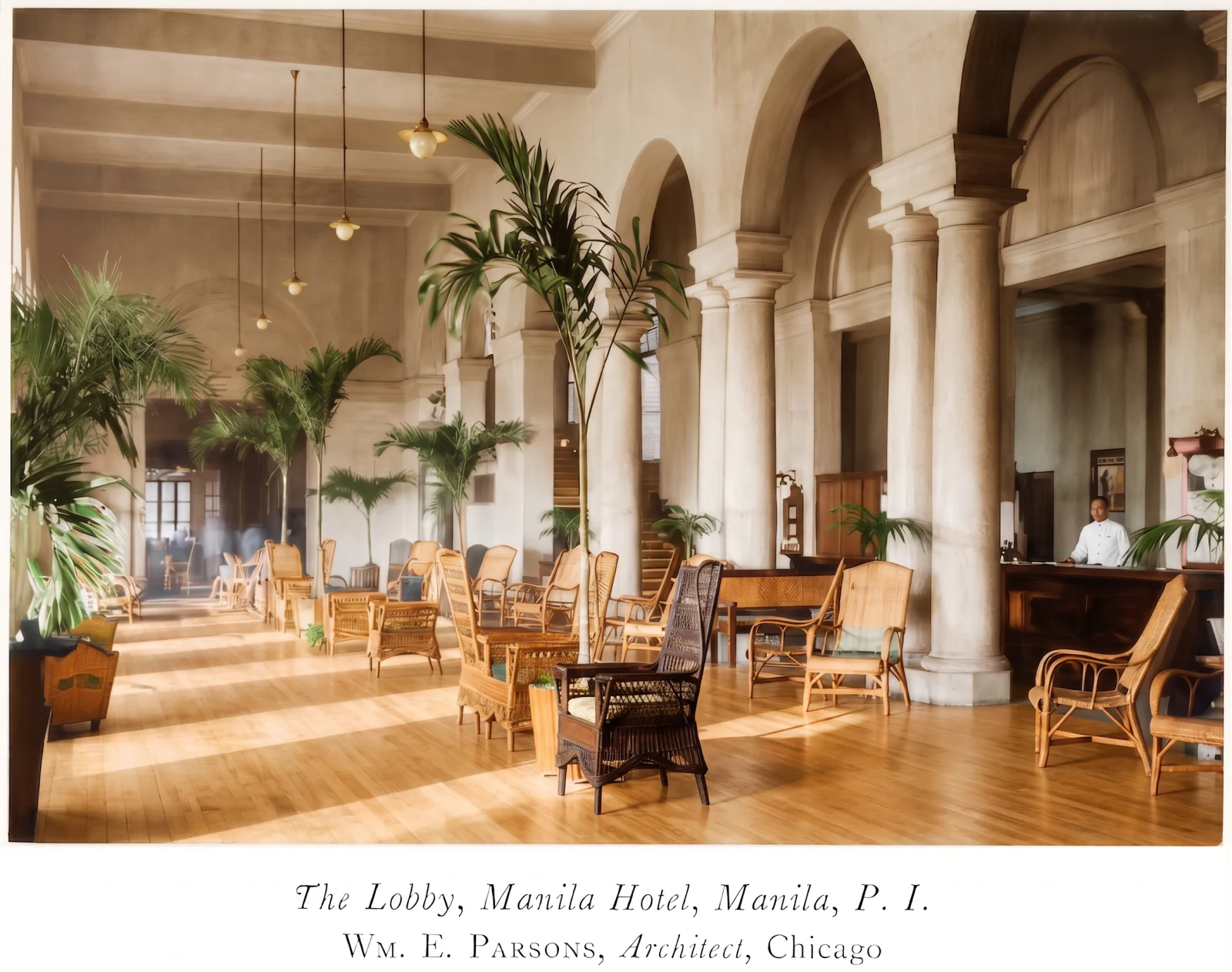
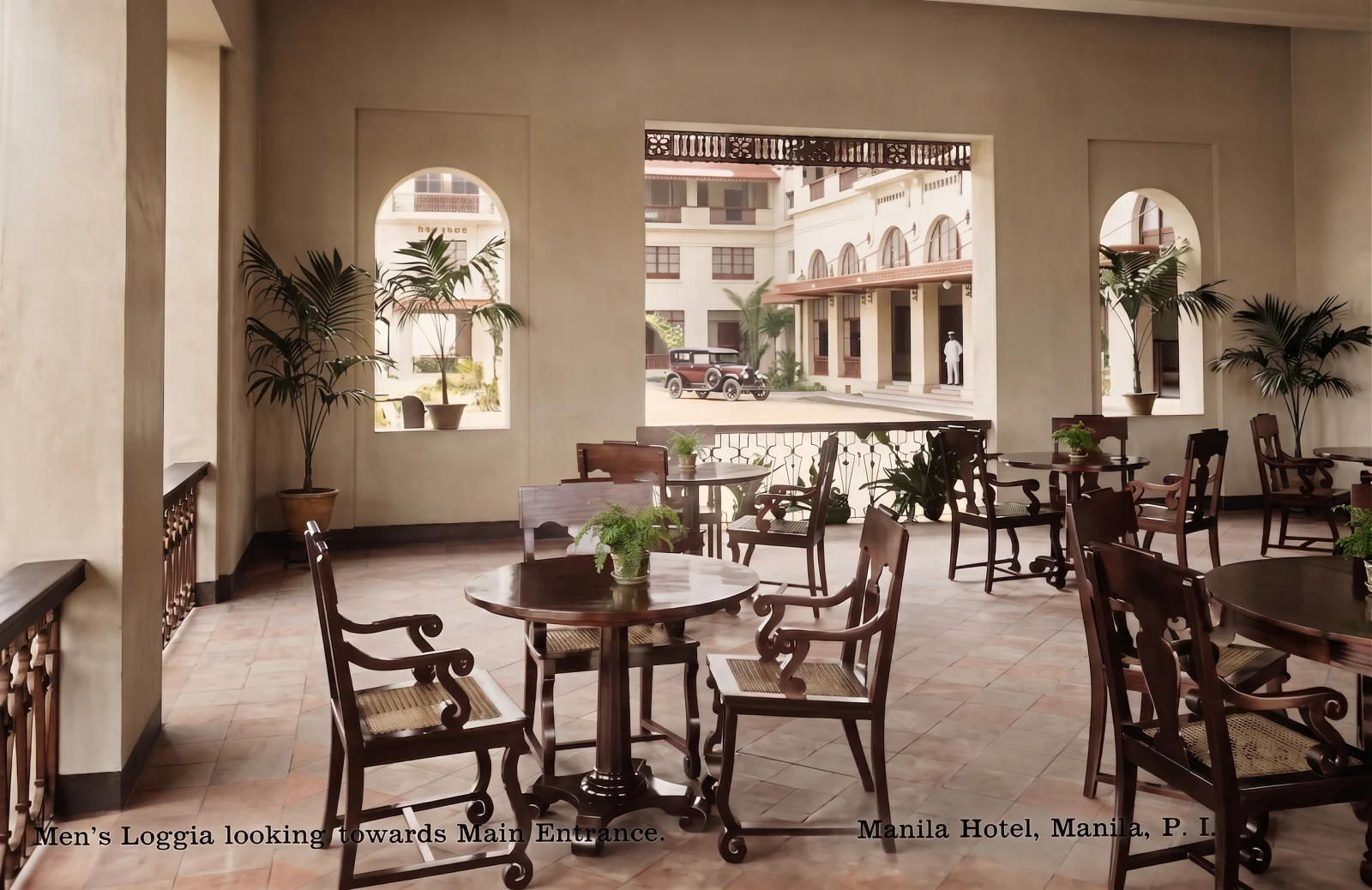
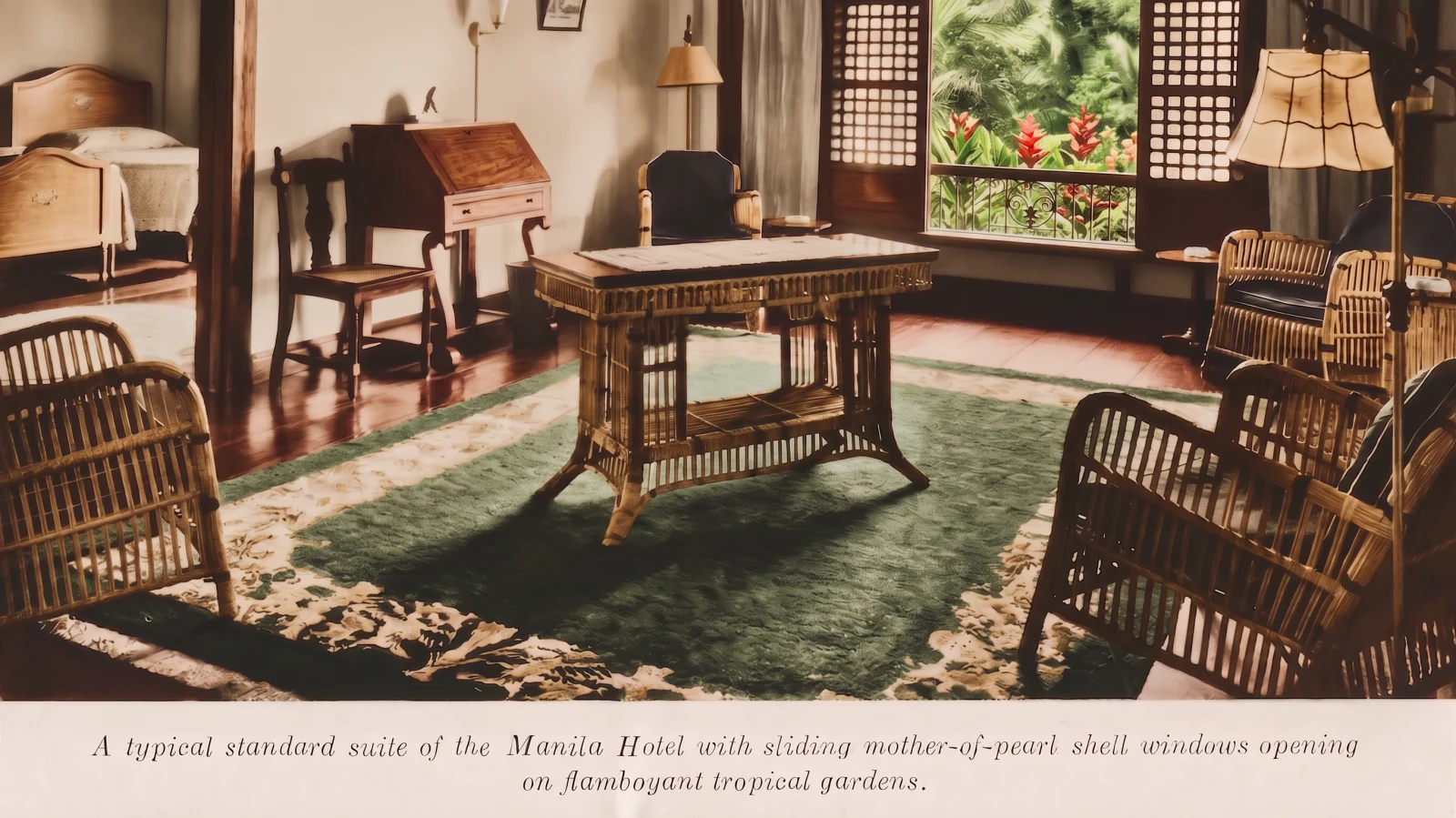
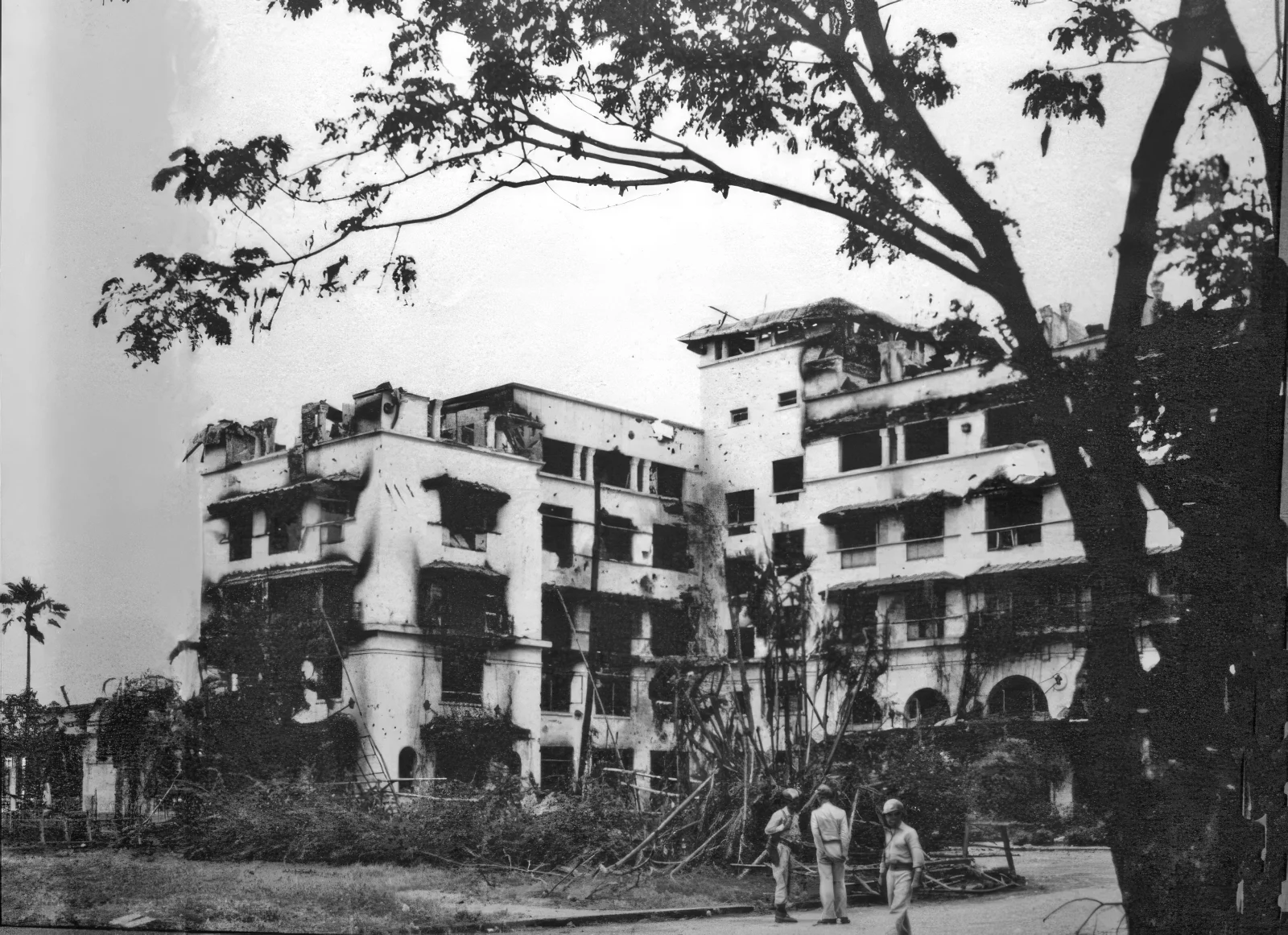
Hubert C. Anderson, the manager of the Manila Hotel, died in the summer of 1938. The American Chamber of Commerce in Manila printed the order of his funeral in the September issue of its Journal: the order of service, the list of mourners, and, in the body of the page, the twelve honorary pallbearers. They were General Douglas MacArthur, by then military adviser to the Commonwealth; Jorge B. Vargas, President Quezon’s secretary; Rafael R. Alunan, the Negros sugar man who was now Quezon’s secretary of agriculture and commerce; Judge Clyde A. DeWitt of the Manila American bar; Jose Paez of the Manila Railroad Company; six American businessmen whose names the Journal prints in plain block; and Ramon S. Araneta.39
That was the social list, the honorary roster. Anderson’s funeral also had Masonic pallbearers, and they were a separate pair: H. T. Gewald and Judge S. W. O’Brien, the two men who carried the casket under the rite of the Corregidor Lodge of the Free and Accepted Masons, of which Anderson had been a member. The Masonic tribute at the service was pronounced by Chief Justice Jose Abad Santos, the Grand Master of Philippine Masonry that year, who would within four years be executed by the Japanese for refusing to serve the puppet government. Whether Ramon was himself a Mason the obituary does not say, and the honorary list did not require it. What the list does say is that on a September afternoon in 1938 he stood, by published name, in the most senior company Manila could muster for the funeral of an American friend, the only Filipino non-government figure to be so named.
That the standing was more than ceremonial is something Jean MacArthur would put in writing many years afterward. Asked in 1984 to set down what she remembered, the General’s widow certified that she had known the Araneta family personally in the years she and her husband lived in Manila, and that they had been among the outstanding families and the friends of the General’s and her own.69 The pallbearer’s list of 1938 had placed Ramon in MacArthur’s company on paper. The widow’s letter, written from New York forty-six years later, says the acquaintance behind it was real.

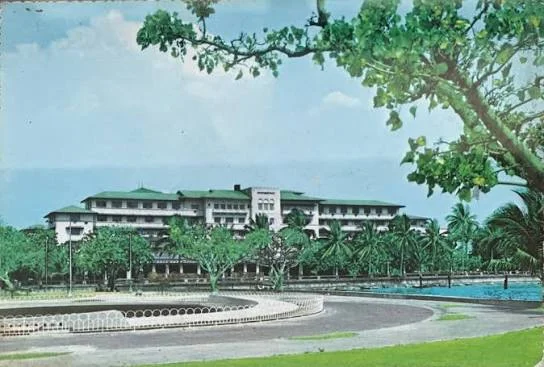
But the September 1938 memorial was only the most public instance of a wider pattern. By the closing months of 1936, Ramon and Coring were already established on the organizing committees of Manila’s elite social-club world. The Tiro al Blanco of Santa Mesa, the Spanish-speaking club whose name (literally “shooting at the target”) preserved its origins as a marksmen’s club of the Spanish-period elite, held its traditional Christmas Eve ball on the night of 24 December 1936. Mrs. Ramon S. Araneta sat on the ladies’ committee; Ramon himself on the gentlemen’s committee. His sister Cecilia (Mrs. Jose Yulo), his sister-in-law Mrs. J. Amado Araneta, and his youngest sister Eva all sat in their respective committees. His niece Conchita Sunico, the bride of three years before, by then a young woman in her own right, stood on the receiving line. Across the same committee rosters sat Mrs. Elpidio Quirino, Mrs. Carlos P. Romulo, Mrs. Vicente Madrigal, Mrs. Pedro Hernaez, Mrs. Jose Fabella, and Mrs. Antonio Vasquez, the same Dr. Antonio Vasquez who would be one of the five men sent to retrieve Ramon’s body in 1944.40 The committee list was a roll-call of the Manila elite of the late thirties, and the Aranetas were on it in numbers.
A year later, on the night of Wednesday 15 September 1937, the same Tiro al Blanco held a private dinner dance hosted by Assemblyman and Mrs. Jose Zulueta in honor of three couples from Iloilo: Mayor and Mrs. Ramon F. Campos, and the two Lopez brothers Eugenio and Fernando with their wives. Eugenio Lopez was building the Iloilo business interests in shipping and newspapers that he would, after the war, expand into the postwar empire of Meralco, the Manila Chronicle, and ABS-CBN. His younger brother Fernando would in his time be Mayor of Iloilo City, three-term Vice President of the Philippines, and twice a vice-presidential running mate. Ramon and Coring were among the named guests, as were the J. Amado Aranetas, the Rafael Alunans, and Don Salvador and Mrs. Salvador Araneta of the Manila branch. The Tribune that night printed a guest list two columns long: Elpidio Quirino, Manuel Roxas, Claro M. Recto, Jorge B. Vargas, Carlos P. Romulo, Vicente Madrigal, Speaker Gil Montilla, General Basilio Valdes, the Posadas family, Judge Manuel Moran, Major Manuel Nieto, and the Sunicos.41
Ramon’s corporate life was thriving in those same months. In April 1938, he was elected to the board of Amalgamated Minerals, Inc. under Ildefonso Coscolluela’s presidency, his third mining-company directorship, alongside the Mindanao Goldfields and Santa Cecilia Mining boards he held by 1940 per the Commercial & Industrial Manual of that year.4243 The Manual also recorded him as vice-president of the Ma-ao Sugar Central, where the family’s haciendas had milled their cane since the 1920s; treasurer of the General Securities Investment Co., a family real-estate and securities firm registered out of the Samanillo Building; and a director of two mining ventures shared with the Zobel family and Rafael Alunan. His business interests now ran from the canefields of Bago through the Samanillo Building, the Crystal Arcade, and three mining boards.
In August 1939, he sailed for the United States a second time, four years after the Coolidge trip. The voyage’s purpose was a college run. He was escorting his eldest daughter Jenny, then about eighteen, and her cousin Maria Yulo, Cecilia’s eldest, to a Pennsylvania college, one of the small American Catholic women’s colleges (Bryn Mawr, Rosemont, Villa Maria, Saint Joseph’s are plausible) that had become, by the late thirties, a standard destination for the daughters of the Manila Catholic elite. The Honolulu Star-Advertiser, reporting his transit on 26 August, identified him as “a prominent Philippines sugar planter and Manila executive of newspapers and radio.”44 It was the first time any source had used those three identities in a single phrase. The confidential U.S. intelligence assessment that would call him “the real power in the family” still lay two years in the future.
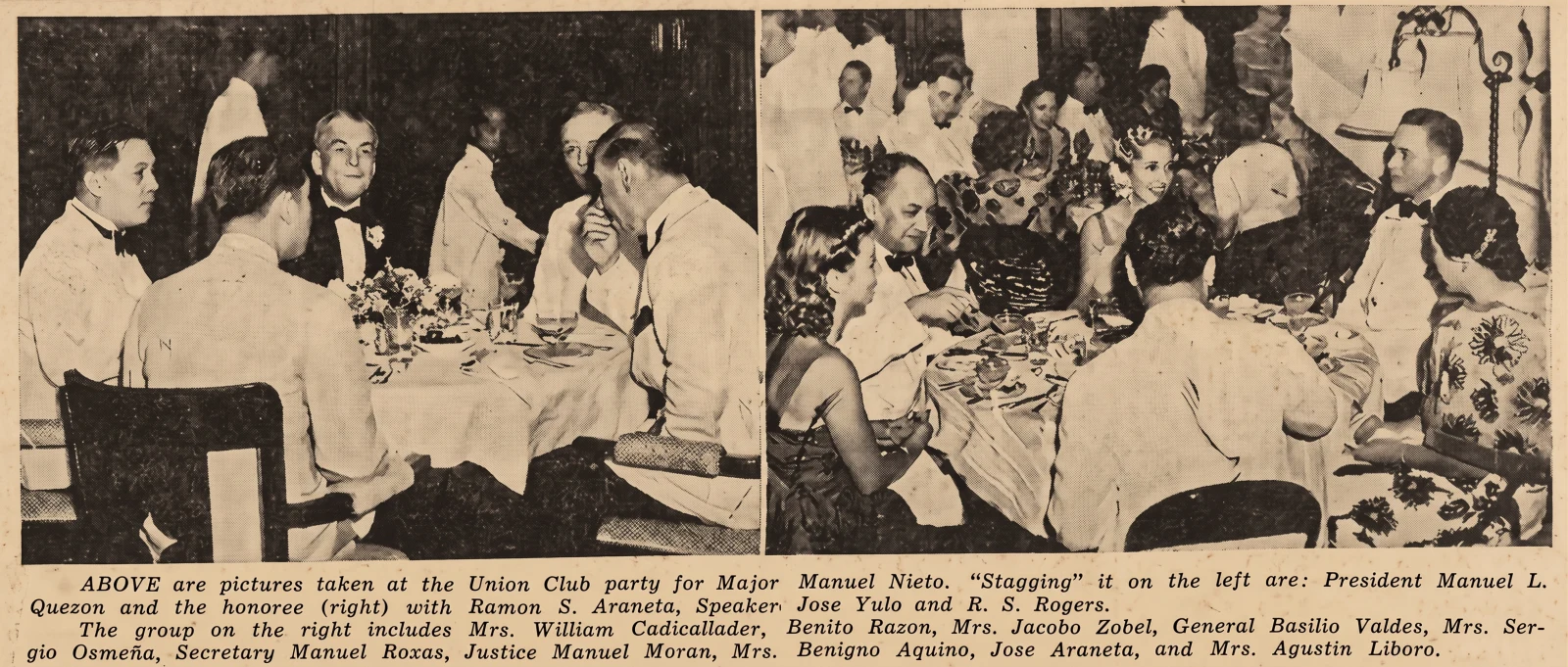
By the summer of 1940, Ramon was being photographed in the rooms of power. On the evening of Friday 16 August, at a party in the Union Club for President Quezon’s military aide Major Manuel Nieto, the Tribune photographed five men “stagging it”: Quezon himself, the honoree, Speaker Jose Yulo, the American businessman R. S. Rogers, and Ramon.45 Ten days later, at Speaker Yulo’s home on Peñafrancia, Paco, Ramon and Coring were among the guests of a dinner for U.S. High Commissioner Francis B. Sayre and Mrs. Sayre, with MacArthur and Mrs. MacArthur as the second guests of honor. The published Tribune photograph showed Mrs. Sayre, Mrs. Yulo, Mrs. MacArthur, Mrs. I. Beck, and Mrs. Pedro Campos seated in the front row, with Mrs. Ramon Araneta and Mrs. Jorge Vargas standing behind them.46 The guest list was extensive. Among them were General and Mrs. Henry C. Pratt; Floor Leader Quintin Paredes; Chief Justice and Mrs. Jose Abad Santos; Secretary and Mrs. Benigno Aquino; Secretary and Mrs. Jorge Vargas; Justice Jose P. Laurel; Carlos P. Romulo; Juan Elizalde; Enrico Pirovano; Mr. and Mrs. Ramon S. Araneta; and J. Amado Araneta. It was the senior establishment of the Commonwealth on the eve of war.
The men in that room sat under a darkening sky that none of them had yet thought to look up to. Within little more than a year, Pearl Harbor would be bombed. Within a year of that, Chief Justice Jose Abad Santos would be dead, executed by the Japanese in May 1942 for refusing to serve their puppet government. Justice Laurel would be that puppet government’s president by October 1943, his name on the proclamation declaring the Republic of the Philippines independent under Japanese sponsorship. Jorge Vargas would chair the wartime executive commission. Benigno Aquino would be the puppet Speaker. Juan Elizalde and Enrico Pirovano, the two men in the room who would join the resistance most deeply, would be caught, tortured, and killed by the Kempeitai. MacArthur would re-enter Manila in early 1945 over the rubble of the Battle of Manila. Ramon Araneta would be dead in a cell of Fort Santiago by 11 November 1944, three months before the American return. In the summer of 1940, none of this was yet visible. The men photographed at Speaker Yulo’s house were at the apex of their lives.
Print, signal, screen
Sugar was one business. The brokerage was a second. By 1937, there was a third. The family had been investing in publishing for some years, but the formal incorporation of D.M.H.M., Inc., the holding company that would consolidate the Araneta-family newspaper and radio interests, was announced in President Quezon’s Messages of the President on 22 May 1937.2 The board was a family-and-friends roster. Jorge L. Araneta, a Bago Araneta cousin then in his late forties, was the President. J. Amado Araneta, Ramon’s younger brother, was the Vice-President and Treasurer. The Directors were Ramon S. Araneta; Oscar Ledesma, a Negros sugar man and future congressman; and Carlos P. Romulo, the Filipino-American journalist who, five years later in 1942, would win the Pulitzer Prize for his series I Saw the Fall of the Philippines. Romulo was also the Publisher. The flagship publication was the Philippines Herald, by 1937 the leading Filipino-owned English-language daily in the country.
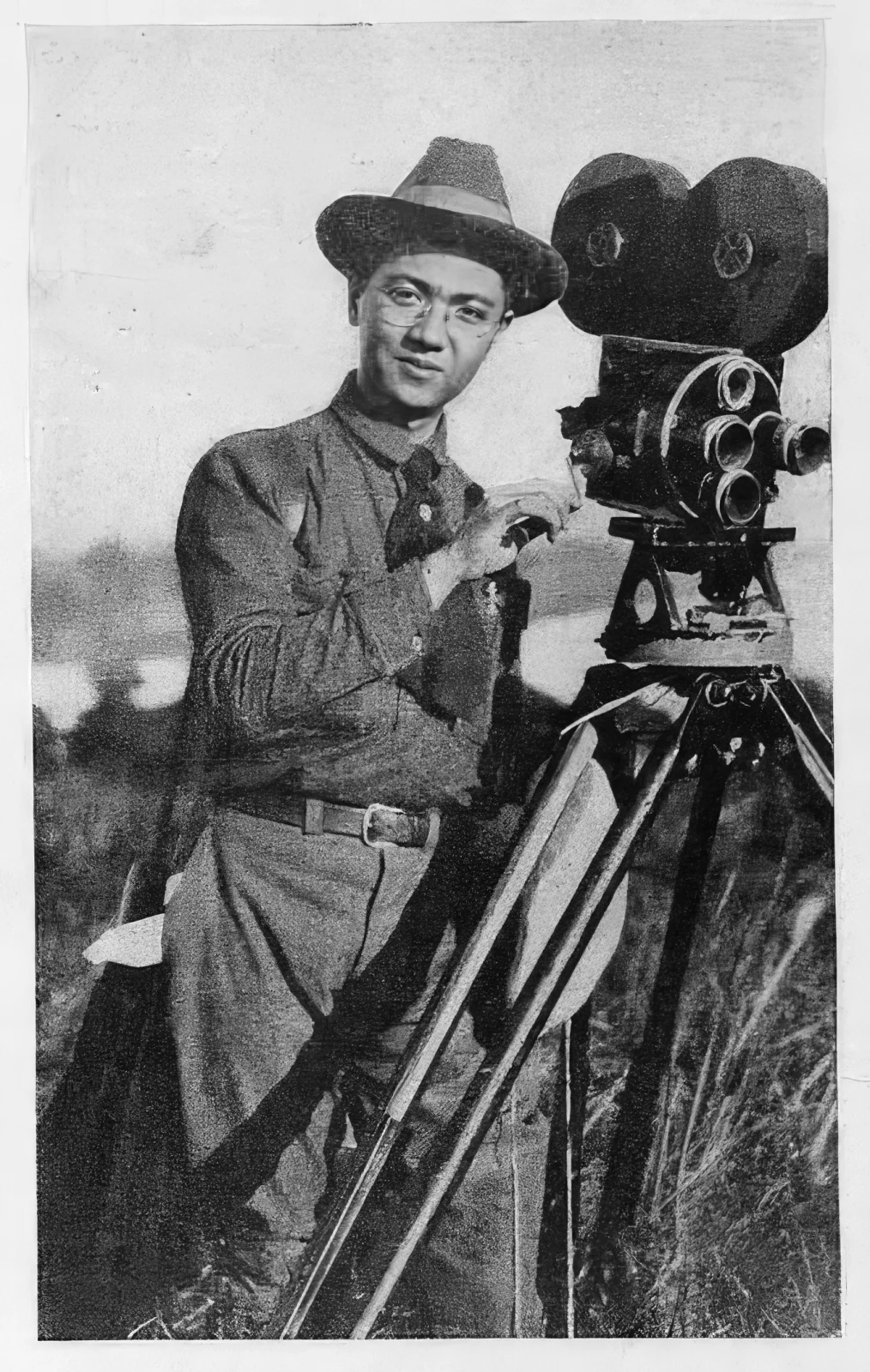
Four months later, there was a film studio. On Saturday 11 September 1937, the Tribune ran a business notice headed “Prominent Local Businessmen Back Up New Motion Picture Company.” Excelsior Pictures, Inc. had been registered with the Bureau of Commerce, capitalized at ₱200,000. The founding officers were Angel Padilla as President; Plácido L. Mapa, the Yulo-circle figure who had been at the Speaker’s birthday parties, as Vice-President; Ramon as Treasurer; Norberto Quisumbing, Ramon’s standing brokerage partner since the previous October, as Secretary; and Felix N. David as Director. The studio had acquired a tract of land in New Manila and engaged the Sta. Clara Lumber Company to put up the first building. As technical director it had engaged José Nepomuceno, the pioneer Filipino film-maker whose silent Dalagang Bukid of 1919 had been the country’s first Filipino feature.47
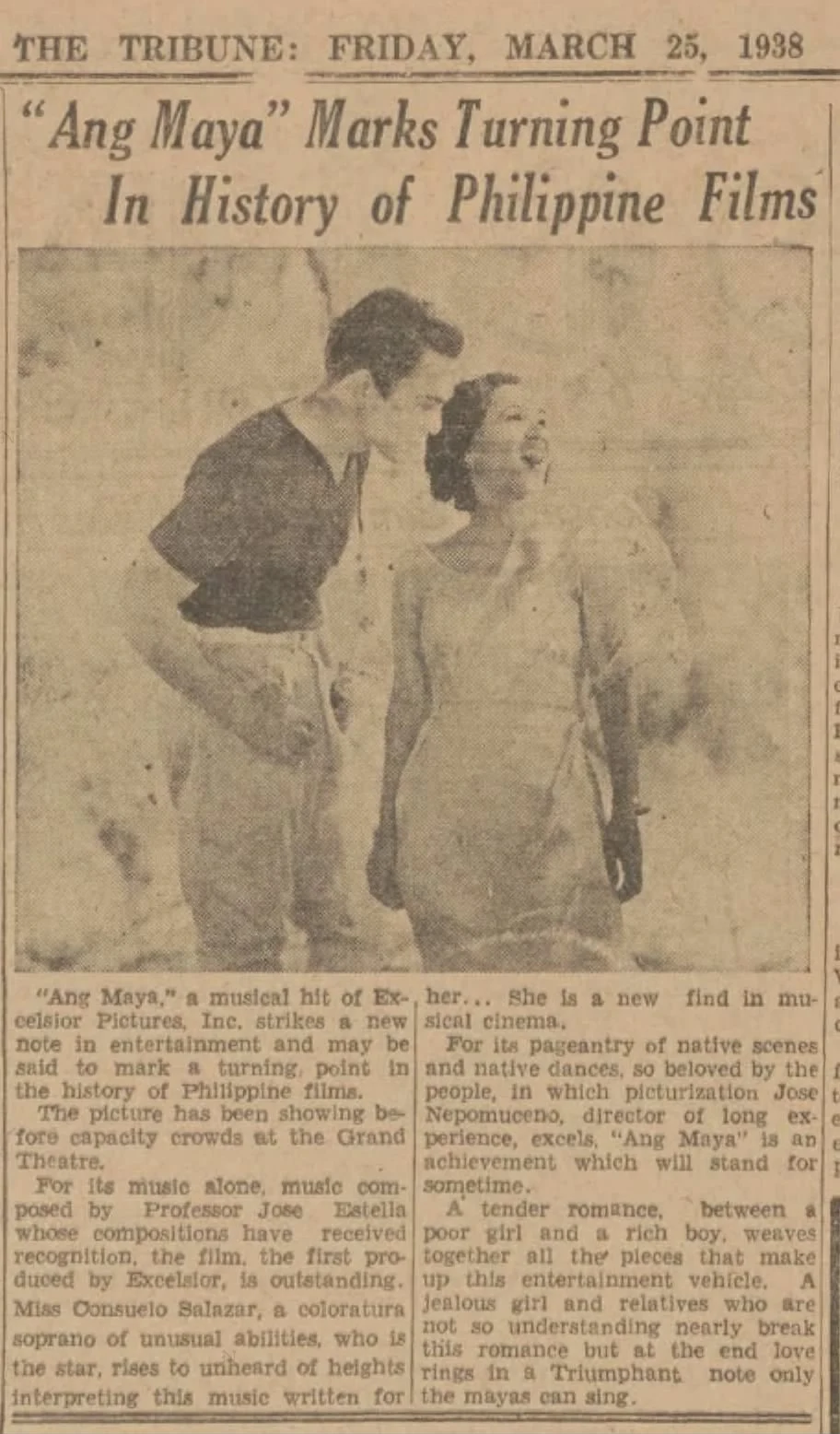
Excelsior aimed at the prestige end of the cinema market. Its first feature, Ang Maya, premiered at the Grand Theatre on Wednesday 16 March 1938, directed by Nepomuceno himself, with music by Professor José Estella, and starring the University of the Philippines Conservatory soprano Consuelo Salazar-Perez opposite Fernando Poe Sr. The Tribune called the film a turning point in Philippine cinema, noting that it was the first local production to put university-trained performers in its leads.48 The studio’s second major production, Celia at Balagtas, came a year later: a biopic of the Tagalog poet Francisco Balagtas (1788–1862), directed by Gregorio Fernandez, with José Padilla Jr. in the title role and a balagtasan poetry-debate staged at the gala.49 The Philippine industry was producing roughly 50 features a year against 500 American imports; Excelsior’s two-films-a-year prestige catalogue was positioning itself at the top of that domestic 50.
Then came the radio chain. In late 1938, the Araneta group bought up KZRM, the 50,000-watt private Manila station, and its sister broadcaster KZEG, marketed together as “Radio Manila.”50 The acquisition put the family at the head of both the leading Filipino-owned English-language daily and the largest private radio station in the country. The Filipino-language press had its own world, deep and contentious, in the Tagalog and Spanish dailies. The English-language press was where the Commonwealth state spoke to its American audience, where the Manila elite read its own news, and where the case for Philippine independence was made to Washington. D.M.H.M. was the Filipino-owned counterweight to the Manila Daily Bulletin and the Tribune in that English-language press, and the Aranetas were now its principal shareholders.
Within the family, J. Amado was the publicly recognized head of the media business, but contemporary sources suggest that Ramon was the operational man. On 24 September 1939, a Philippines Free Press profile of Speaker Jose Yulo, by the journalist Leon Ma. Guerrero, identified Cecilia Yulo as “sister of the general manager” of “the powerful D.M.H.M. newspapers and the only nationwide radio chain, Radio Manila.”51 The profile did not name the general manager. By the period’s conventions, the most plausible choice would be Ramon, as the eldest sibling and the D.M.H.M. director with the day-to-day Manila presence; J. Amado, the younger brother, was the corporate Vice-President and Treasurer. The identification is inferential, not flat, but it fits everything that can be said of the brothers at this point in their working lives.
By August 1939, the studios were coordinating as a regional operation. Excelsior and J. Amado’s parallel studio, Filippine Films Productions, announced a joint distribution agreement with Pan-Oriental Films and a target of twenty-four super productions within the next twelve months.52 The Tribune framed the two as among the biggest and most modern in the Far East. Hollywood-style equipment was on order. Print, signal, screen: by the end of 1938 Ramon was an officer of all three. By 1941 the family-and-cousins network had three film studios in it—Excelsior, J. Amado’s Filippine Films Productions, and the cousin J. Antonio Araneta’s X-Otic Films—and a U.S. intelligence report would later count Excelsior among the country’s top four producers.53
By the late summer of 1941, the U.S. High Commissioner’s office was watching them. The commissioner now was Francis B. Sayre, the man at whose table Ramon and Coring had sat the previous August. On 25 September 1941, Sayre’s office filed a confidential intelligence assessment of the Philippine radio infrastructure, the so-called “Sayre Radio Survey,” in the U.S. State Department’s classified files. The survey assessed each major Philippine station for ownership, audience reach, and political loyalty in the event of war. KZRM’s entry placed the Araneta family at the head of the station’s “respective order of authority”: J. Amado Araneta first, as the publicly recognized controlling manager; Ramon Araneta second, with the survey’s note that “reliable sources indicate this is the real power in the family”; and Noel Araneta third, as “general manager in name only.”54 The family’s loyalty was assessed as “believed to be loyal.” The same year’s Manila City Directory recorded the corporate footprint behind the survey’s reading: Ramon as acting president and general manager of Ma-ao Sugar Central; treasurer of Excelsior Pictures; president of Amalgamated Minerals; president and treasurer of General Securities & Investment; and secretary of Ormoc Sugar.55 Five concurrent corporate offices, the footprint the Sayre survey was reading off. The note about Ramon being the real power was the High Commissioner’s office’s own reading, attributed to unnamed reliable sources.
Just over two months later, on the morning of 8 December 1941 in the Philippines, the Japanese began their bombing of the U.S. Asiatic Fleet at Cavite and the U.S. Army Air Forces at Clark Field. The American defense of the islands lasted four months and gave way; by January 1942, the U.S. and Philippine governments had withdrawn to Corregidor, Manila had fallen, and the Commonwealth state Ramon had been part of had become a government in flight. The D.M.H.M. publishing offices were destroyed by bombing in late December 1941. The Philippines Herald suspended publication on 2 January 1942 and would not resume until 9 July 1949. KZRM was seized and incorporated into the Japanese-controlled broadcasting system. Excelsior’s New Manila studio site went dark. By January 1942, the Filipino-owned media establishment that the Aranetas had built across the late thirties, spanning print, radio, and film, was gone. The man Sayre’s office had named as its real power found himself, by that month, in occupied Manila.
Listening to San Francisco
By January 1942, the city was unrecognizable. The American defense had collapsed in four months; MacArthur and Quezon had withdrawn first to Corregidor and then to Australia; and Manila was declared an open city in late December 1941 and was now under occupation by the Imperial Japanese Army. The D.M.H.M. publishing offices had burned in the bombing. KZRM had been seized and folded into the Japanese-controlled broadcasting system. Excelsior’s New Manila studio was dark. The Commonwealth state Ramon had served as a corporate officer for half a dozen of its leading enterprises was gone. The Aranetas remained in their house at the southern end of Taft Avenue Extension, with the city around them being remade as the capital of a puppet republic.
The interrogators of that capital sat in Fort Santiago, the old Spanish stone fortress at the mouth of the Pasig. The Kempeitai, the Japanese army’s military police, had taken over the Fort in January 1942 and had kept it as their Manila headquarters since then. Anyone in the city understood what it meant to be taken there.
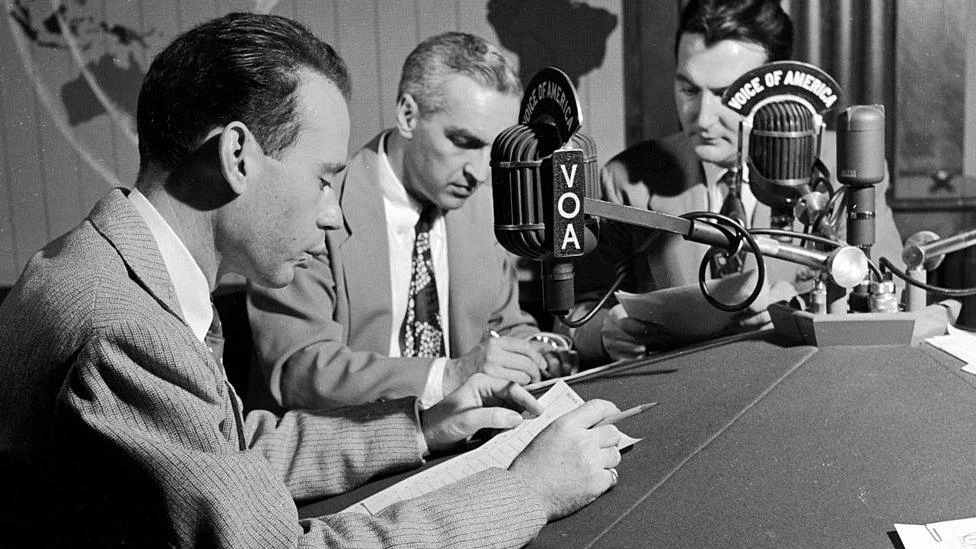
For most of the occupation the Aranetas lived as the elite of occupied Manila lived: cautiously, ostensibly cooperating with the new state at the surface, and quietly working against it underneath. J. Amado, Ramon’s younger brother, was later described by family and contemporary sources as having secretly funded the anti-Japanese resistance. In the house at Taft Avenue Extension, there was a short-wave receiver. The set was capable of pulling in KGEI, the U.S. government’s San Francisco station that broadcast across the Pacific in English and in Tagalog and was the medium through which the Voice of America and MacArthur’s “I shall return” reached occupied Manila. Listening to it was a punishable offense under the Japanese occupation. A 1945 war-crimes deposition by Jean Carlo Fontana, a Manila businessman who had known Ramon during the occupation, would later state that “Mr. Araneta had received American propaganda pamphlets through the underground,” the first primary-source attribution of Ramon to direct contact with the resistance distribution network.56 Family memory also carries a contested variant, that what the Kempeitai eventually found in the house was a transmitter rather than a receiver; the contemporary diary record of the arrest, kept by Felipe Buencamino III and by Marcial Lichauco, is unambiguous as to whether or not the charge was listening to short-wave.
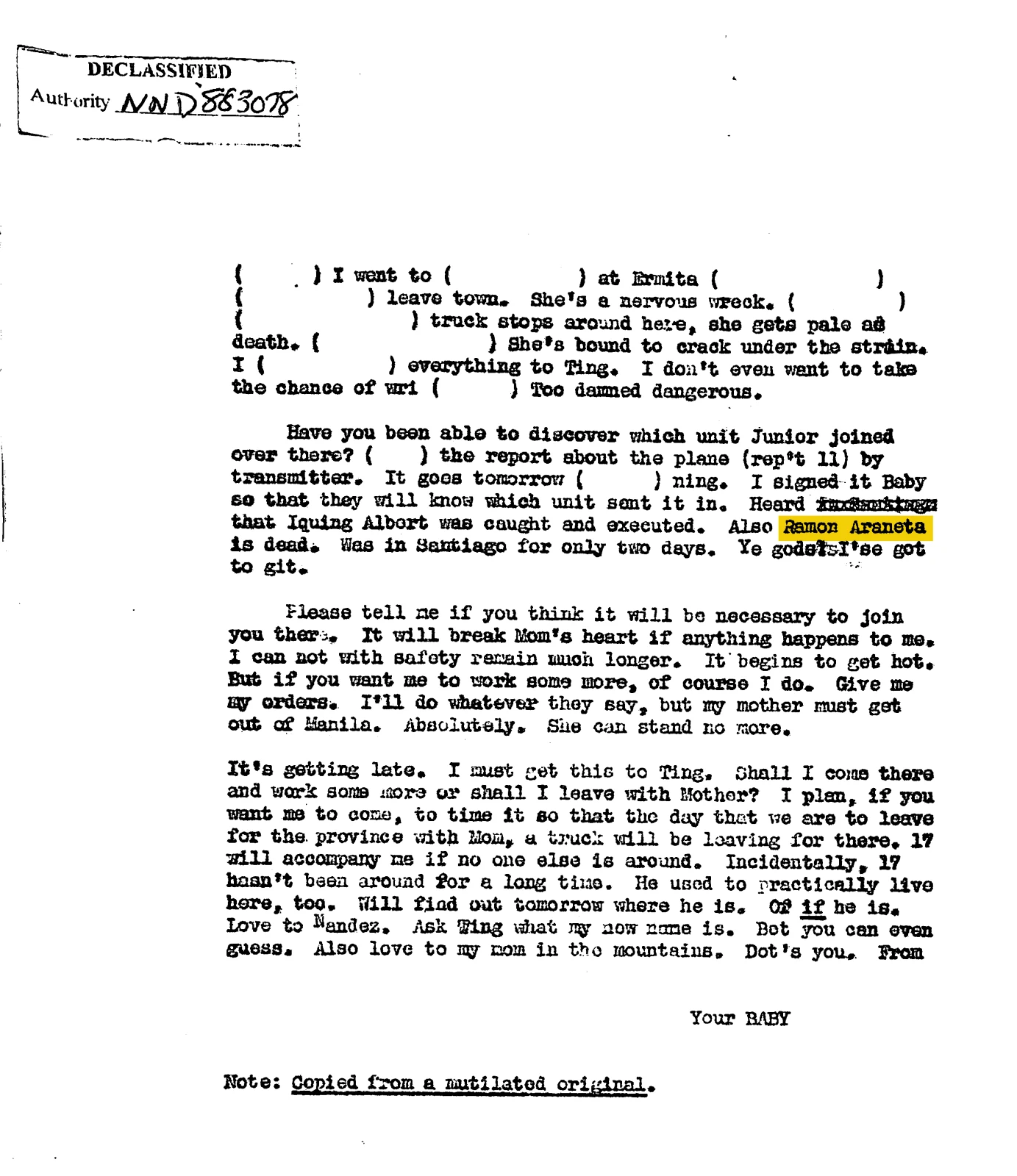
The household’s resistance ties were not only Ramon’s. The postwar U.S. National Archives recognition file of the Porch Club Unit of Marking’s Fil-Americans, one of the major Luzon guerrilla organizations, carries on its auxiliaries list the name “Mrs. Ramon Araneta.”57 Coring had been on the auxiliary roster of a Manila guerrilla unit. The unit was run by Lydia Villanueva Arguilla, a U.P. journalism graduate code-named “Nell” inside the resistance, who would rise from Lieutenant to Major in its ranks. Arguilla had joined Marking’s with her husband, the Ilocano writer Manuel Arguilla; the Kempeitai killed Manuel at Fort Santiago in October 1944, a month before they came for Ramon. The same file contains a 22 November 1944 letter by the Porch Club operative “Baby,” reporting back up the chain: “Heard … that Iquing Albert was caught and executed. Also Ramon Araneta is dead. Was in Santiago for only two days.”58 “Baby” was Rosie Osias, a Porch Club radio encoder and decoder commissioned in December 1943. The Porch Club tracked Ramon’s death because the Porch Club tracked Filipino deaths in its operational area; the household’s connection to the Club ran through a different door.
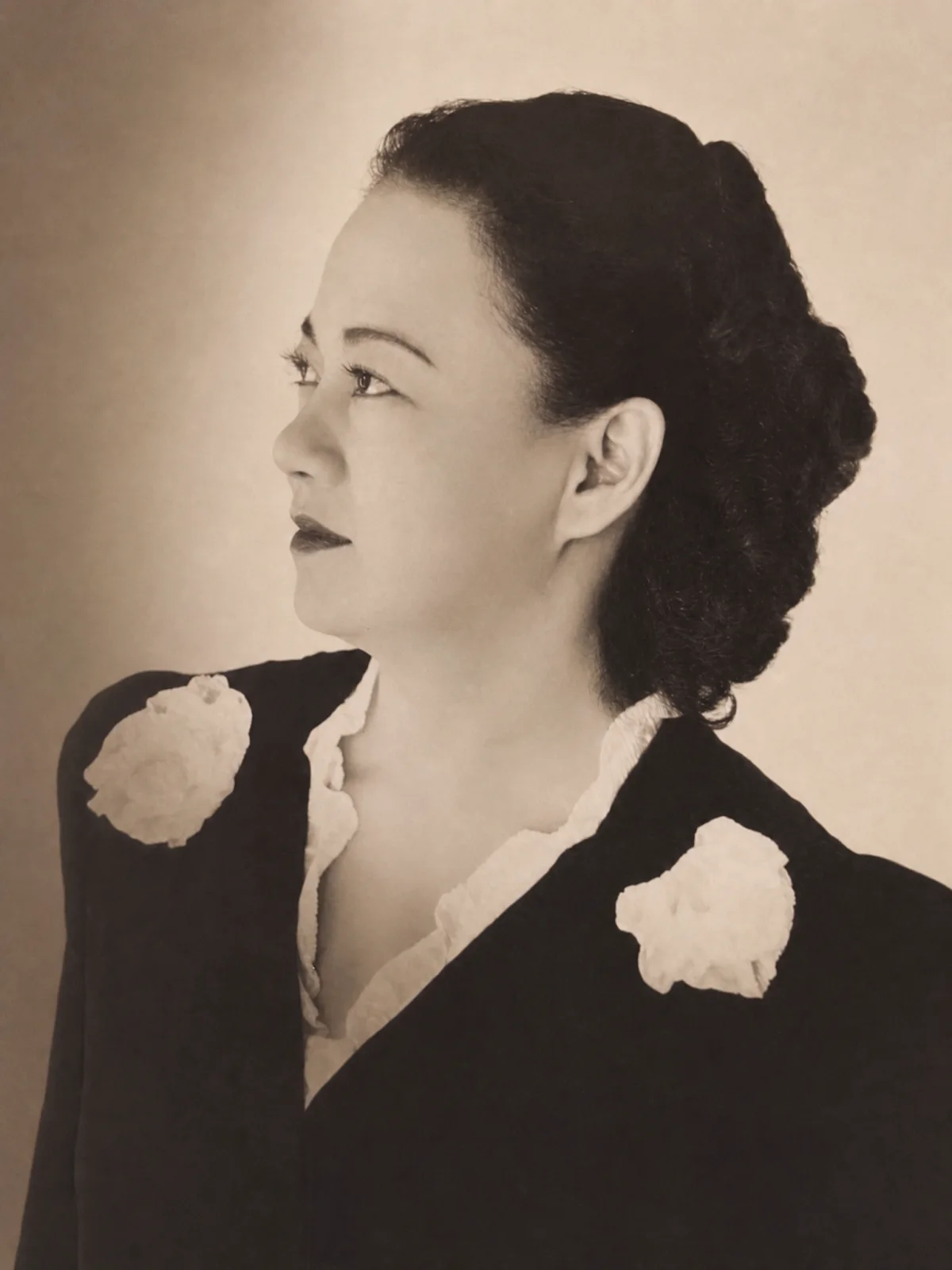
Corito remembered her mother’s foresight. When the war came, Coring had begun quietly buying and storing whatever food she could, and those stores were what kept the household from starving through the occupation.
The aid the household gave the Americans went beyond Ramon’s listening. Through the worst of the occupation, Coring cooked for the men and women the Japanese had locked inside the University of Santo Tomas, the Manila campus the enemy had turned into an internment camp for Allied civilians, and carried the food to them twice a week until the Japanese stopped her early in 1944.67 The family took a graver risk as well. At some point in those years, two American women and two children were hidden inside the Taft Avenue house, fed and kept out of sight while the enemy hunted them.66 These things are known now because a U.S. Army citation set them down after the war, and because the family kept the memory of them.71 They were done in 1943 and 1944, when discovery meant the fort.
Their eldest daughter was fighting the same war from the far side of it. Jenny, the girl Ramon had taken to a Pennsylvania college in 1939, had stayed in the United States when the Pacific closed behind her, and by 1943 she was on the staff of Current History, a world-affairs monthly published in Philadelphia. In the issue of June 1943, she put her own name to an essay, “Japan’s Eleventh Hour,” a cold reading of the empire’s overreach written for American readers and signed M.T.J. Araneta.70 Her father kept a forbidden radio in occupied Manila. His daughter argued the case against Japan in print in an American journal. For most of those years neither could know how the other fared.
In August 1944, three months before the arrest, Ramon paid off the ₱125,000 Agricultural and Industrial Bank mortgage that had been outstanding on the Hacienda Fermina lands since March 1940. The repayment was made in Japanese military notes, the rapidly depreciating fiat currency the occupation regime had imposed in place of the prewar peso. By August 1944, the scrip was already in steep decline; by mid-November rice would cost ₱8,500 a sack in Manila. Whether the timing was a calculated unloading of cash, a sale of inflating notes for a real asset, or simply the conclusion of a long financial cycle is unrecoverable. The legal record simply shows what happened: the mortgage was cleared in August 1944, Ramon was dead in November 1944, and after the war his widow would have to litigate up to the Philippine Supreme Court to establish that the August 1944 payment had in fact retired the debt.30
Somewhere in those Manila months, on a walk near his own house, Ramon ran into his cousin Salvador Araneta on Harrison Boulevard—the broad American-era avenue that ran parallel to Taft and within walking distance of the Araneta gate. The two paused, exchanged whatever passes for greeting between cousins who have not seen each other in some time, and went on their separate ways. Salvador remembered him afterwards as he had always seen him: well dressed, neat, with the manners of a perfect gentleman. He wrote later: “The last time I saw him was during the Japanese occupation, when we met casually while walking in the direction of Harrison boulevard. Weeks later we heard the sad news that he had been taken by the Japanese.”10
The Quezon emissary
The Commonwealth government had, by 1943, been working out of a Washington address for nearly two years. President Manuel Quezon had reached the United States via Australia in May 1942, had reconstituted his cabinet in exile, and was dying of tuberculosis. He kept his line into Manila open by every channel his Washington office could open. One channel was Lt. Col. Emigdio Cruz, his personal physician, a Filipino-American officer of the U.S. Army medical corps. In 1943, Quezon sent Cruz back into the occupied Philippines to take the pulse of the country and reach the men whose judgement he trusted on what needed to be done.
Cruz crossed into the islands by submarine and worked his way up to Manila. Once there, the historian Teodoro Agoncillo would later record in The Fateful Years (1965), Cruz “in succeeding days” met with General Rafael Jalandoni, the prewar chief of staff of the Philippine Army; Chief Justice Jose Yulo, head of the Supreme Court under the Japanese-organized Executive Commission and, through Cecilia, Ramon’s brother-in-law; Ramon Avanceña, who had been chief justice of the prewar Court for sixteen years until 1941; Ramon S. Araneta; Rafael Alunan, the former secretary of agriculture and commerce and the head of one of the senior Negros sugar families Ramon had known since boyhood; and General Vicente Lim, the first Filipino graduate of West Point, who as a young cadet had stood beside Maximo Manguiat Kalaw at the 1912 Filipino Rizal Day commemoration in Washington and was now one of the USAFFE generals organizing the Luzon resistance from the field.59 It was, by any reading, the inner circle of Filipino political and military authority that could still be reached inside the occupied capital.
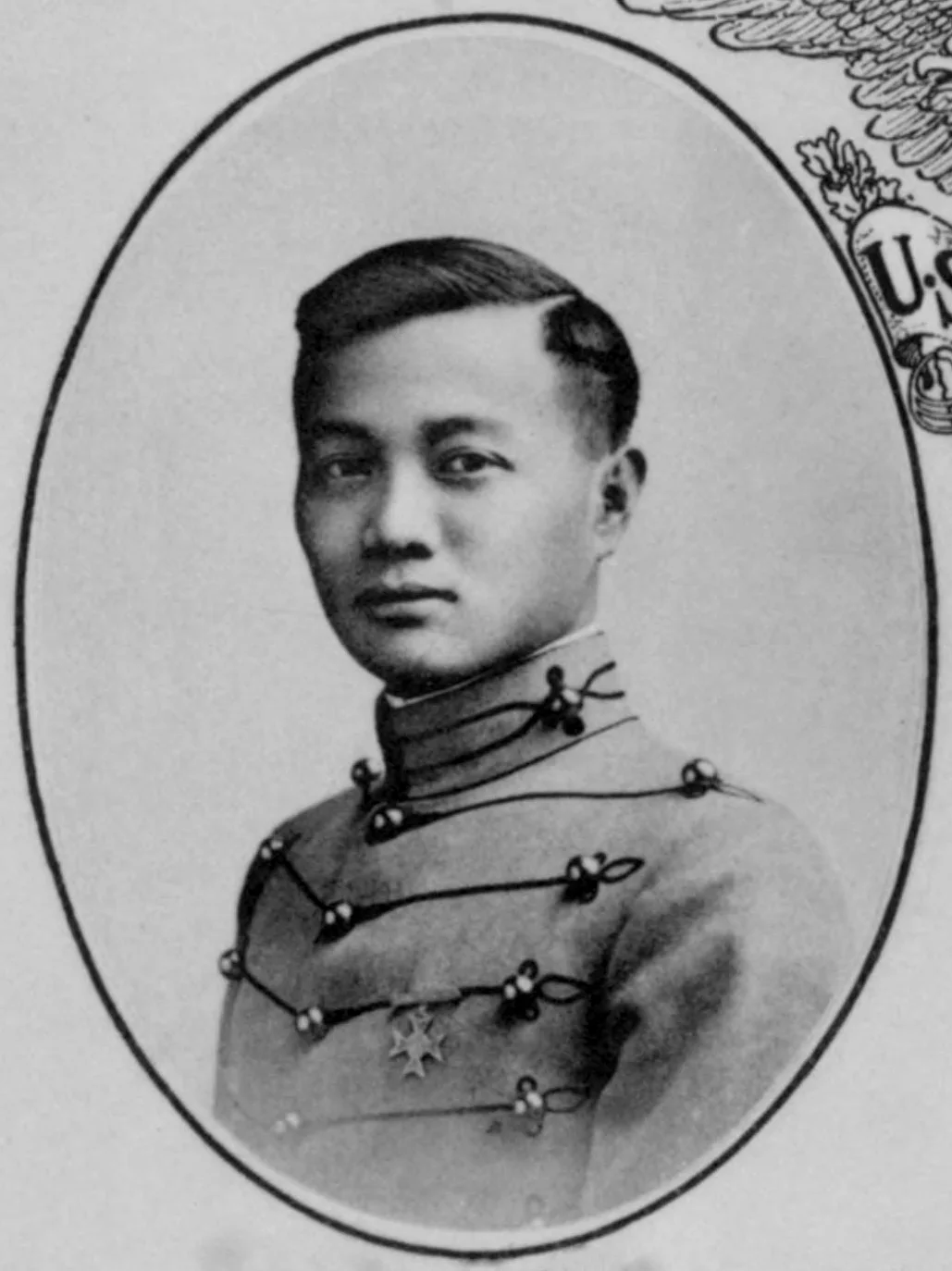
That Cruz met with Ramon, and that Agoncillo names him alongside two chief justices, two generals, and a former secretary of agriculture, places the eldest Araneta brother at a level of the wartime political order that no other document does at this level. The corporate-and-press figure of his generation is named in named company, in a Manila room sometime in 1943, by a secret emissary of the President. Yulo was at the same table. What passed between the six men is not in the historian’s record; only the fact that they were brought together, in the heart of an occupied capital, to take counsel with a man sent on the personal authority of the President in Washington.
Thursday evening, 9 November 1944
Manila in November 1944 was a city counting down. The American return was visibly imminent; U.S. air raids over the Bay had become regular; Japanese fiat scrip was collapsing into hyperinflation; the Japanese had been picking off prominent Manilans through those months at a pace everyone in the city had begun to notice. The Aranetas had moved the short-wave receiver out of the house. Ramon’s secretary had it now.
The men who would come for Ramon were the Kempeitai. The Imperial Japanese Army’s military police corps held a writ that stretched across every occupied territory of the wartime empire. They were not the army’s discipline force in any narrow sense, but its political-and-security arm, charged with counter-intelligence, the surveillance of civilian populations, and the suppression of any organized resistance in any country the Japanese army held. Across the previous decade, in Korea, in Manchuria, in occupied China, they had earned a reputation for cruelty in interrogation that had preceded their arrival. By 1944, they had been three years inside Fort Santiago. Every elite Manila family with a man in any wartime role of any kind knew the pattern: the midnight raid, the subordinates tortured first, the principal taken last, the body returned days later with the cause of death given as cardiac arrest. The choreography of fear was as much the point as the violence itself.
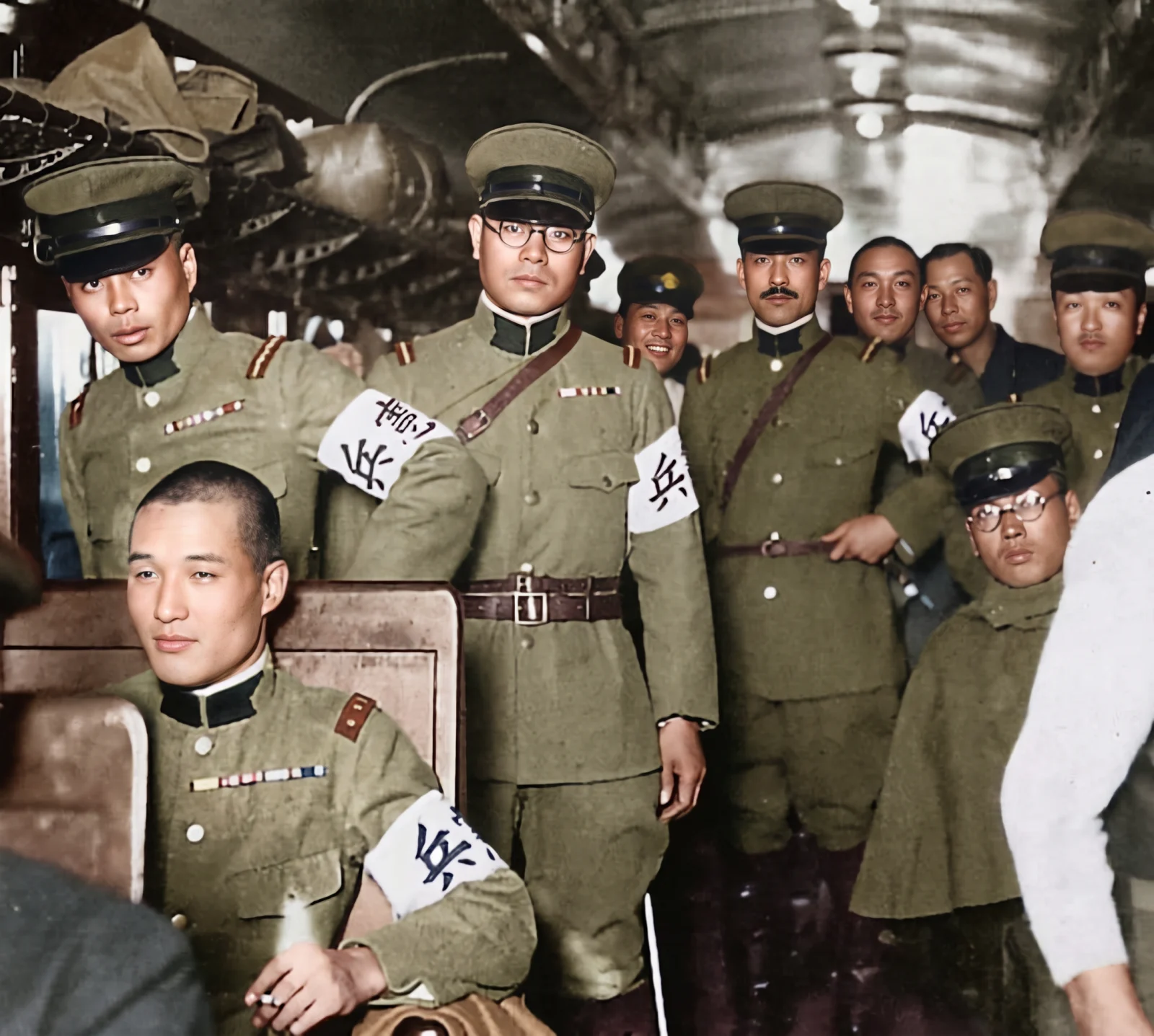
On Thursday evening, 9 November 1944, in Marcial Lichauco’s wartime phrasing, the Japanese Military Police “swooped down on Ramon’s palatial residence and took him into custody.”1 They broke down the door before Coring could find the key. They tied the night watchman. Four Filipino informers searched the ground floor; the Japanese went upstairs and interrogated Coring, the daughters, and the servants. They took ₱40,000 in cash from a drawer. They drank Ramon’s wine, took the canned goods, and emptied the back garden of his chickens, turkeys, and pigs. Then they took Ramon.
They did not take only Ramon. Mary, the American woman who had kept the house, was taken from it the same night. The family never learned what became of her.72
The charge was listening to American short-wave broadcasts. The Kempeitai had a confession to act on. Ramon’s secretary had been picked up some time earlier and tortured into naming him; Ramon had been tipped off in time to move the radio set out of the house but not in time to escape the secretary’s testimony. Corito was suspected as well. The Japanese wanted to take her with her father but changed their minds when she went to dress; one of them told her, “O.K., just stay, we are gentlemen, we take you some other time.” She was nineteen. Felipe Buencamino III, the Filipino intelligence officer whose diary in occupied Manila recorded the night’s events three days later, called her “a very courageous girl.”60
When the house was finally quiet, Coring picked up the telephone and called her sister-in-law Cecilia. Cecilia’s husband, Chief Justice Jose Yulo, was the most powerful Filipino still recognized by the puppet state, and he was Ramon’s brother-in-law. If anyone in Manila could get Ramon out of Fort Santiago, it would be him. Lichauco’s diary records the next move plainly: “Mrs. Araneta, of course, immediately contacted the chief justice who lost no time in exerting his best efforts to obtain the release of his brother-in-law.”1
Forty-eight hours
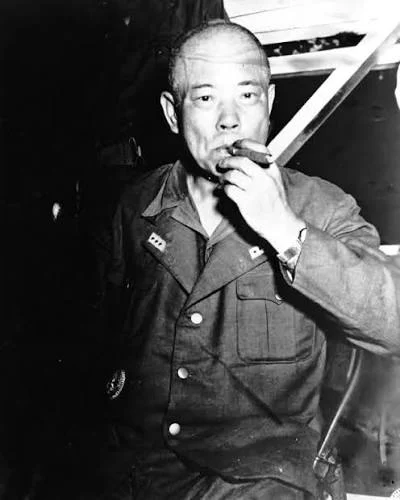
By Friday morning, Jose Yulo was ready to appeal to the puppet state’s apparatus on Ramon’s behalf. Colonel Nagahama, the head of the Kempeitai for the Philippines, was Yulo’s friend in the new order. His was the kind of working acquaintance the postwar generation would find difficult to imagine, but which the occupation made unavoidable for any Filipino still functioning at the top of the state. Yulo brought him the case. The chief justice of the Philippines, husband of one of the Araneta sisters and brother-in-law of the man inside the fortress, asked the head of the secret police for the release of one of his own family.
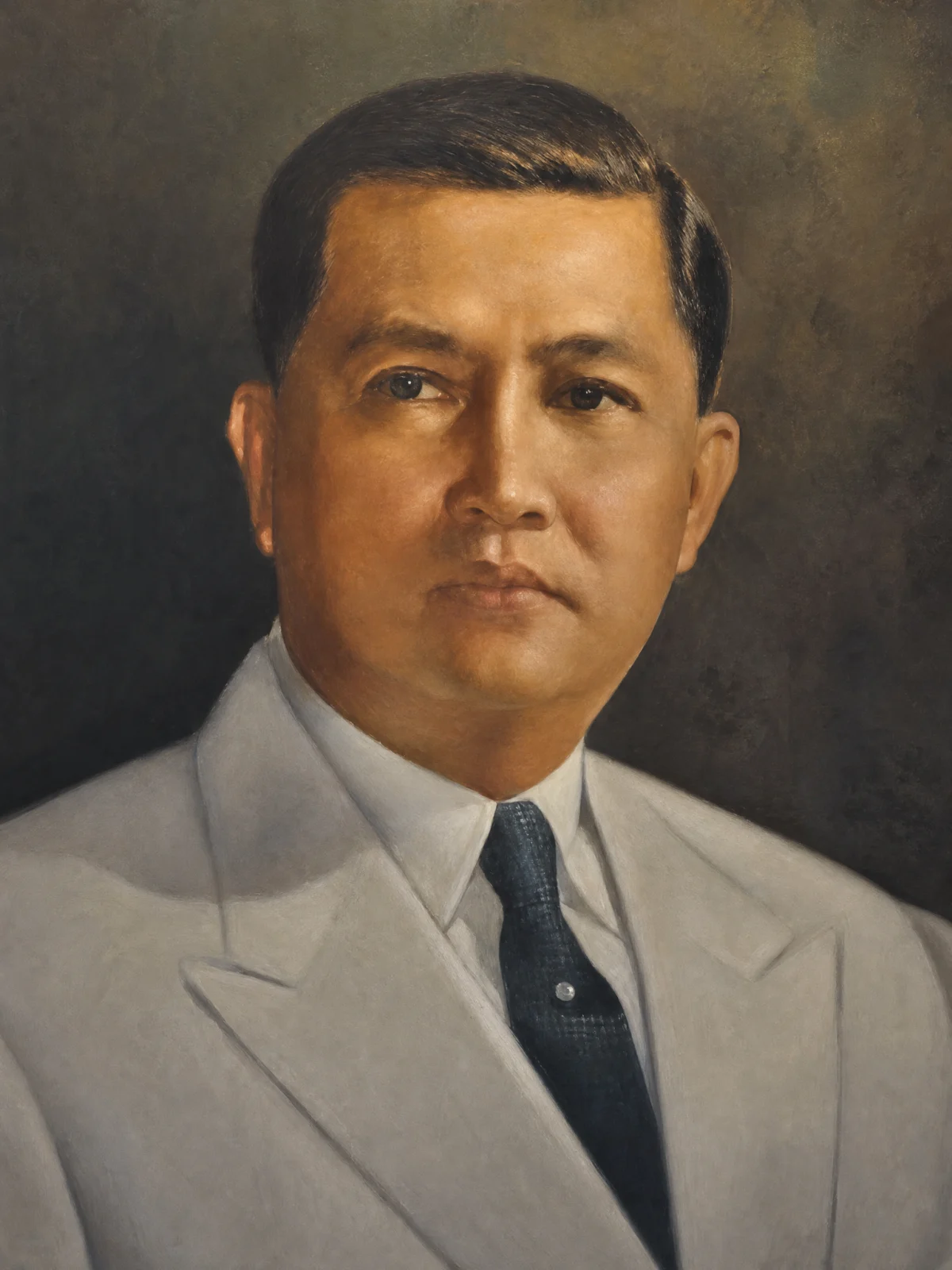
Nagahama promised a prompt investigation. He explained the radio suspicion. He gave no timetable. No charges, in Lichauco’s careful phrasing, had been put forward, “and, as usual, no explanations were given as to the nature of those charges.”1 Friday passed. Whatever influence a sitting chief justice carried under the puppet state did not, it turned out, reach into the cells of the Kempeitai building from which it nominally derived its authority. Yulo had not been deceived in any active sense; the colonel may not have known what was happening in his own dungeons.
By Saturday afternoon, Ramon was dead. The most precise account of that afternoon comes not from the Manila diaries, which would only learn of the death later, but from a witness who was inside the fortress. Sister Mary Trinita Logue, the American Maryknoll sister whom the Japanese had interned at Fort Santiago through most of the occupation, kept the cell directly next to Ramon’s. Her sworn deposition survives in the U.S. Army war-crimes case file opened over Ramon’s death, case 40-401, now held at the U.S. National Archives.56 Taken in Manila in May 1945, it recorded the afternoon in her own words. Questioned by Captain Ward W. Kelley and Lieutenant Lynn B. Griffith, the U.S. Army Judge Advocate officers taking her deposition, she answered:
Q. Were any of these men Americans?
A. No, mostly Filipinos and Chinese. The man who died after the torture was Ramon Araneta.
Q. Where was his home?
A. Manila, Taft Avenue Extension. He was brought in to Ft. Santiago on a certain Thursday, placed in the cell next to me. He was taken for investigation the following Saturday at about 3 p.m. One of the Chinese boys working around told the woman in our cell in my presence that his body was lying in the washroom. That was at 7 p.m. that same night.
Q. You overheard that conversation?
A. Yes.
What she could not see, she heard, in the way information moved among the imprisoned. Sister Trinita knew the fortress from the inside as few witnesses could. She had gone in weighing 175 pounds and would come out weighing less than 100. She had seen the marks of beatings on a certain Sister Brigida and about six other women, and reckoned she had watched about 100 men beaten, with hundreds more during the mass round-ups the Japanese called zoning.
What had happened in the four hours between three and seven was a beating. The postwar autopsy showed contusions around the stomach pit and other marks consistent with sustained blows. The doctors who conducted the autopsy, according to Buencamino, refused to talk “until the day of liberation.”60 The Japanese would report Ramon’s cause of death as cardiac arrest. Almost everyone in Manila understood that the official story was nothing more than fiction. They had read it many times before.
The family’s own account of the method, carried down through Quirino Eleizegui, a colleague from Ramon’s office who was among the men later allowed to bring the body home, ran harsher than the autopsy’s clinical lines. They had torn out his fingernails, forced water into his stomach until it swelled, and trampled him.72 The water and the stomach blows are the two things the autopsy’s contusions quietly bore out.
That same Saturday afternoon, while Ramon was still with the investigators, or perhaps already in the washroom, Cecilia telephoned Coring. She had what sounded like good news. The colonel had given Yulo to understand that the case was nearly closed, and he was inviting Coring for cocktails that evening, the way such cases were sometimes settled. The invitation, a warm and ordinary courtesy, reached her while Ramon was almost certainly already dead.
“This is Fort Santiago”
The phone rang in the Araneta household late on Saturday night. Corito answered. The voice on the other end was Japanese.
“This is Fort Santiago. You come now and get your father.”
“Oh, thank you, thank you,” Corito said, thinking he was being released. “Thank you very much!”
“Very sorry. But your father now dead.”
Corito nearly fainted at the news. When her mother came into the hall and asked what was the matter, the girl pulled herself together, said she had not been able to understand the call, and let Coring go on believing, for some part of an hour, perhaps less, that her husband was still alive. Two contemporary diaries, kept independently by men with no part in the household and both since published, set the call down within days, and they do not agree on the words. The exchange above follows Marcial Lichauco.1 Felipe Buencamino III recorded a harsher call: in his telling the voice said only, “You can take your father now. He is DEAD, DEAD, DEAD…. do you hear me?”60 A third account differs from both, and it is the only one from the person who held the receiver—Corito’s own, as she told it to her granddaughter years afterward. The caller, she remembered, kept telling her she could come and get her father, and when she began to thank him he cut her off: “No, no. I did not say you can pick up your father. I said you can pick up his body.”73 The diarists were writing secondhand, days after the death; Corito was remembering her own night on the line. What all of them set down alike is only the heart of it: a daughter answered, and the fort told her that her father was dead. She was nineteen. Her father had called her Cuchay.
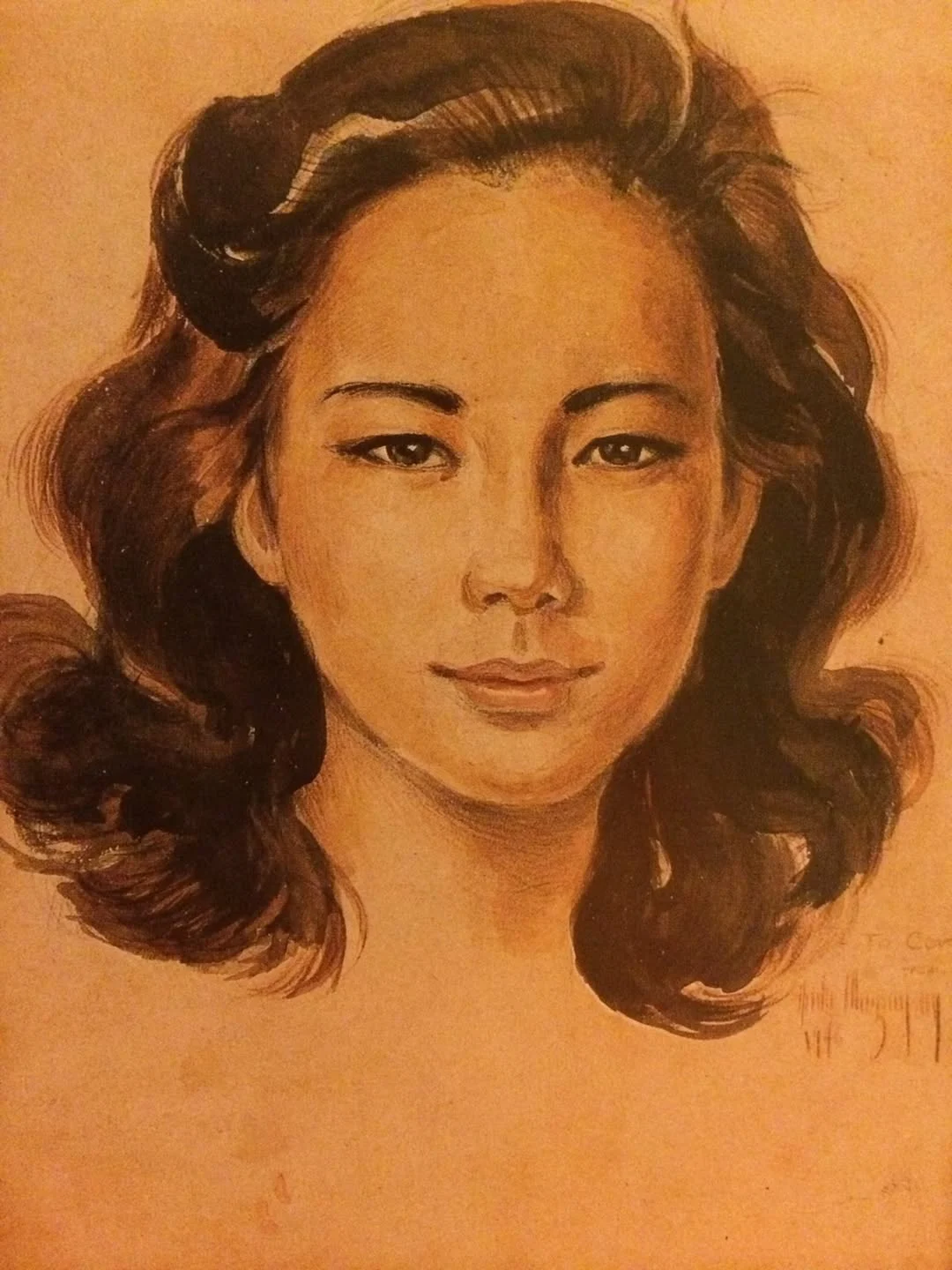
The fortress on the other end of the line had been one of the oldest stone buildings in the city for three and a half centuries. Fort Santiago, the Fuerza de Santiago, was the citadel the Spanish had begun in 1593 at the mouth of the Pasig, the western anchor of the walled city of Intramuros, named for the apostle Santiago Matamoros under whose protection the conquest of the islands had supposedly been carried out. The Spanish had used it as a garrison, a treasury, and a prison; the Americans had inherited it in 1898 and used it for much the same. From January 1942 it had been the Manila headquarters of the Kempeitai. Vicente Lim, of the Cruz consultation list, had been inside the walls since June 1944, picked up at sea on his way to a submarine bound for Australia; he was already under death sentence somewhere in the same complex in the days that Ramon was beaten.
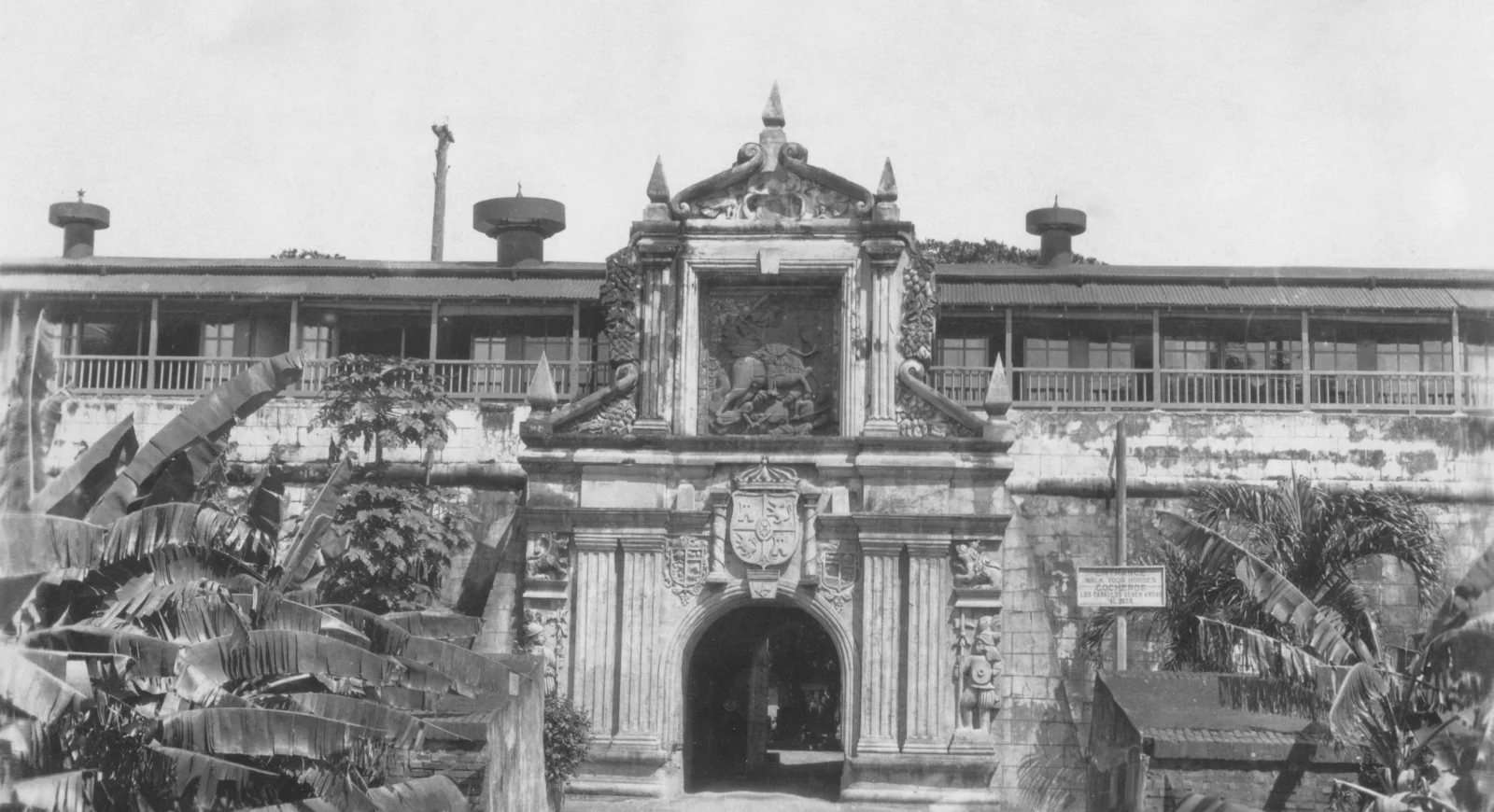
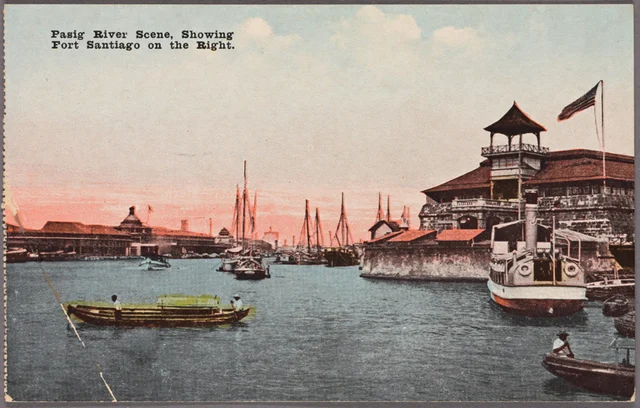
On Sunday morning, five of Ramon’s friends went to claim the body, their way into the fort opened by his brother-in-law the chief justice and by Colonel Antonio Torres of the Manila police.71 They were Minister Arsenio Luz, who had stood with Ramon on the 1936 founding committee of the Manila Stock Exchange; Peping Corominas, an old friend of the family; Juan Chuidian, Coring’s relation by blood; Dr. Antonio Vasquez, who had known the household for years; and Quirino Eleizegui, a colleague from Ramon’s office. The Japanese had trouble understanding why the men had come and made them wait for an officer who could follow English. Then one of them led the party into a room. Ramon was on the floor, stiff, in a dirty sweater. Luz lost his composure and shouted in Spanish, “Esto no puede!” (this cannot be), until Dr. Vasquez silenced him. Corominas, who had been imprisoned in the same fort once before, said nothing. He looked at the Japanese officer in the room, and the Japanese officer looked back. He kept looking, Buencamino wrote, “spoke a thousand words by his silence,” and after some moments the officer dropped his gaze. The men carried the body out.60
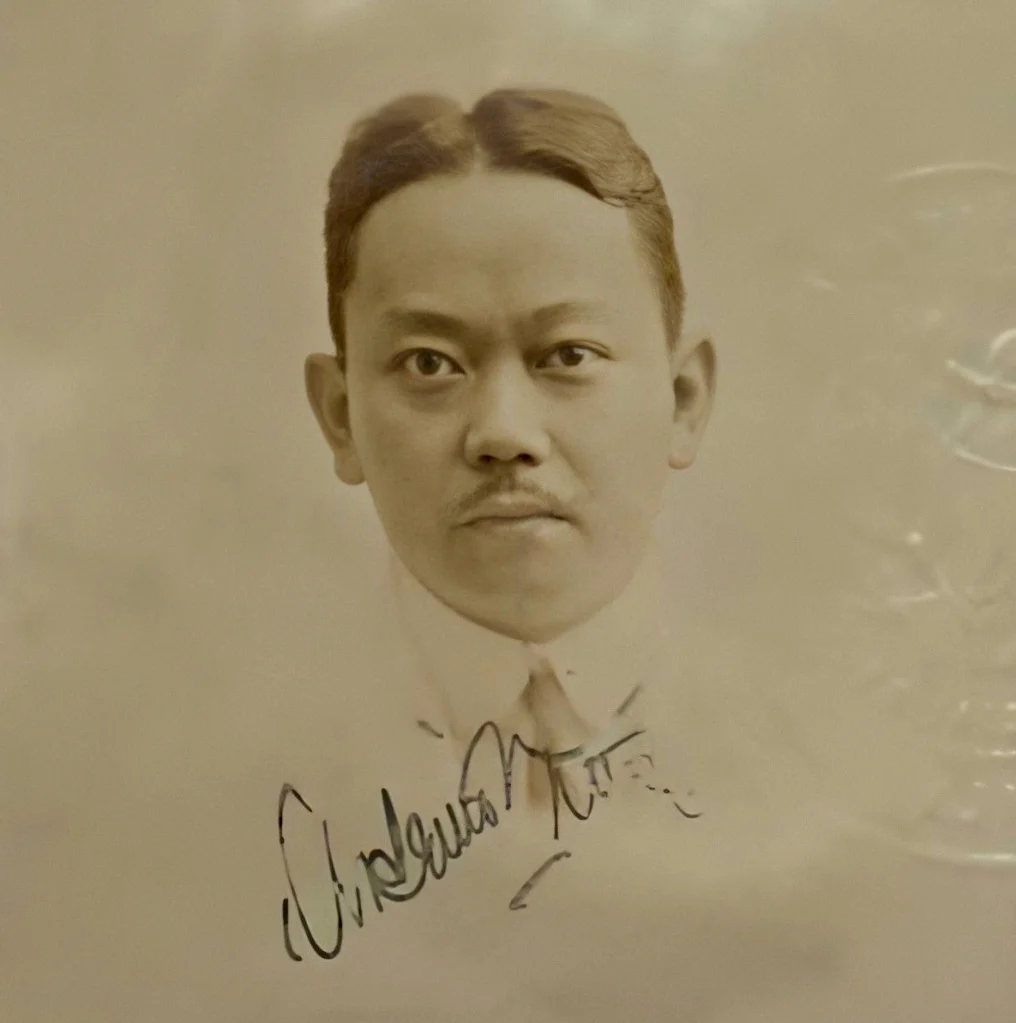
The interment was hurried. Cecilia and her husband came down from Peñafrancia for it; Coring buried Ramon within the days the Kempeitai allowed for the rite. He lies today in a niche at the Minor Basilica of San Sebastián in Quiapo, beneath a marble plaque his wife and daughters set there.75 And the family’s memory of him among the heroes of Fort Santiago is written in stone as well: his name is cut into the fort’s Honor Roll, the tribute a grateful nation raised to those it had held, where Ramon Araneta stands among the named and the hundreds of unknown heroes who resisted the enemy.76 A 1981 biography of Speaker Jose Yulo would later name the method by which Ramon had died and treat it as a fact requiring no qualification. The torture, the book said, was the water cure.8 It was a technique the Kempeitai had brought to Fort Santiago from elsewhere in the empire and applied with the regularity of a method, and one which left exactly the autopsy pattern the Araneta examination would record.
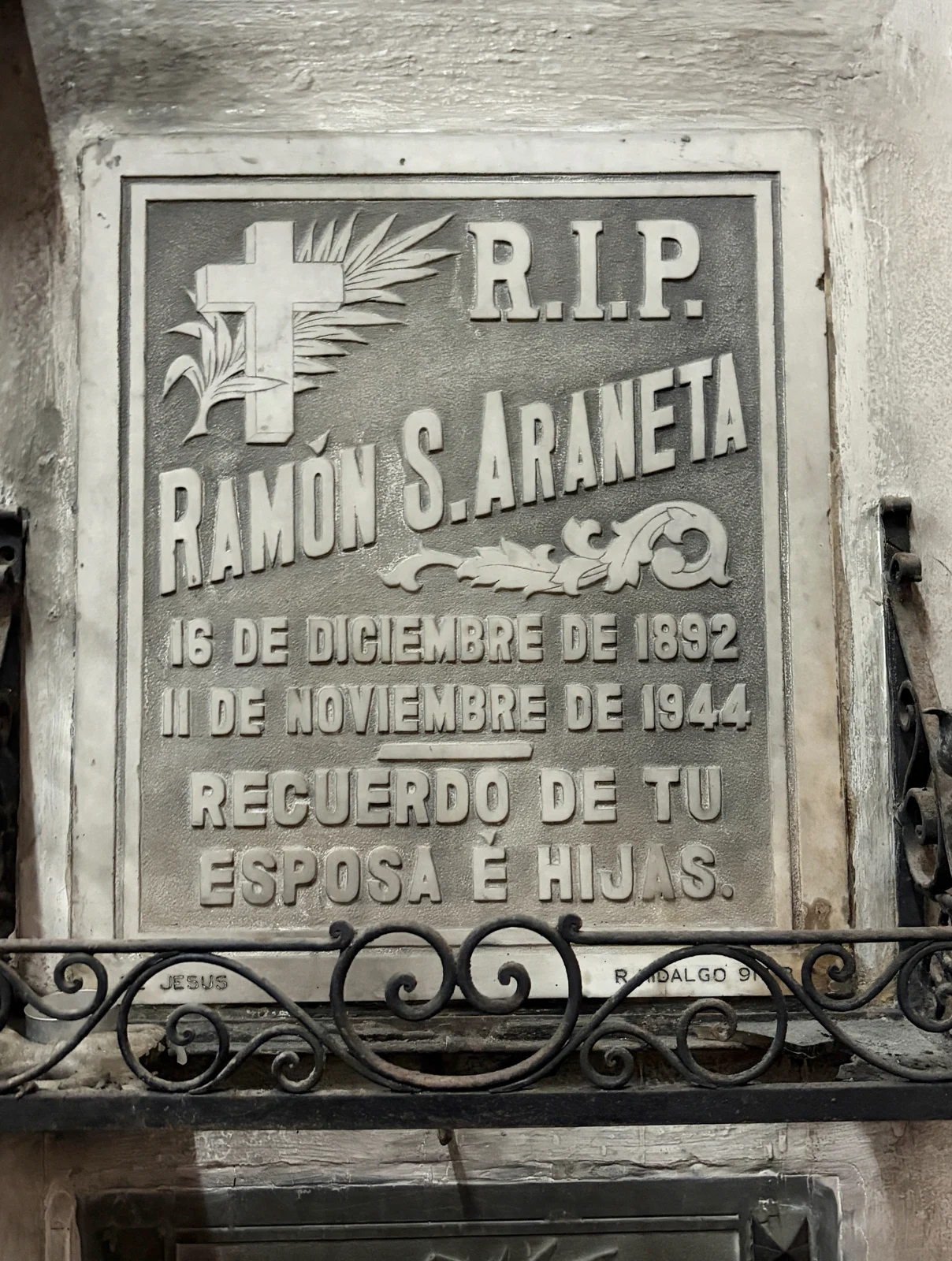
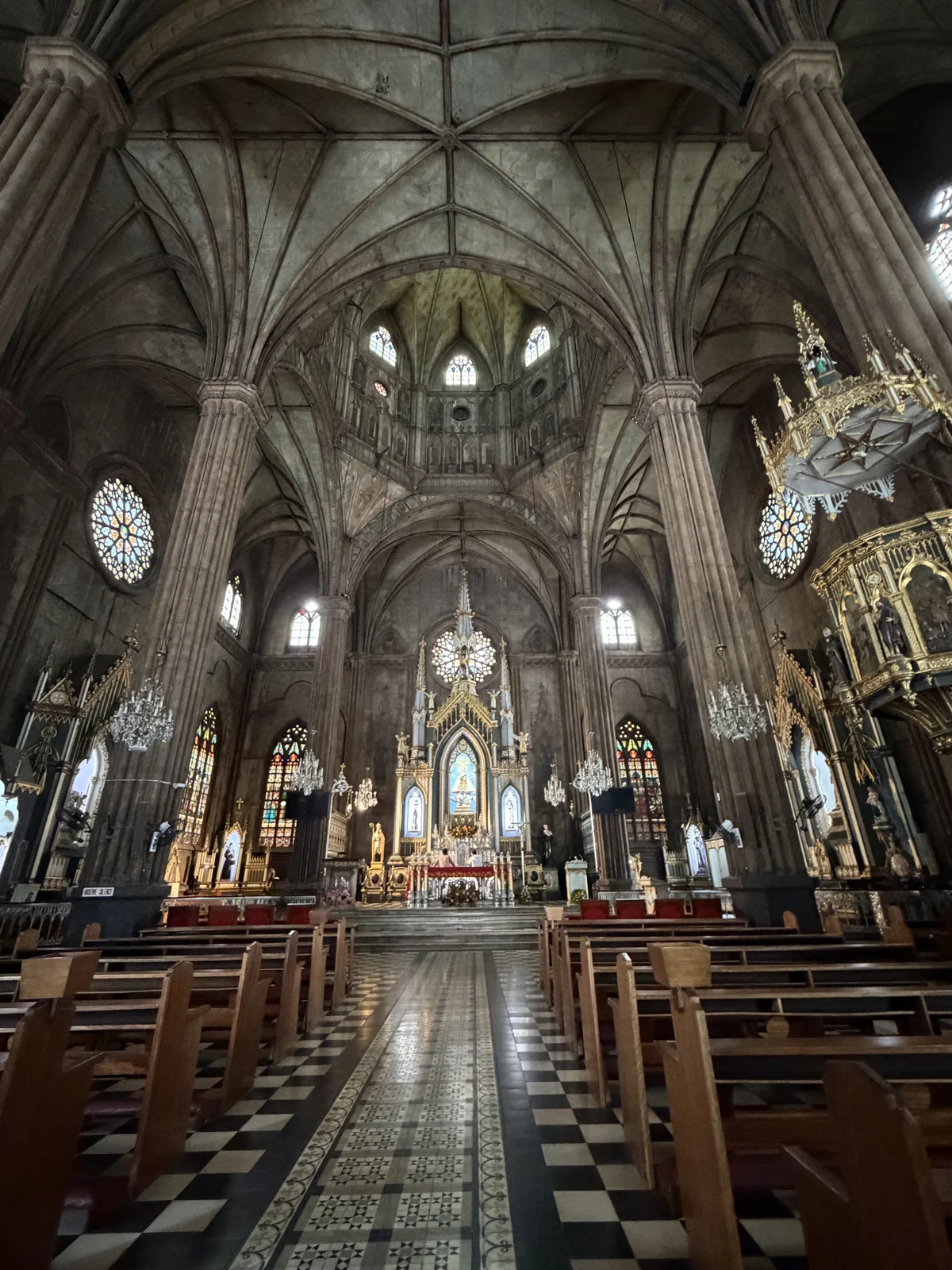
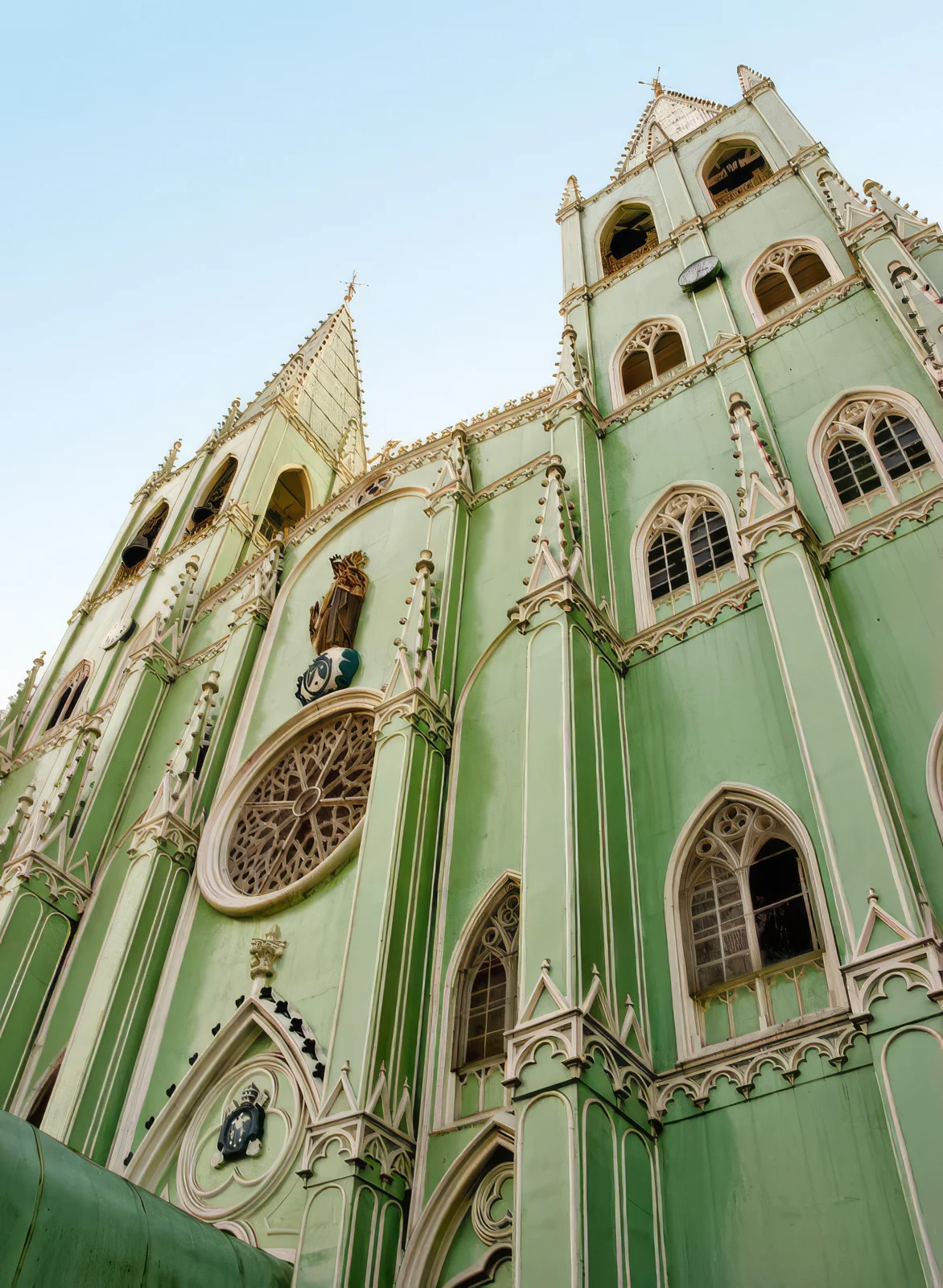
One of Ramon’s daughters did not learn of any of this for some weeks. Jenny was in Pennsylvania at a Catholic women’s college her father had escorted her to, by way of Honolulu, five Augusts earlier. The Pacific war had cut her off from her family ever since. Coring wept when she thought of the girl returning eventually to a household that no longer had a house or a father. The cable would reach Jenny by some channel, in someone else’s country, on her own.
On Tuesday afternoon, three days after the retrieval of Ramon’s body, the U.S. Army Air Forces flew over Manila. A bomb fell in the Araneta garden, the spacious one between the house and the Hernaez residence, and partially covered the building with earth, breaking some of the windows. By that week the Imperial Japanese Navy had let the family know that they would be taking the house at 3060 Taft Avenue Extension; Coring and the two younger daughters were packing what could still be carried. Outside, Manila was a city in collapse. Sugar was ₱14,000 a bag. On the same Taft Avenue, on the other end from the Araneta gate, an anonymous man lay dead behind City Hall. Lichauco bicycled past him on a Thursday morning and again two days later, the body still uncollected, swarming with flies, in plain view of Mayor Guinto’s fourth-floor window. The bomb in the garden, in retrospect, was the easier news to take.
Vengeance is in every heart
Felipe Buencamino, writing on 12 November 1944, placed Ramon’s death in a sequence. Through the autumn the Kempeitai had been picking off Manilans of standing. “Teddy” Fernando had gone first; then Almazan; then Carlos Preysler, the prominent businessman and clubman; then Ramon. Four men in something under three months.60 The pattern was visible for anyone keeping notes.
The Preysler case sat in Lichauco’s diary one entry before Ramon’s. A friend dispatched to identify Preysler’s body at Fort Santiago could not recognize the dead man and had to summon the family to confirm the corpse. There was nothing left of poor Carlos, Lichauco wrote, but skin and bones; three of his ribs were broken, his face and body badly lacerated, and what had apparently put an end to his sufferings was a blow that cracked the base of his skull.1 The Kempeitai’s official line was that Preysler had died of natural causes. Ramon’s body, when it came back the day after his death, was returned in a condition that allowed the same fiction to be repeated—but allowed it only just. The autopsy contusions told the truer story to anyone who came close enough.
The pattern did not end with Ramon. On the last day of December 1944, seven weeks after Ramon’s death, the Kempeitai took Vicente Lim and roughly fifty other men from the cells of the fortress and trucked them to the Chinese Cemetery on Manila’s northern edge. There was a long pre-dug trench. The fifty were made to kneel beside it. They were beheaded, and the bodies were pushed in. The Lim family would not learn how he had died for fifty years; in 1994 an American intelligence agent who had been in the Philippines through the war finally told them.61 He had been on the same Cruz consultation roster as Ramon, eighteen months earlier.
Buencamino, writing in the week of Ramon’s death, recorded that the Kempeitai’s calculation had failed. The intention had been to intimidate, and the effect had been the opposite. More of the young men were going to the hills than before. “Vengeance is in every heart,” he wrote.60
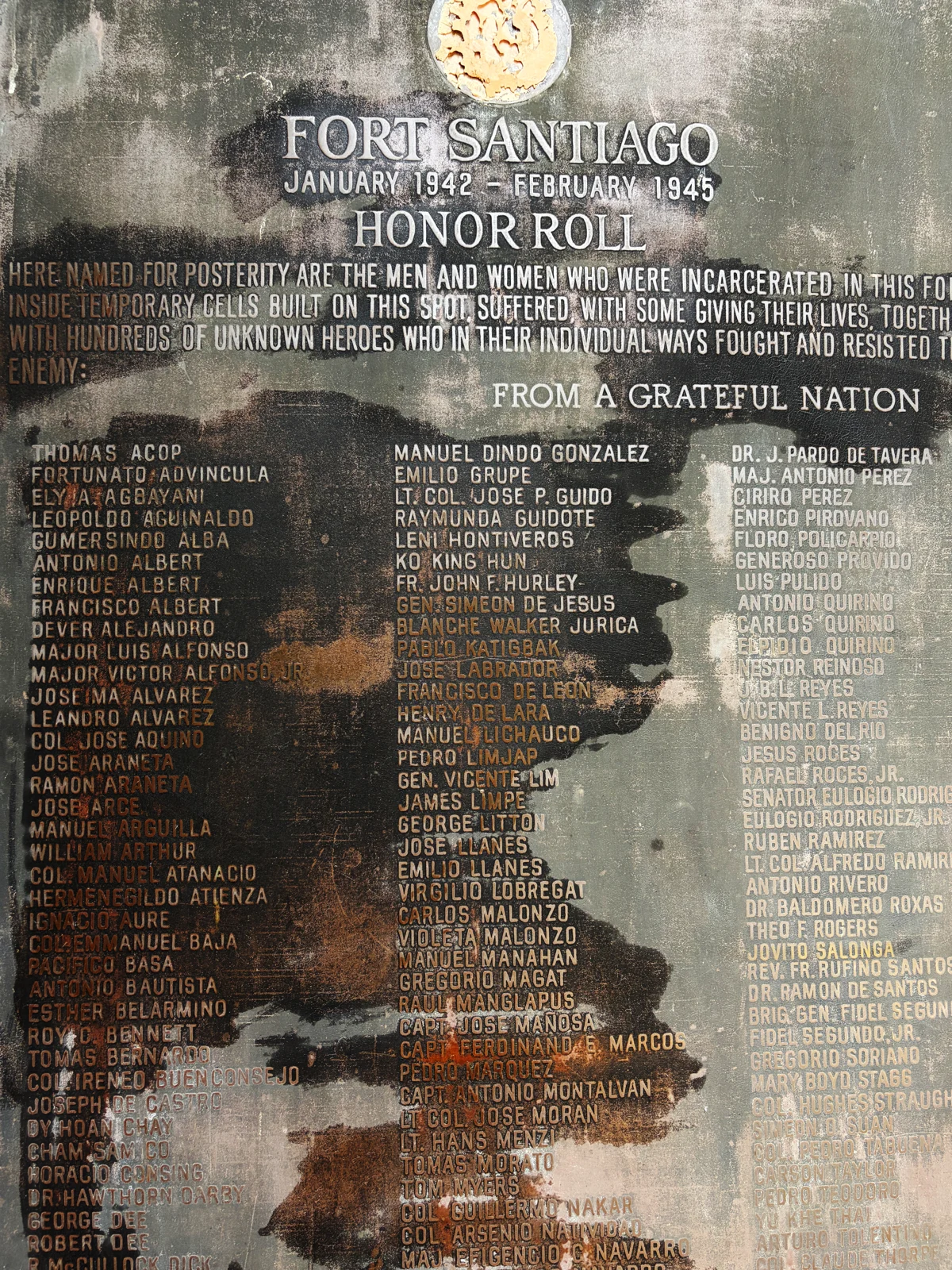
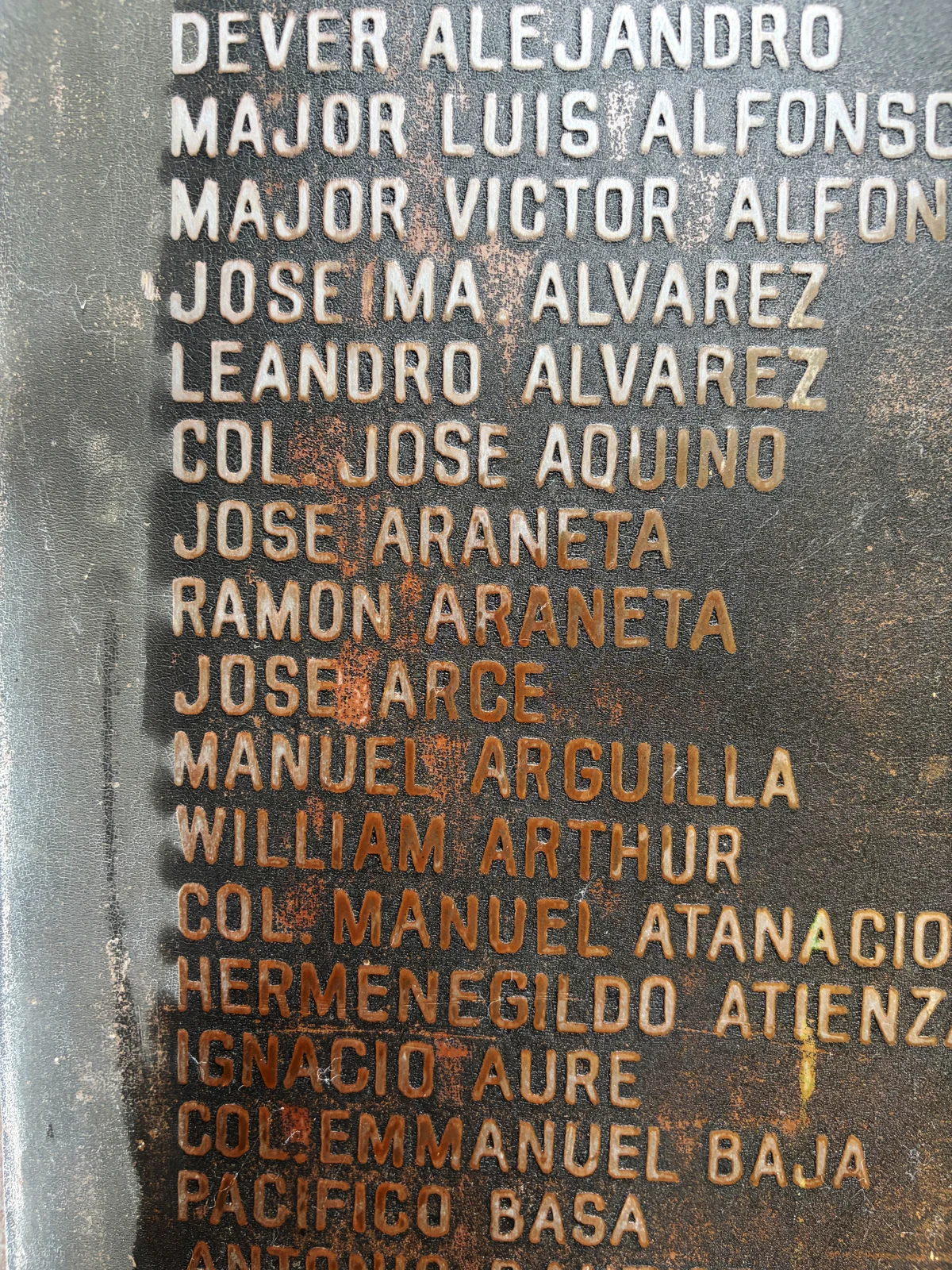
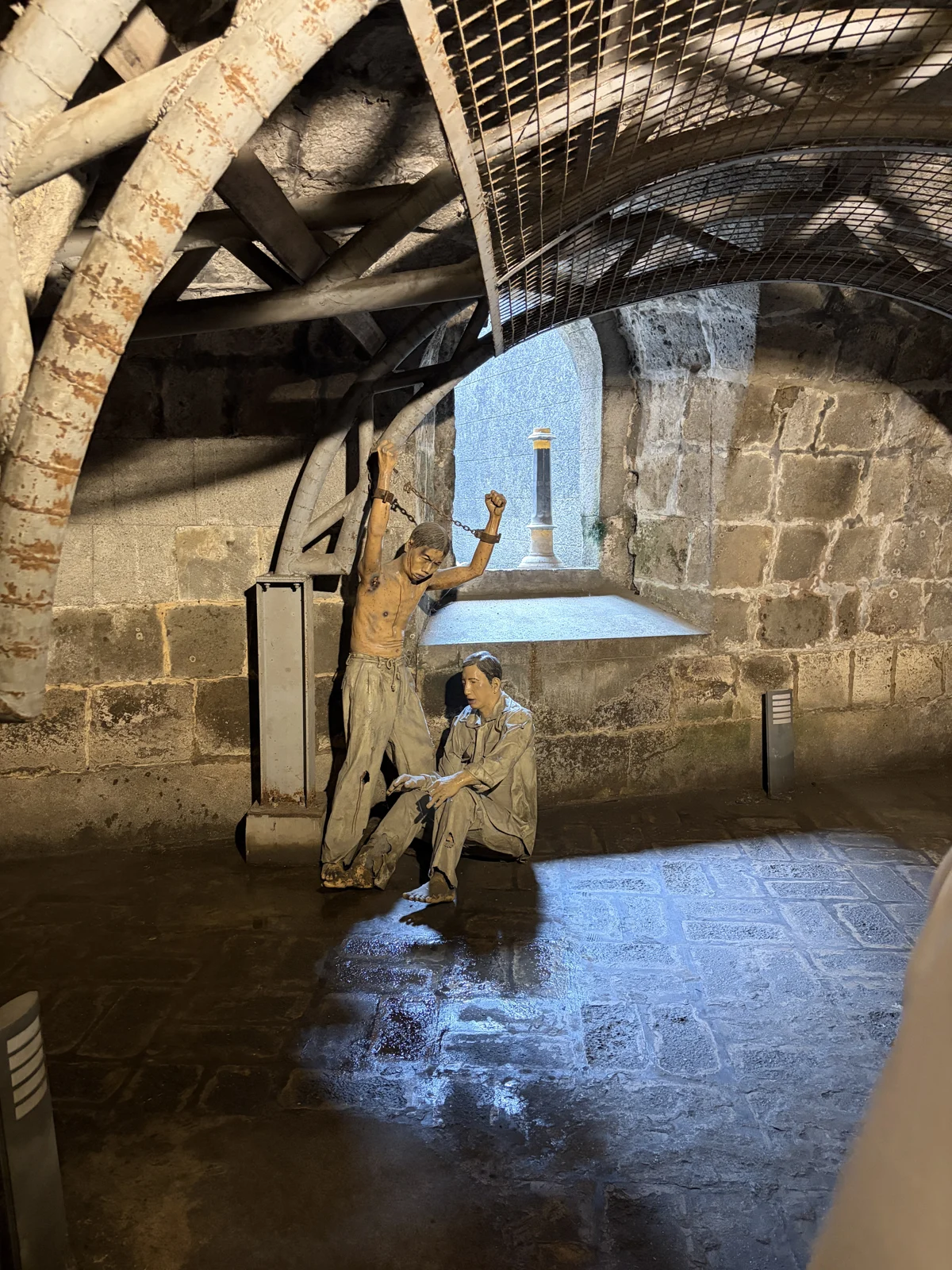
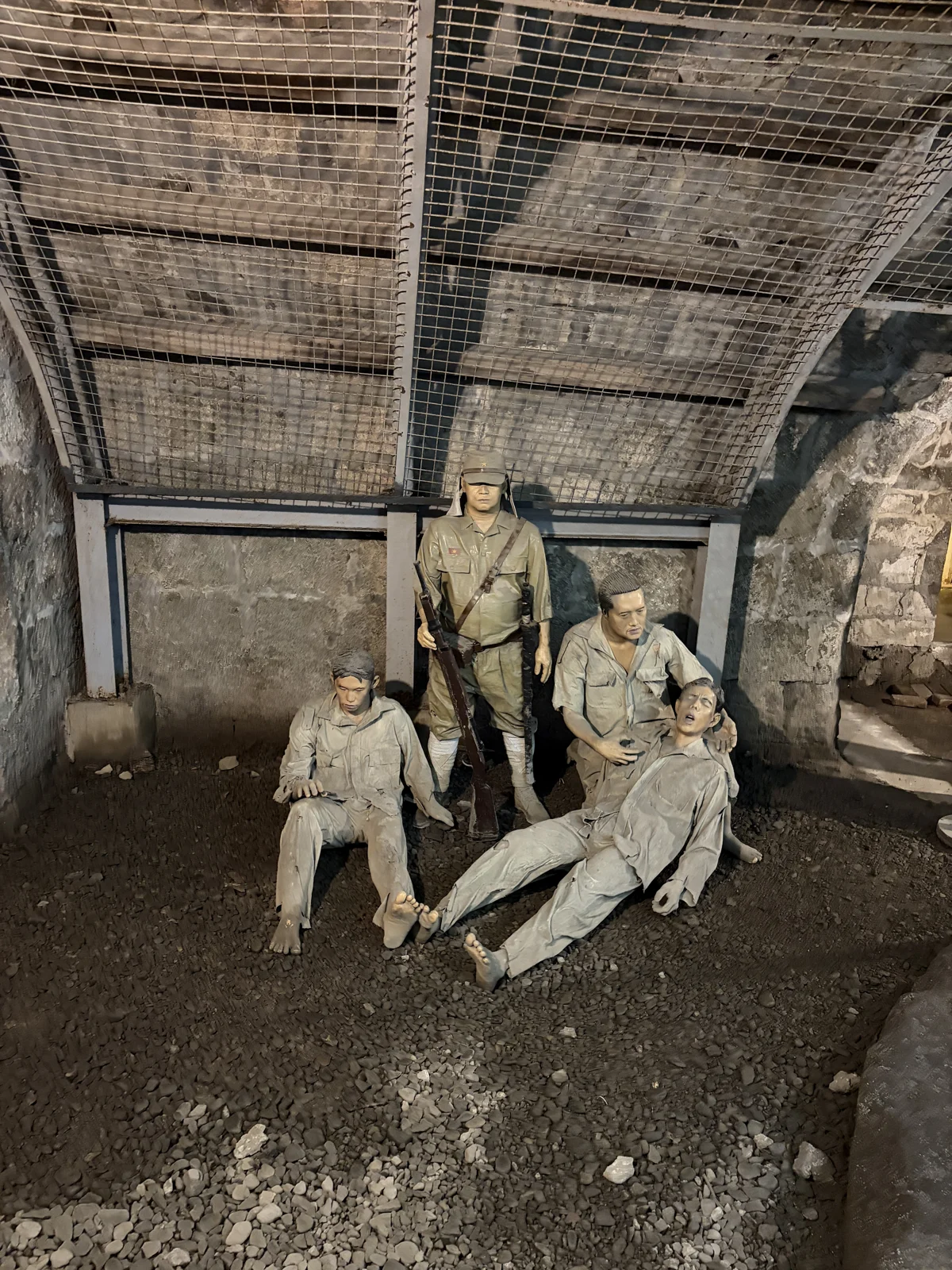
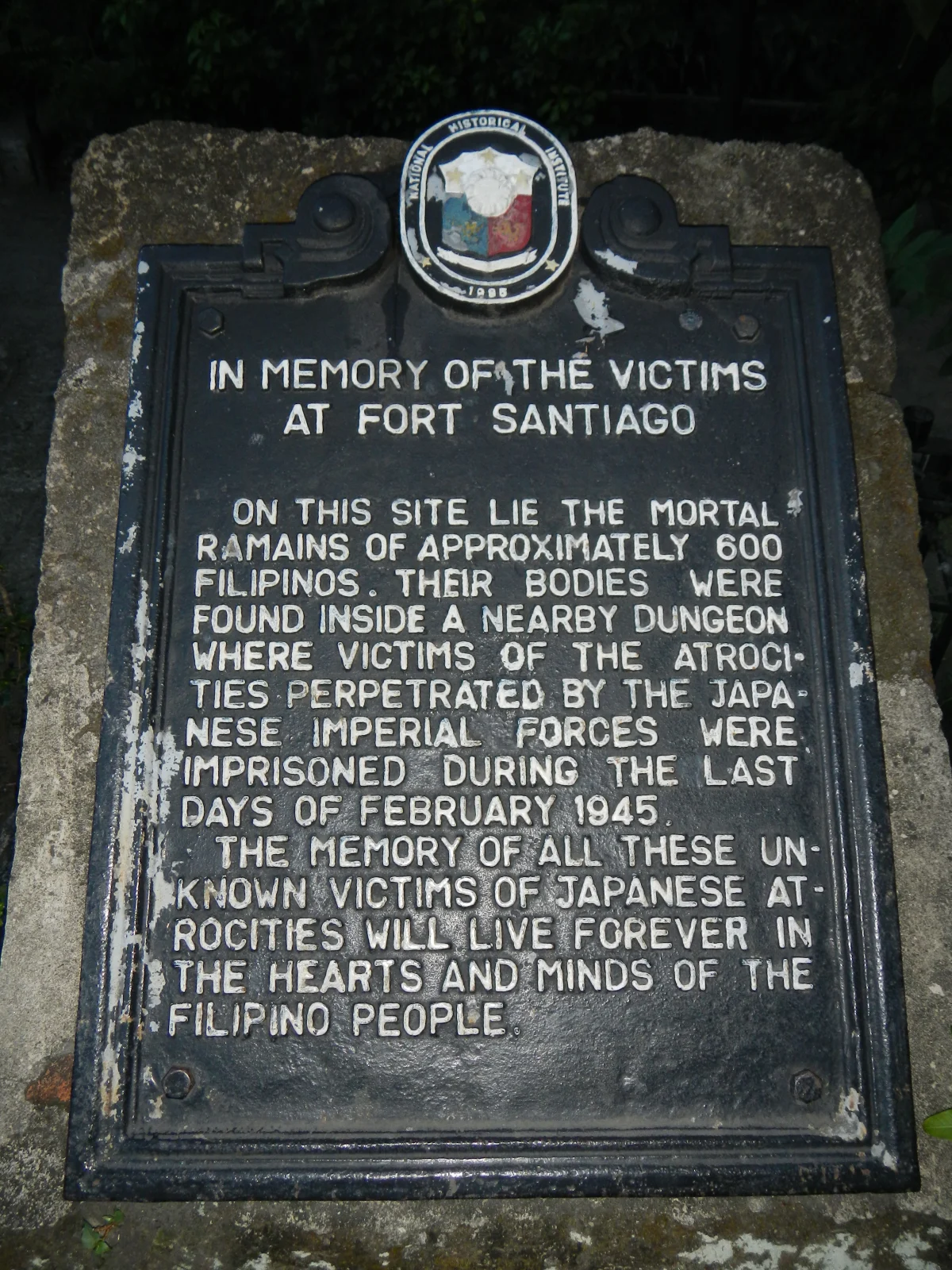
What the war left
In the weeks after the funeral Coring moved her younger daughters into Cecilia’s house, the great Yulo house at Peñafrancia in Paco, which had taken in much of the wider family through the occupation. The household was already on harder ground than it had been a month earlier. Ramon’s death had given the Japanese a fresh reason to watch his brother-in-law, the chief justice. The Kempeitai’s standing assumption about Jose Yulo, that he had been useful to the resistance through his own quieter channels, had become a working hypothesis after the Araneta funeral. The guarding at Peñafrancia tightened. Sentries were now visible from the windows of the house Coring had moved into. The Japanese state had not finished using the household, either. On the lower floor of the same house, by some assignment the family never explained, lived a senior officer of the Imperial Japanese Army. He was an educated man, the daughters were told, who had read at one of the English universities; in time he sent up an invitation to Coring to take her meals at his table, and she went down. The arrangement was the kind that the occupation produced without warning, civility carried on across the worst possible distance, a Filipino widow with her husband three months in the ground dining with one of the army that had killed him. At war’s end, he would write a letter on her behalf to protect her family, and the family would keep the letter. The household remained unsafe, however. Corito would tell her children what happened to her on the stairs one morning. She was on her way down when she saw a Japanese soldier standing at the foot of the staircase, watching her come. When she reached the bottom she thought better of it and turned to go back up, and as she turned the soldier kicked her in the back and sent her sprawling. She was badly frightened, but she said nothing, picked herself up, and went on her way. Cecilia’s husband Jose Yulo, the chief justice who had not been able to save Ramon, told the family that this had to stop. The Yulos would go up to Baguio just in time to avoid the carpet-bombing that would commence that April. Coring refused. She would not leave Metro Manila, and she said so plainly enough that her brother-in-law abandoned a scheme of having himself ostensibly kidnapped by the guerrillas as cover for the family’s flight, on the grounds that the Japanese would take it out on the relatives left behind. She kept the two girls with her and held her ground in the city.
The Battle of Manila began on 3 February 1945, three months after Ramon was carried out of Fort Santiago. The Sixth U.S. Army entered from the north; the Japanese garrison fought house to house through Intramuros and through the southern districts; American artillery flattened block after block; the Japanese murdered as they retreated. By the time the city was declared secured on 3 March 1945, perhaps a hundred thousand Filipino civilians were dead and most of Manila south of the Pasig was rubble. Ramon’s Manila office on the Escolta, with its papers and contracts and the deed of cancellation he had bought with Japanese military notes in August 1944, burned with the rest of it. Cecilia’s house at Peñafrancia, where the daughters had lived and where the Imperial Japanese officer had taken his meals downstairs, was leveled and burned in an exchange of artillery fire and lost, with the rest of its block, in the February fighting. The Araneta house at 3060 Taft Avenue Extension, in the southern stretch of the boulevard, came through. It was one of the few houses left standing in south Manila when the city was declared secured, a fact the Olivera biography would later record with the small wonder it had earned at the time.8 The bomb in the garden of the previous November, the murdered man behind City Hall, the Japanese guns on the Peñafrancia terrace, the carpet bombing of Baguio that had carried off the Yulo branch—Coring and the two girls had stayed under the house in Pasay and the house had held. When Cecilia Yulo came down from Baguio with her surviving children and found her Peñafrancia compound a ruin she came to Taft Avenue, and her sister-in-law took her in.
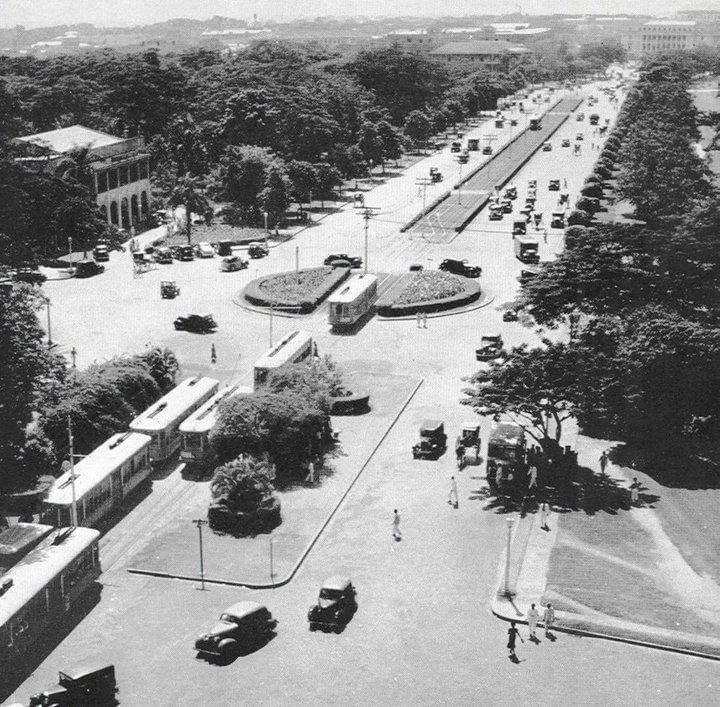
Coring emerged from the war as the head of the family. By September 1945 she was registered at a Pasay address and paying her residence tax there. By 20 February 1946, she signed her first postwar mortgage in her own hand as Socorro C. Vda. de Araneta—the widow of Araneta—the Spanish form that would now be her name.62 The loan was for ₱10,000 from the Agricultural and Industrial Bank, drawn against the family’s sugar quota and earmarked for palay-land improvement, agricultural implements, and the rebuilding of laborers’ housing at Hacienda Fermina. The Bago canefields, the world she had married into in 1920, were now hers to keep going.
A different kind of reckoning came in 1948. On 23 January of that year the General Headquarters of the U.S. Far East Command, by direction of the President, conferred on Ramon a posthumous Medal of Freedom with Bronze Palm for the wartime service this account has already described, the aid to the interned Americans and the sheltering of the hunted.66 Coring received the same decoration in her own name the same day, cited for the food she had carried to the Santo Tomas internees.67 Theirs was the bronze palm, the third of the award’s three grades, given in a mass conferral General MacArthur announced that month for seventy-three recipients.68 The family would remember the honor in later years as a Bronze Congressional Medal of Honor. The papers that came in the mail named it the Medal of Freedom.
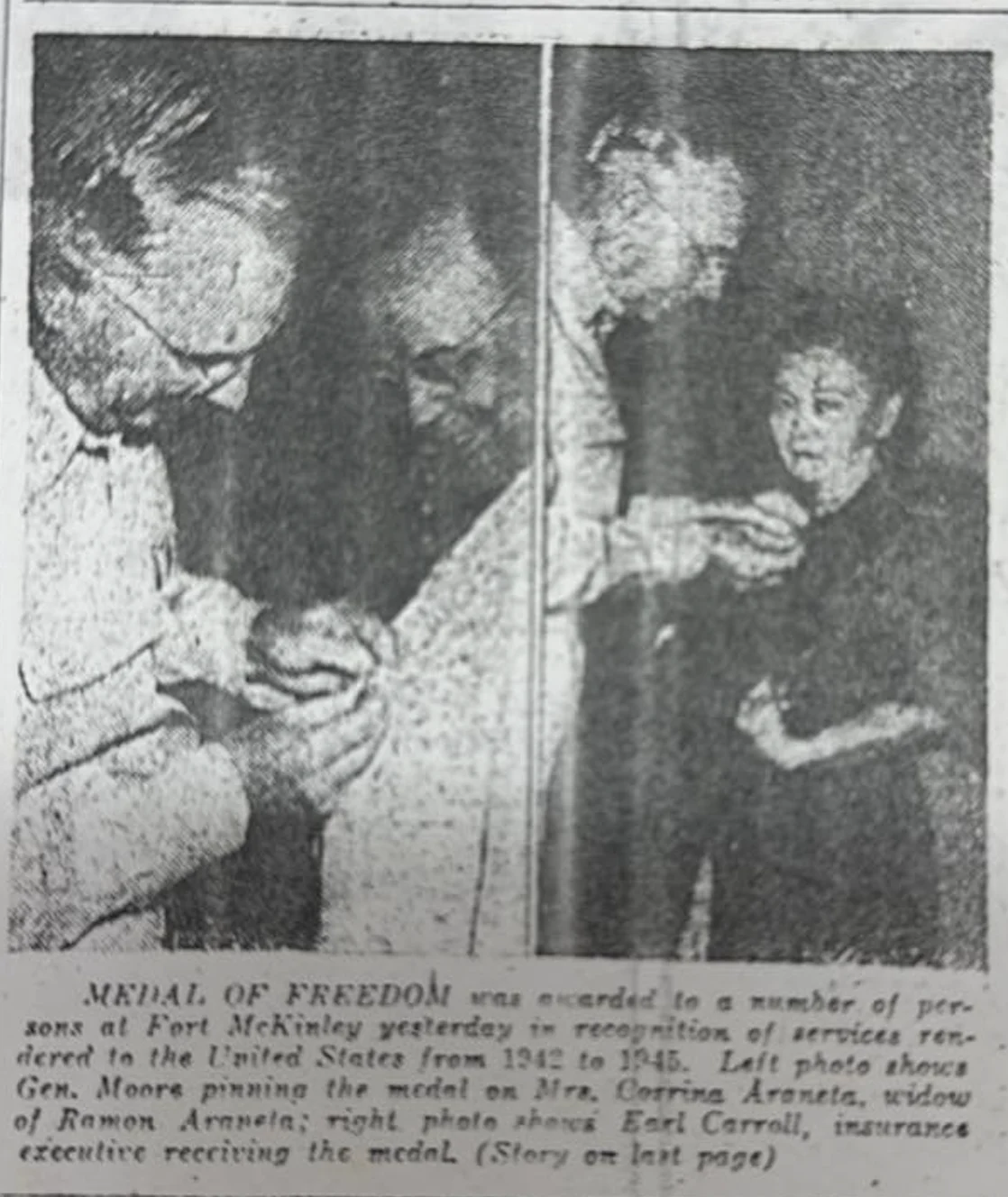
In 1949, the Supreme Court took up the lingering ghost of her husband’s death with a financial cleanup. The Rehabilitation Finance Corporation, postwar successor to the AIB, was claiming that Ramon’s August 1944 repayment in Japanese military scrip had not in fact retired the ₱125,000 mortgage on the Hacienda Fermina lands. Coring, as administratrix, took her case to the Court. Socorro C. Vda. de Araneta vs. Rehabilitation Finance Corporation, G.R. No. L-1438, was decided on 11 August 1949 by the Court en banc, Justice Bengzon writing. The decision recorded one of the small unrecoverable facts of the family’s wartime history almost in passing: “the corresponding deed of cancellation… was lost in the office of the deceased in Manila during the Liberation.” On the substantive point, the Court ruled for the widow.30 The August 1944 payment had retired the debt.
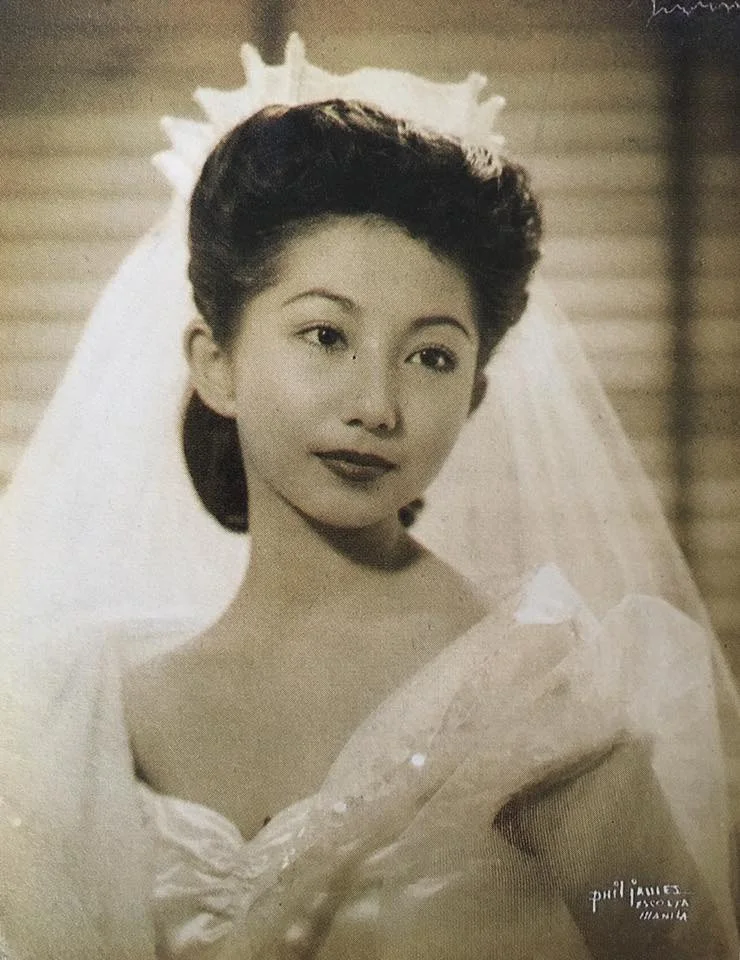
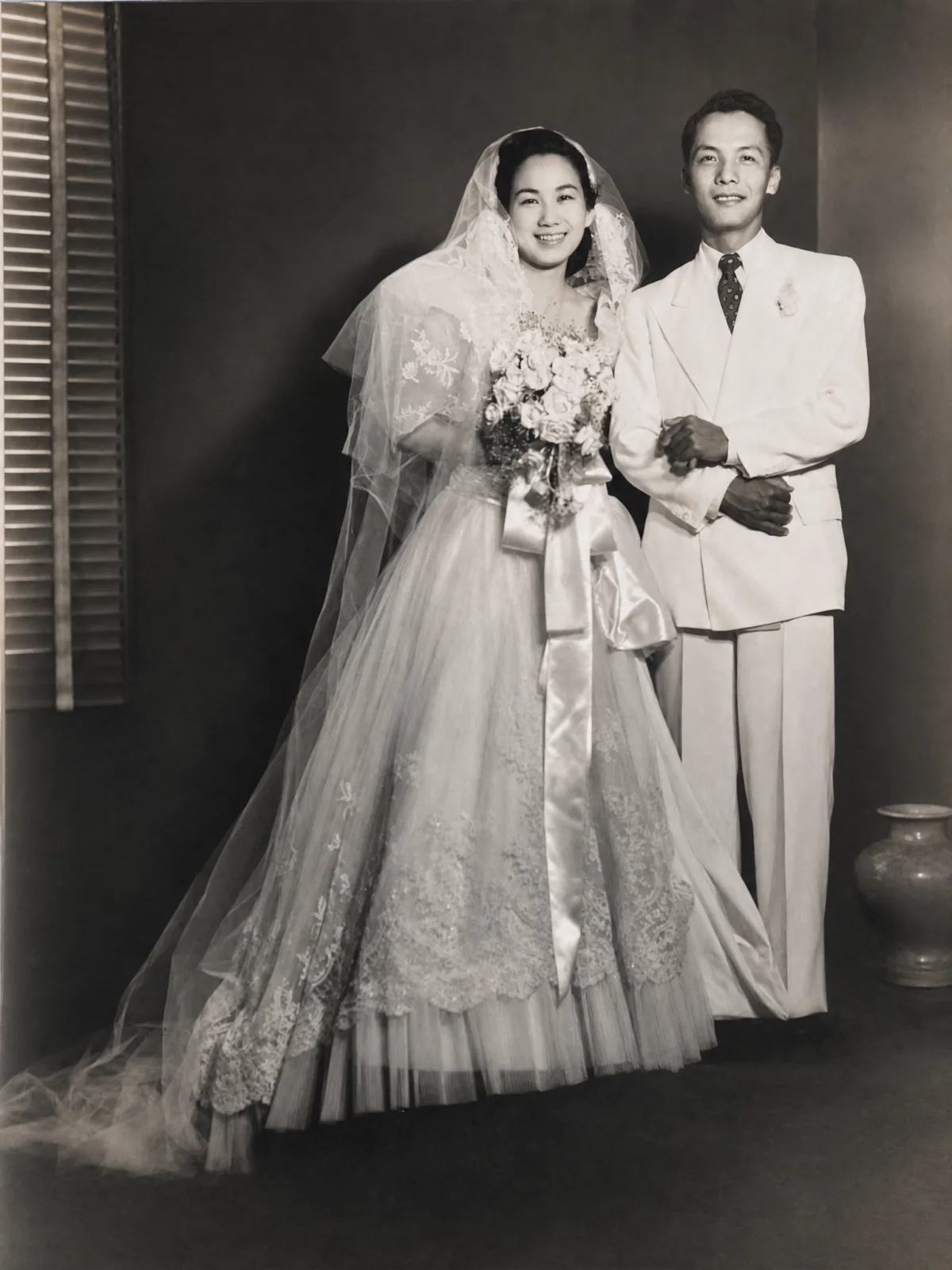
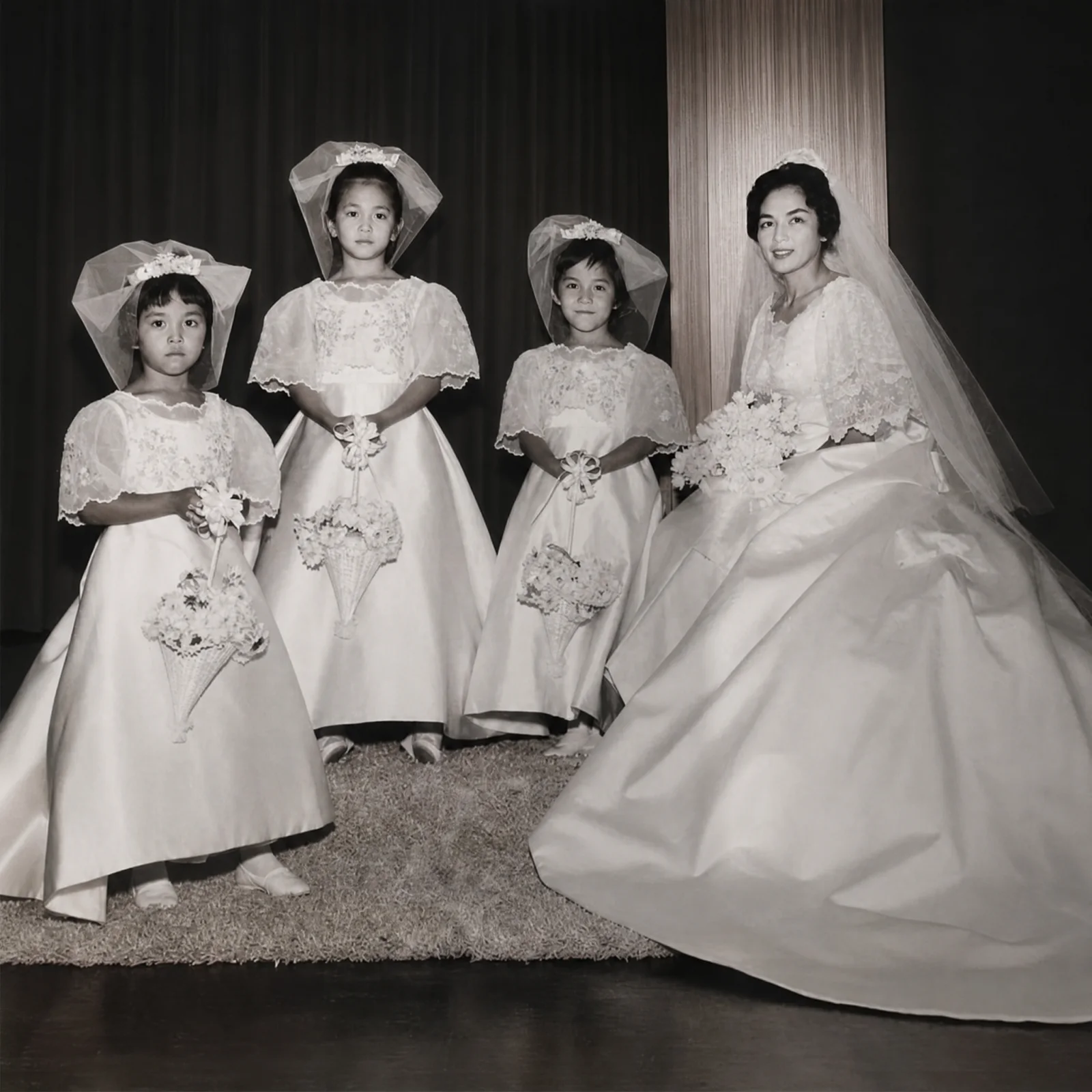
The three daughters reassembled. Jenny came back from Pennsylvania after the war ended and married Salvador Fernandez Neri on 7 February 1948 at the Chapel of the Archbishop’s Palace in Mandaluyong, with Archbishop O’Doherty himself officiating.63 Three years later, on 31 March 1951, Corito married Edgardo Tejico Kalaw “Hadji” at the Parish of Our Lady of Sorrows in Pasay City.64 Hadji was the son of Maximo Manguiat Kalaw, the Batangueño statesman and writer, whose own narrative is told elsewhere in this work. With this marriage, two prewar Filipino lives joined at the level of their children: the Negros sugar planter who had died in Fort Santiago, and the Batangas dean of Filipino political science who had survived the occupation in the Mindoro underground. Corito and Hadji had five children: Paula; twin daughters, Maria Ramona and Maria Victoria, of whom Ramona lived only seven days and Maria Victoria grew up as Vicky; a son, Edgardo Jr., called Eddie, who passed away in 2021; and a last daughter, Maria Socorro, called Corina. Vida, the youngest of Ramon and Coring, married Ben Hur Teodoro Balboa eight years later, on 15 November 1959.65
Coring signed as mother on each of the three marriage contracts. Her address identified 3060 Taft Avenue Extension, the same house the Imperial Japanese Navy had taken from the family in November 1944, returned to her after the war, and which she eventually rebuilt. She had been at Ramon’s table for twenty-four years; widowed at 51, she would carry his name for much longer than that.
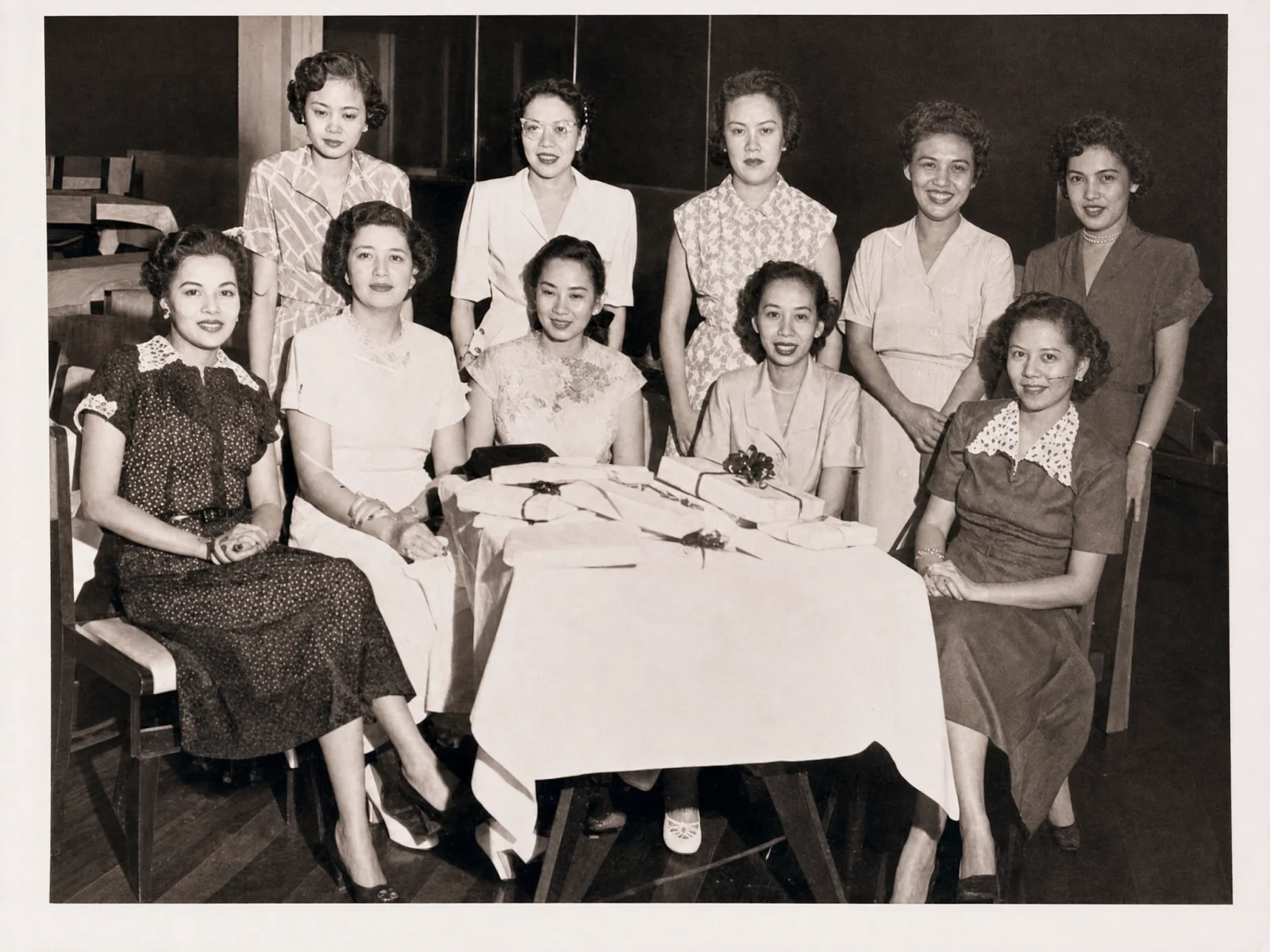
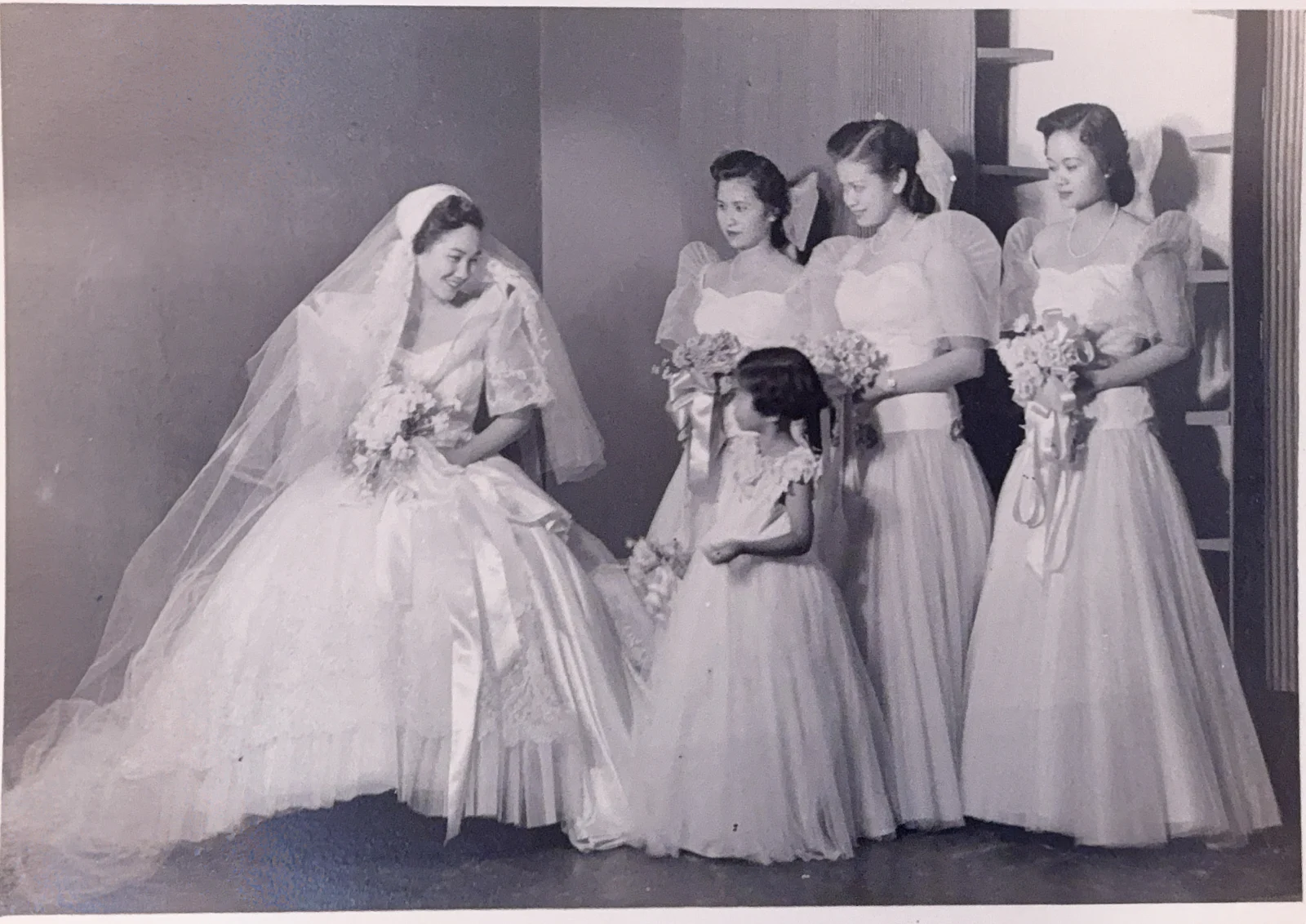
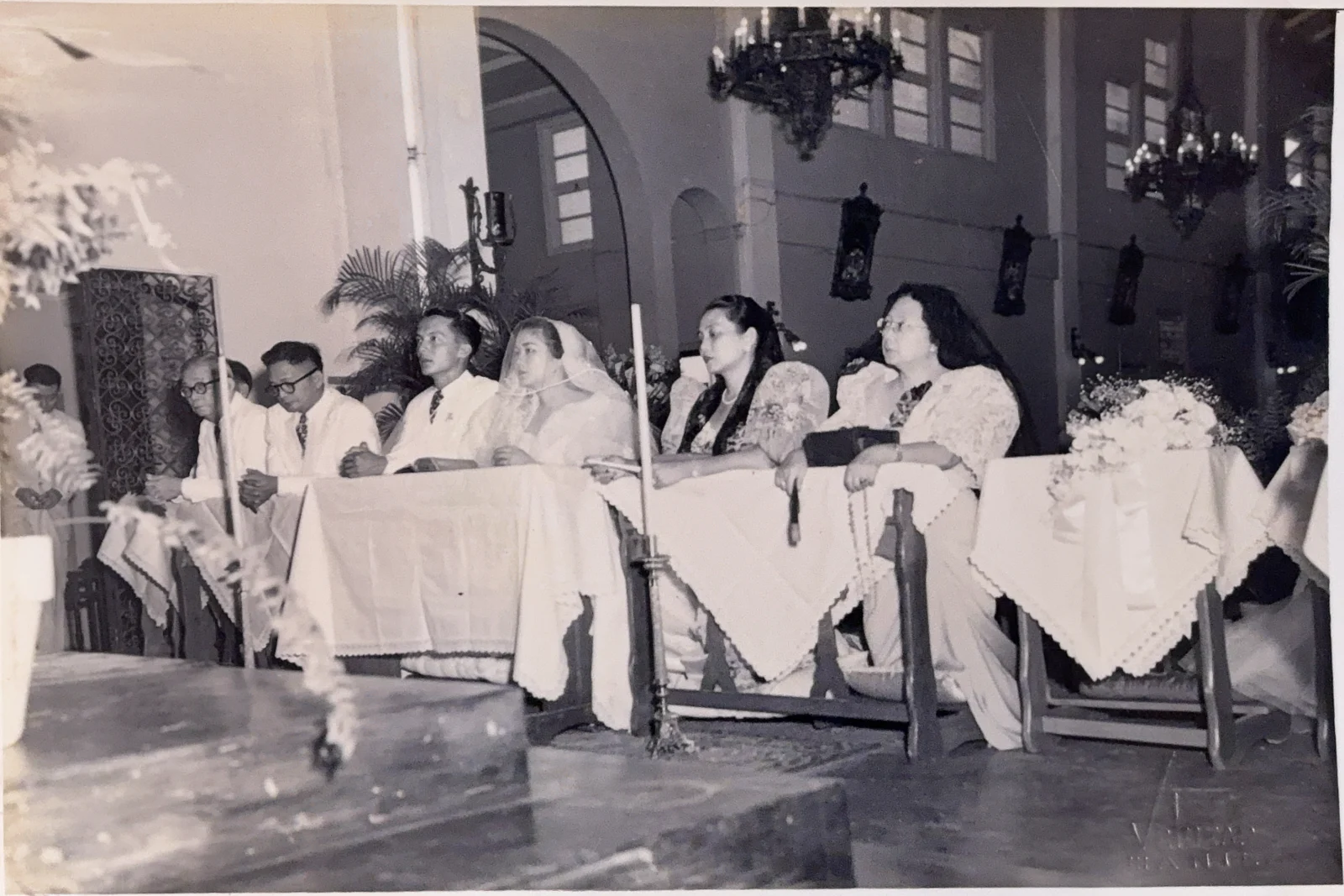
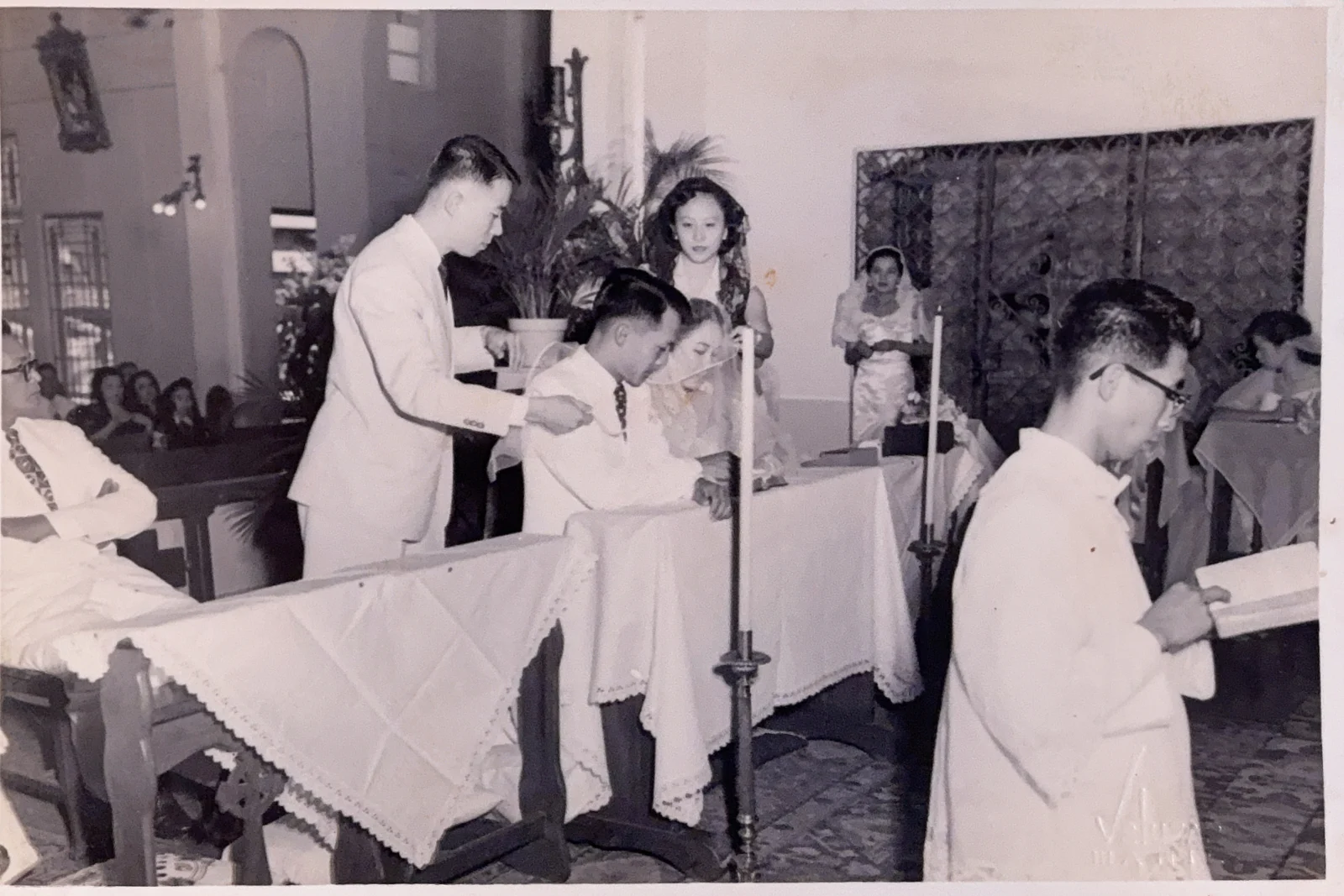
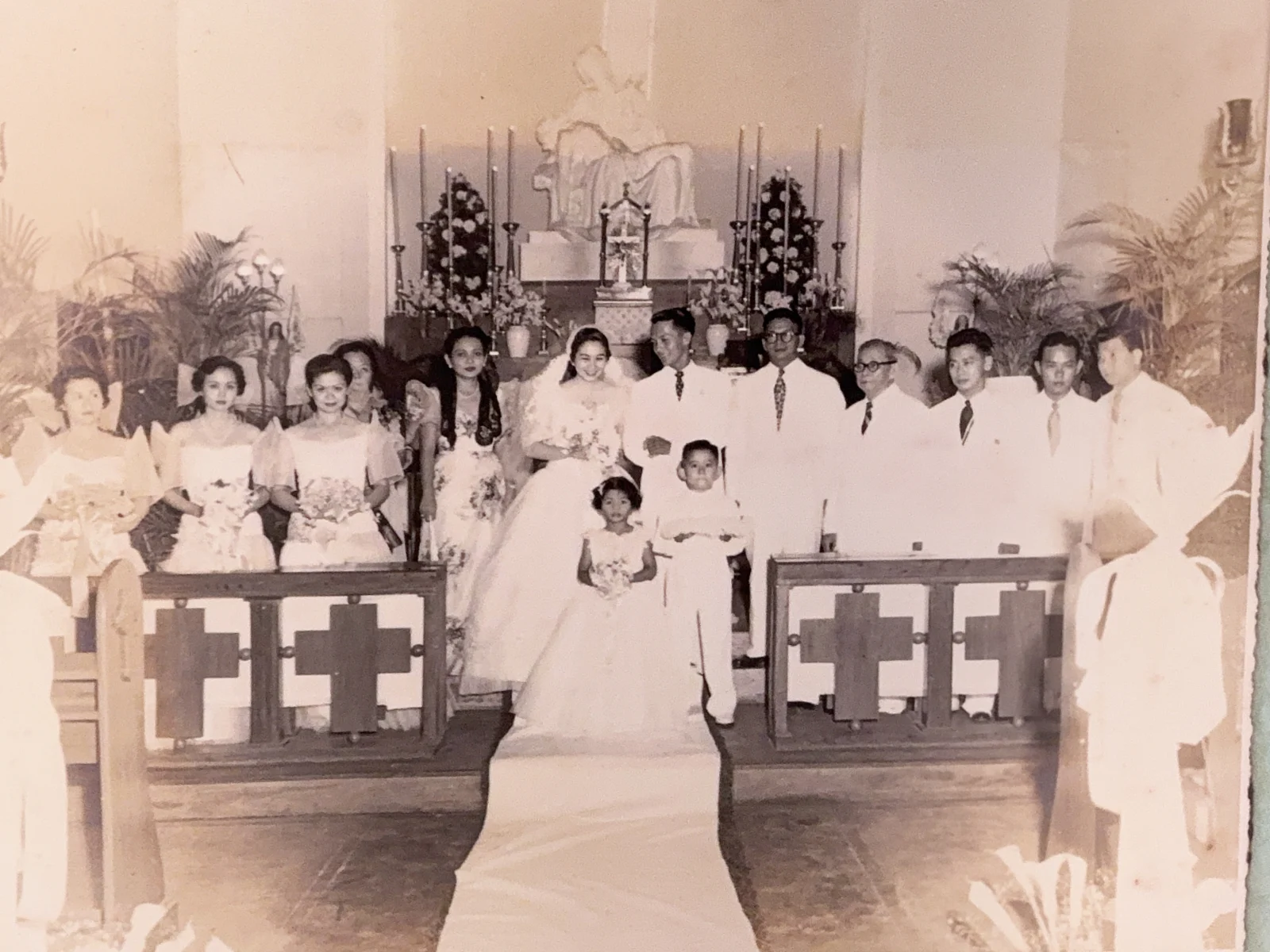
The name that endures
The Araneta name carried on without him. J. Amado, the brother who had handled the family’s media business in name while Ramon ran it in fact, lived through the war and went on to build the postwar Araneta empire in Metropolitan Manila, Araneta City in Cubao with its Coliseum, the commercial center that gave Quezon City its anchoring district. The cousins remained at the head of banks, sugar centrals, mining companies; the surname stayed at the center of Philippine business life through the second half of the twentieth century. The family Ramon had been the eldest of, in the Bago of the 1890s, had become by 1970 one of the more visible Filipino dynasties of the postwar republic.
Within his sister Cecilia’s house, Ramon’s memory took a different form. One of her sons was named Ramon Araneta Yulo, born while her brother was still living, the eldest Yulo nephew given his uncle’s name.35 The naming had been the older form of honor; it became a memorial after November 1944. The name has continued in the family ever since.
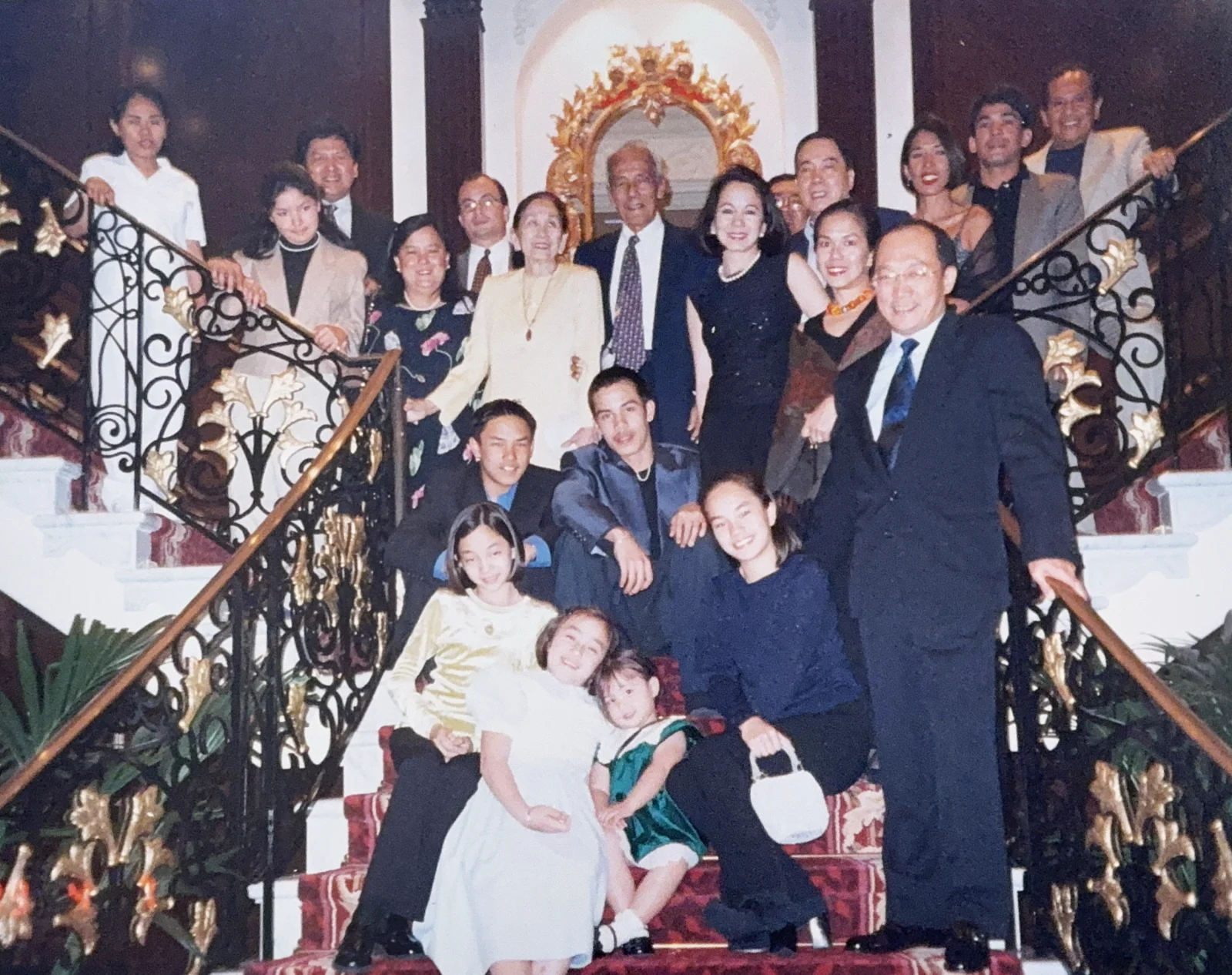
Decades on, the family put the record down in writing. In 1984, it gathered letters from people who had known what the war years had held. Carlos Romulo, who had been MacArthur’s aide on Bataan and Corregidor and was by then the Republic’s retiring foreign minister, certified that he had known Ramon and Coring personally, that Ramon had been one of the financiers and supporters of the guerrilla movement, executed by the Japanese for his work in favor of the United States, and that the United States had conferred the Medal of Freedom on them both.69 The publisher of Current History wrote from Philadelphia to vouch for the eldest daughter, recalling Jenny Araneta as a valued member of his father’s staff in 1943 and enclosing the essay she had published in the journal that June.70 The letters added nothing to the deeds themselves. They were the family’s way of fixing the deeds in the record, so that what the war had taken would at least be written down.
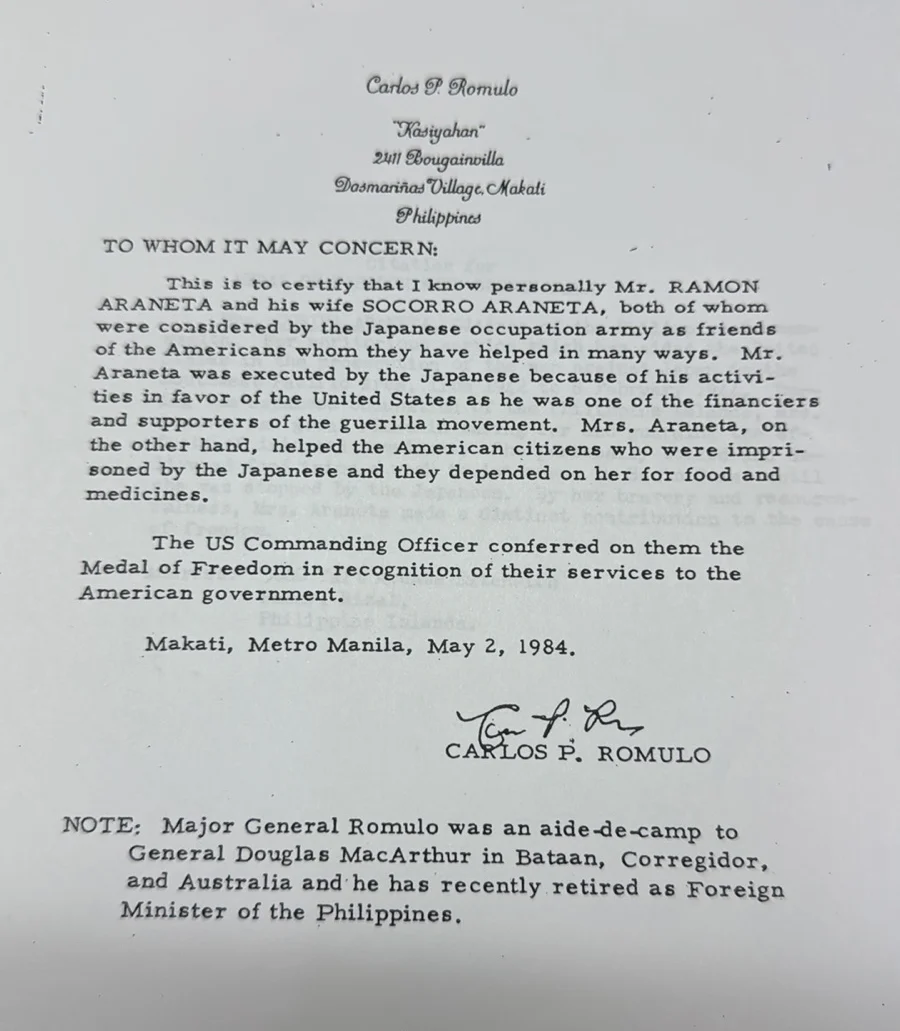
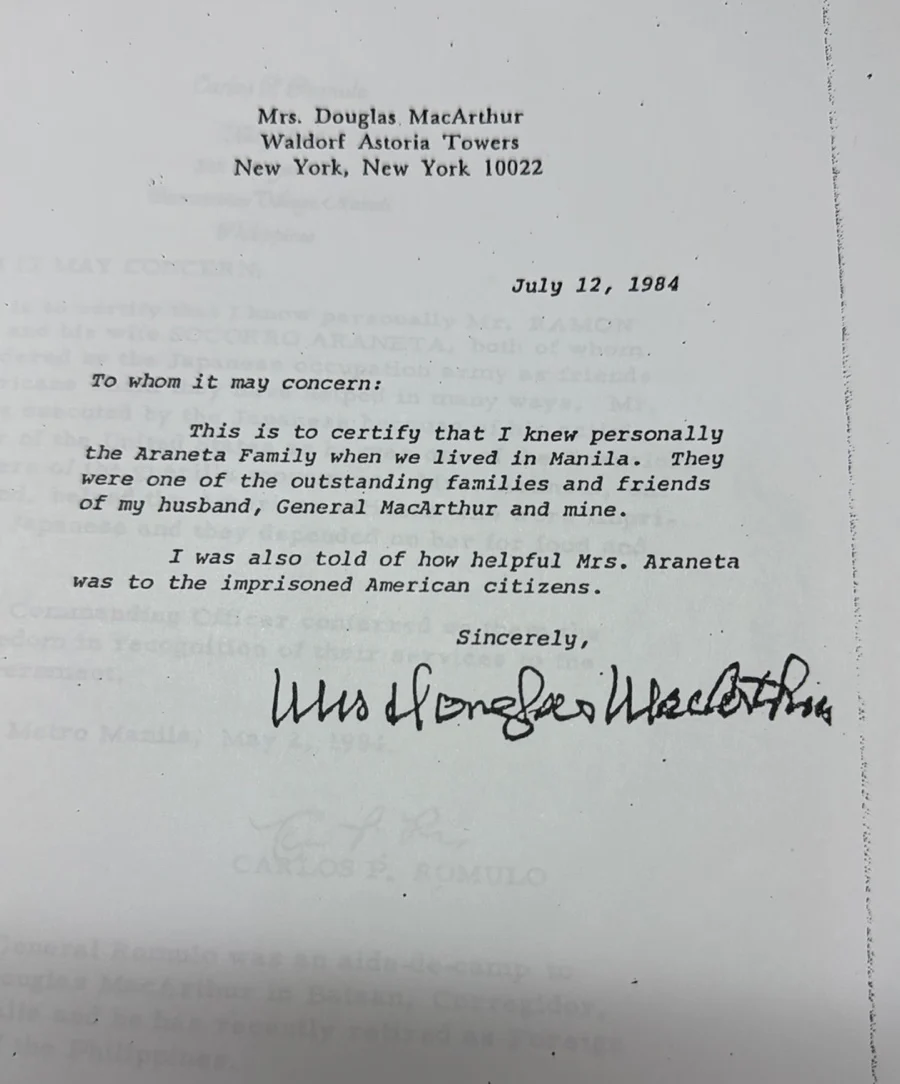
Something of Ramon lived on in the daughter who had answered the telephone. In her old age Corito confided to her granddaughter, Ramon’s great-granddaughter Patricia Feria Lim, that of her two parents she felt herself her father’s child, with his gentle, unhurried manner. She had loved him, and she carried long into her own life a quiet tension between her two parents: the charming, sociable father, who wore his charm a little loosely, and the private mother, who cared nothing for society and near whom Corito felt a daughter’s duty to stay. Even after she married and had children of her own, she went on looking after Coring.
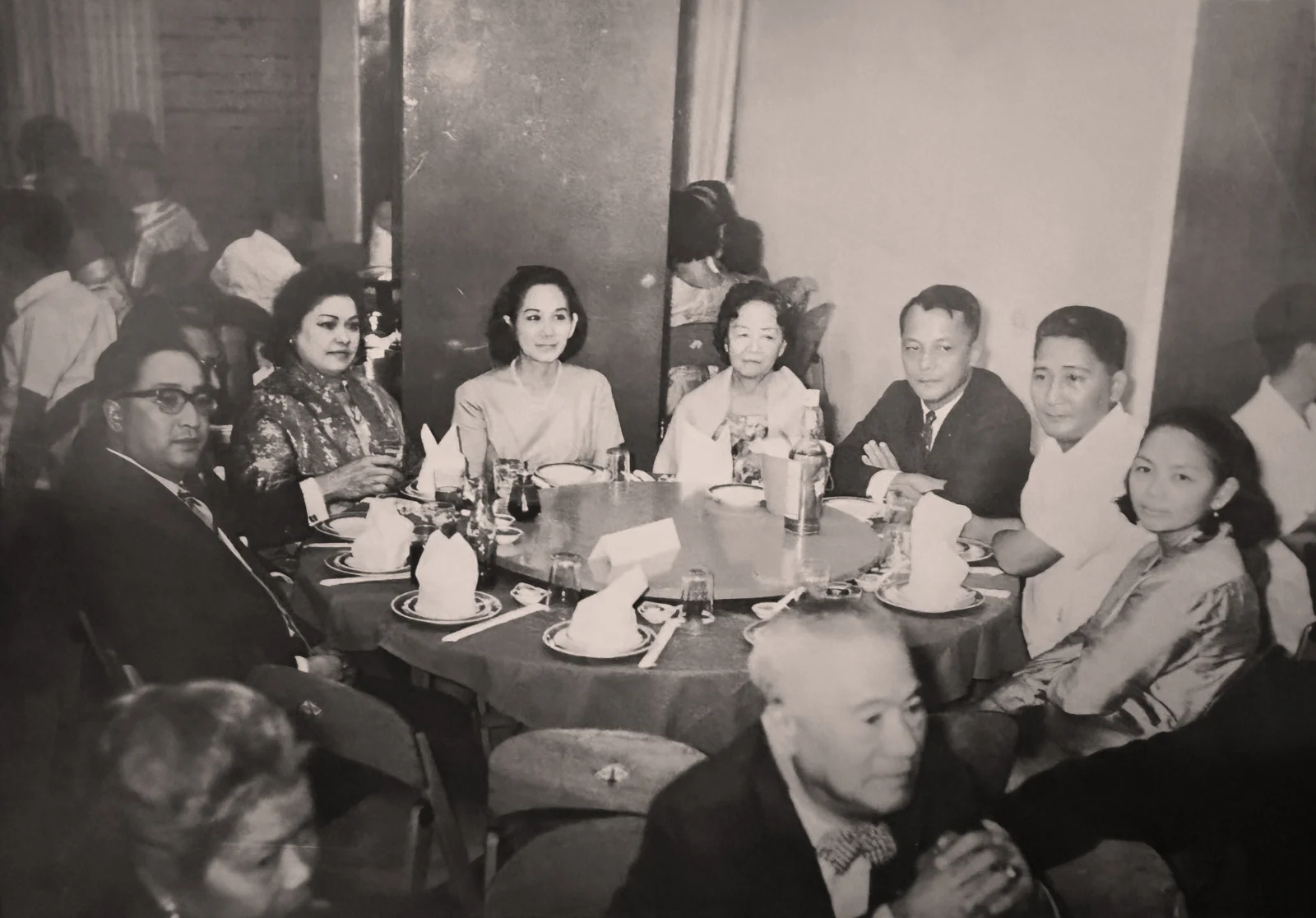
Of Ramon’s three daughters, it was Corito who made the most visible life in the postwar city. A painter, she had trained at the Assumption Convent and in fine arts at the University of the Philippines, and had also studied abroad—courses at the Art Students League in New York and a spell at Grailville in Ohio.
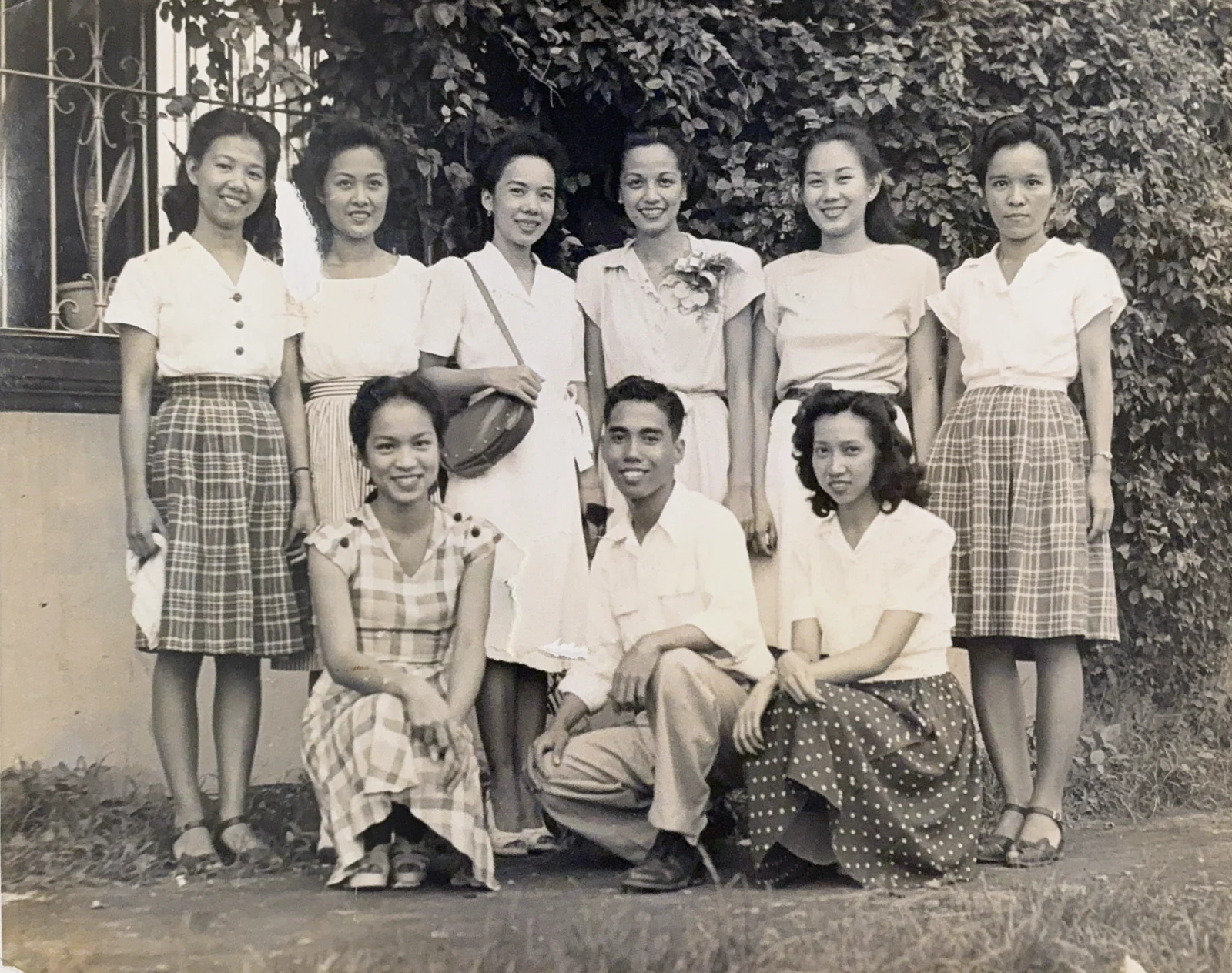
By the early 1970s she had become a figure in the Manila art world: a collector who owned works by modernists like Hernando Ocampo, and a patron to working artists.
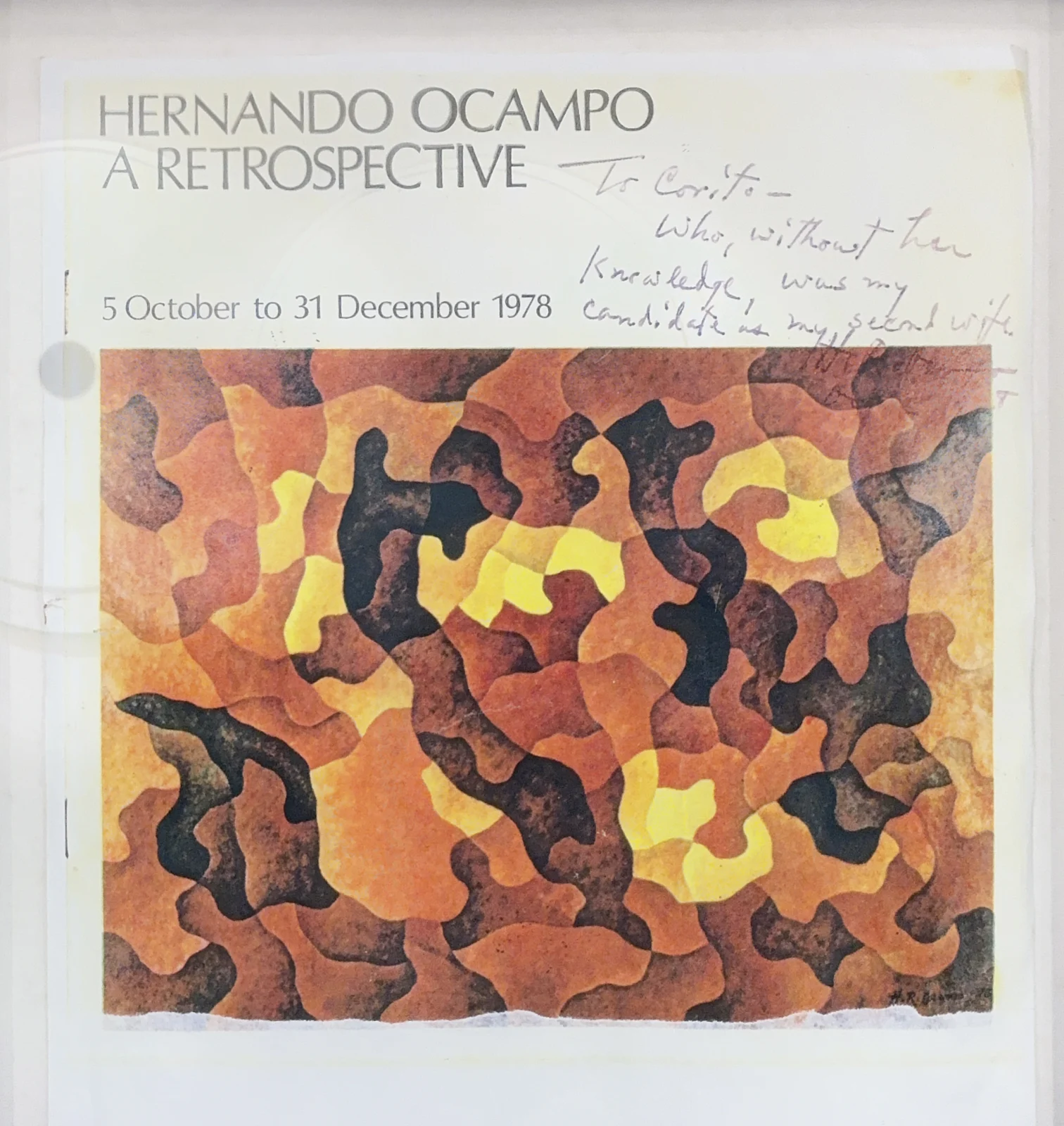
In 1972, she founded Sining Kamalig, an art gallery in Pasay, which she set up and ran, with her sister Vida as part-owner.
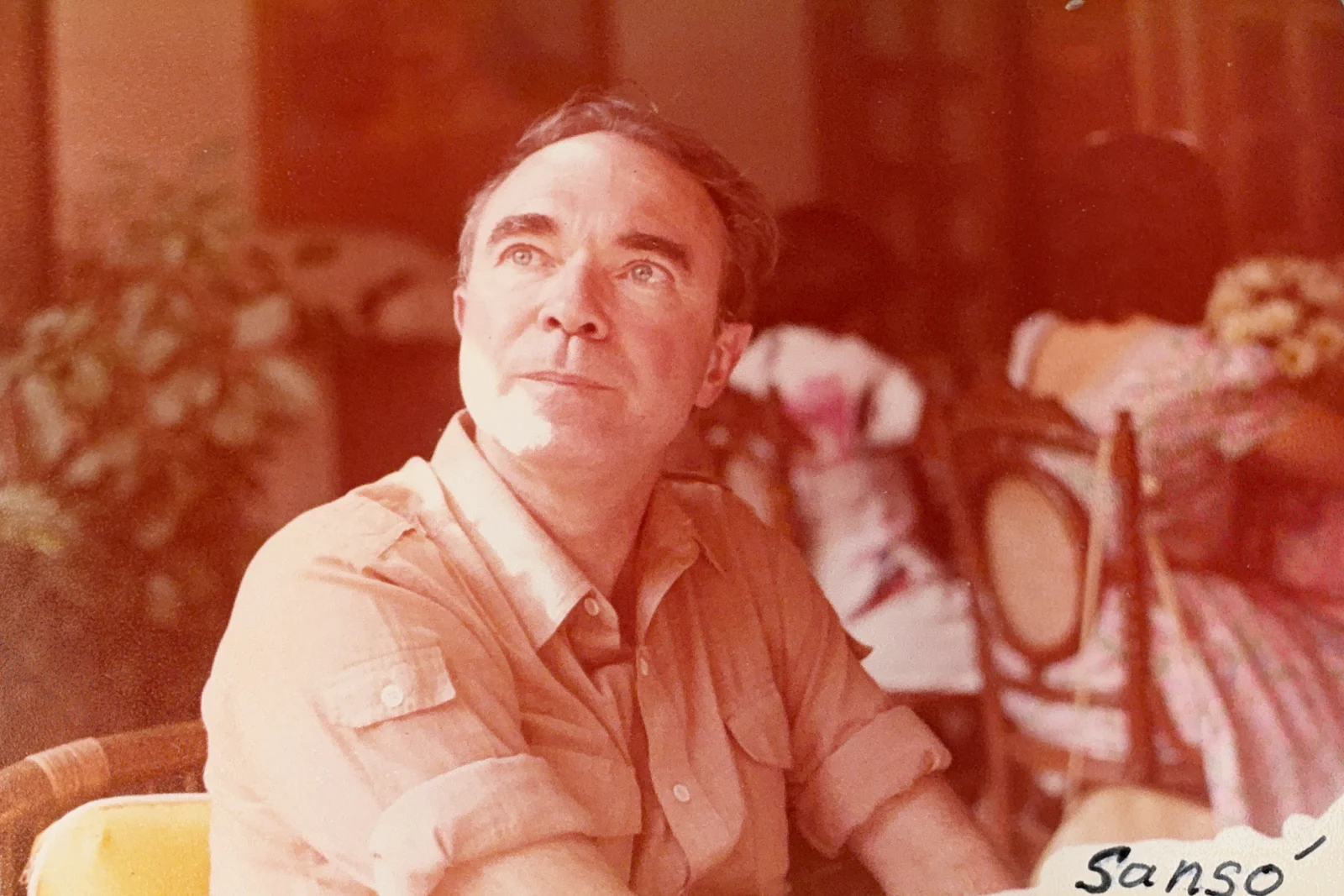
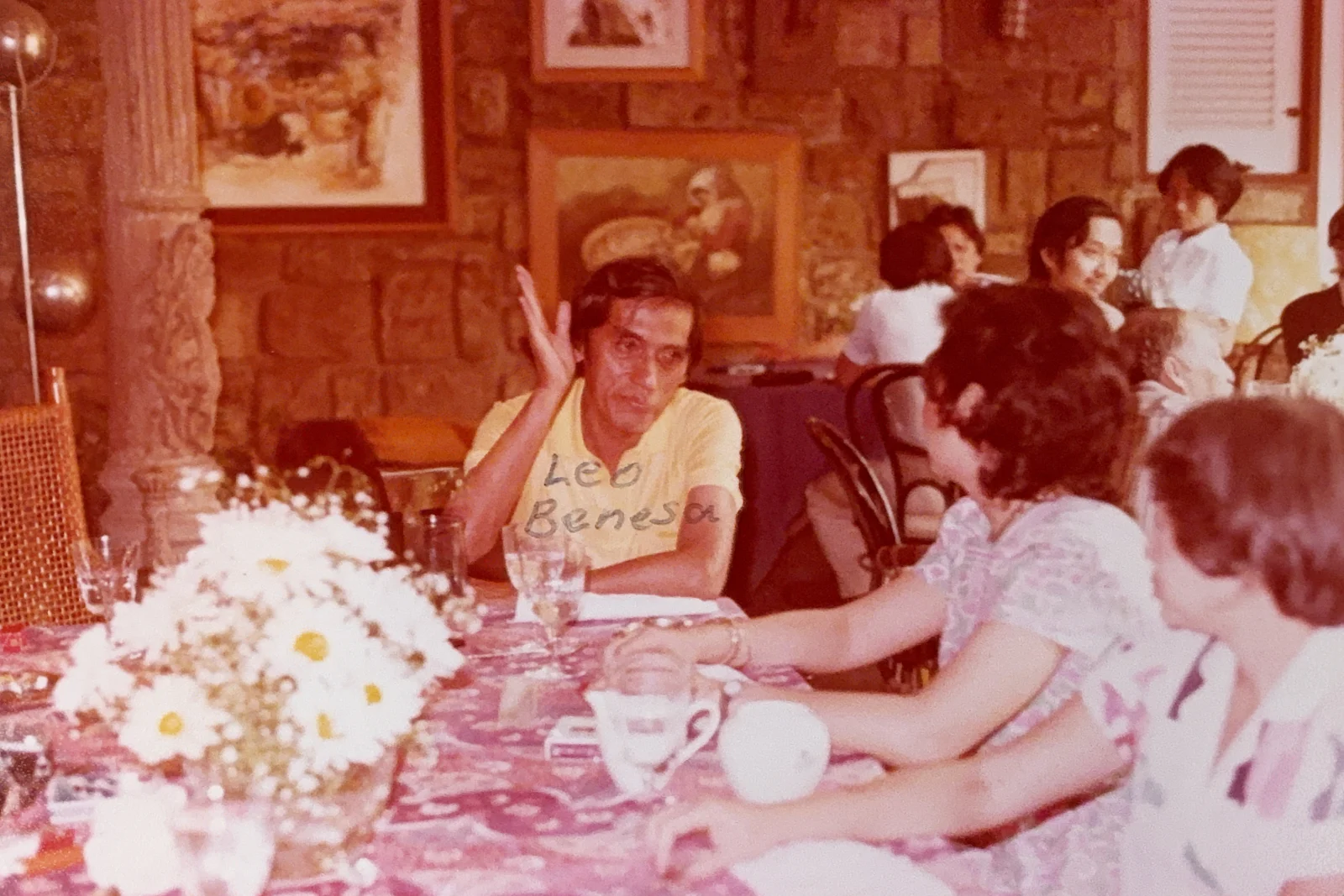
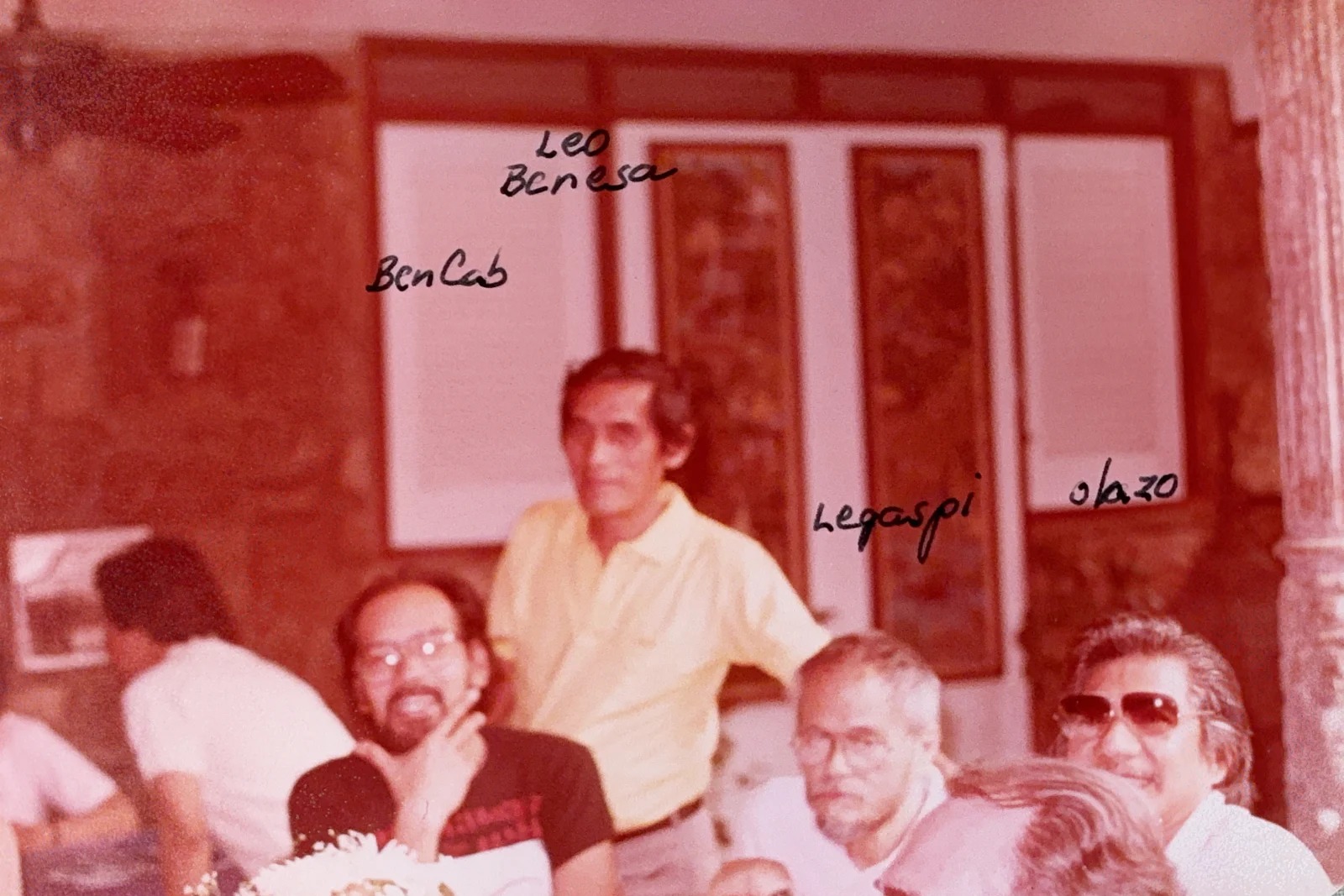
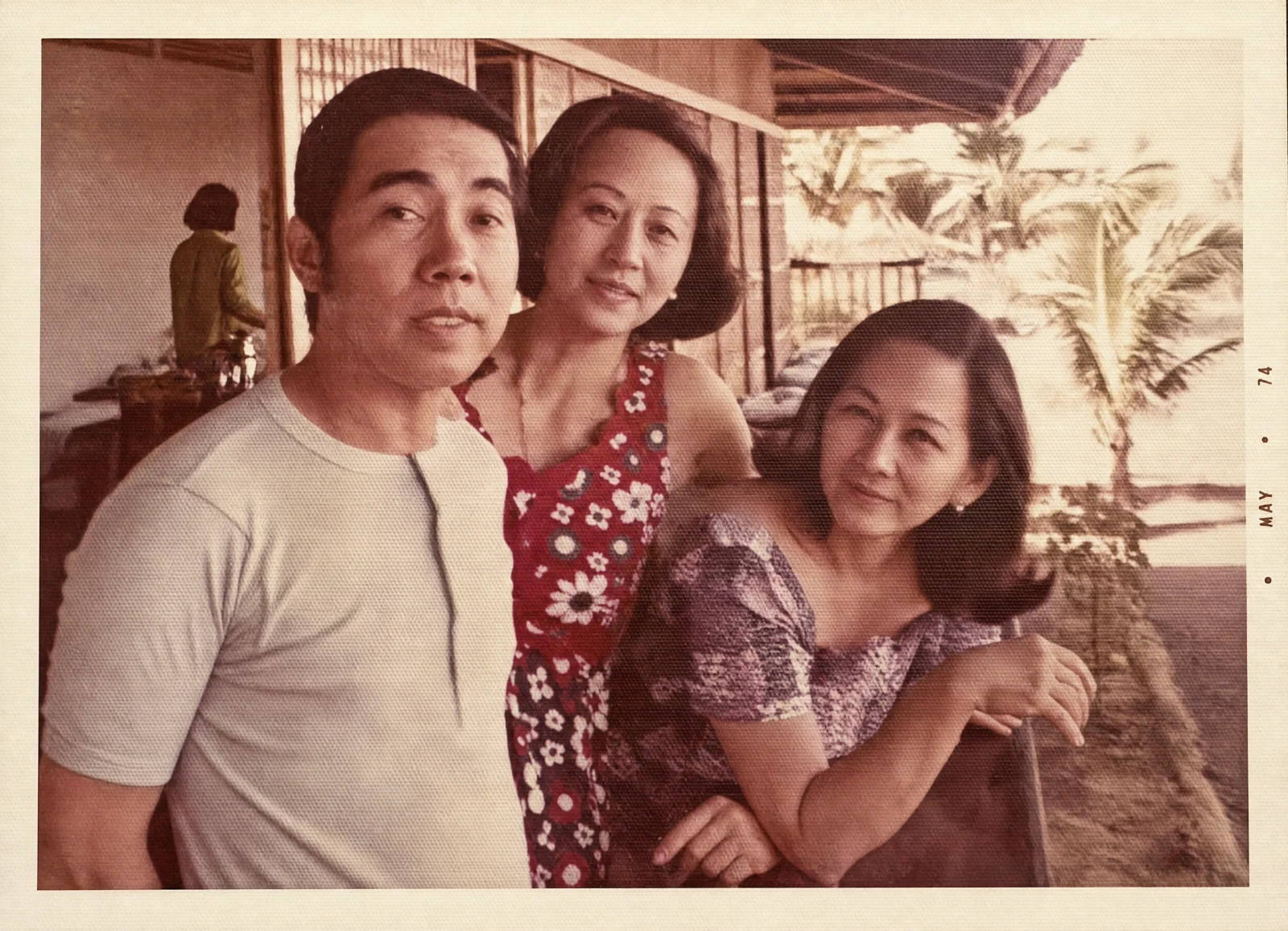
She was the gallery’s heart, close to the established artists whose work she showed and devoted to the new and untried, to whom she made a point of giving a first showing and a head start, the Shop 6 circle around Roberto Chabet among them.
The painters who knew her loved her. She kept the gallery going through the 1970s and into the 1980s before it closed. Her world ran beyond the paintings: her closest friend was the couturier Pitoy Moreno, who for years took Sunday lunches and Christmas Eve at the Kalaw house. Corito died on 8 January 2004.74
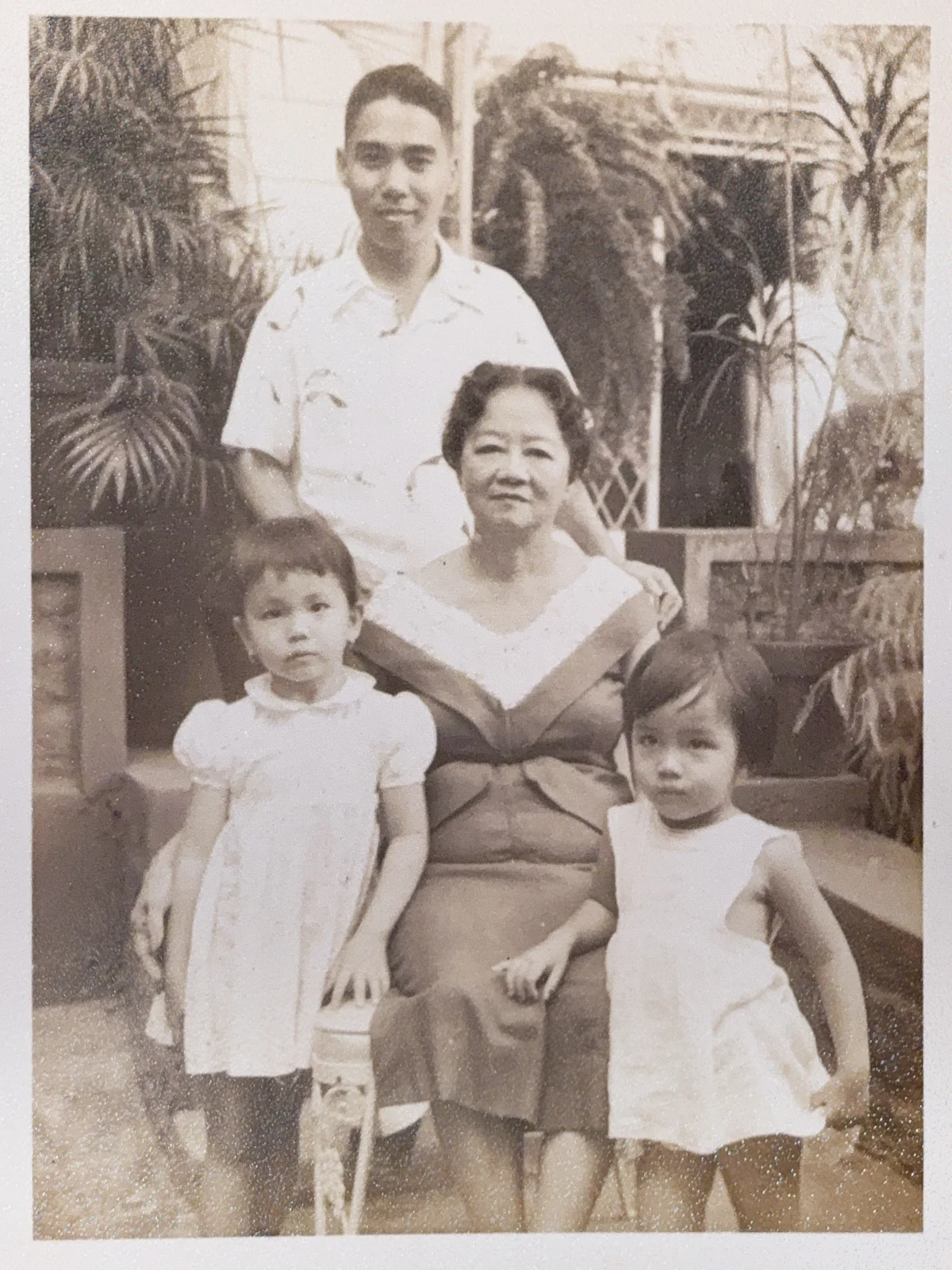
It began with sugar, and it can end there. The cane that remade Negros in his grandparents’ time made the family he was born into, set the rhythm of the Bago years, and paid for the Manila house and the desk on the Escolta. The war took the man and broke the city, but it did not take the land. The canefields still run to the sea below Bago, cut each harvest as they were when he was a boy among them. What the cane built was never only sugar. It was the family that outlasted him, the daughters and the generations after them, rooted in the same ground that made him.